

Table of Contents
Introduction
Proctored exams have now become the standard for protecting the integrity of online exams. They give organisations the capability to deliver remote exams with higher levels of trust, control, and verifiability than traditional pen-and-paper tests.
As education, certification, and hiring shift online, the challenge is not access or scale anymore- it is credibility and safety. Online Proctored exams have rapidly grown across industries. Institutions, employers, certification bodies, governments, and EdTech companies – especially the ones in the assessment or exams space must prove that remote online exams results truly reflect the candidate’s capability.
Proctored exams provide that integrity layer by combining technology, process, and governance with online exams, making them secure and safe to access remotely.
What Are Proctored Exams?
Proctored exams are online exams with supervision in which candidate identity, environment, and behaviour are monitored to prevent cheating and ensure fairness. They replicate and often improve the control over exams using secure browsers, video and audio monitoring, AI-based behaviour analysis, and human proctors if necessary.
Proctored exams are present to confirm that the right person is taking the exam, make sure that exam rules are followed, detect and document unfair practices, and generate evidence that complies with and supports audits, reviews, and disputes, and perform all of the above activities, while being safe and secure.
Why Proctored Exams Emerged
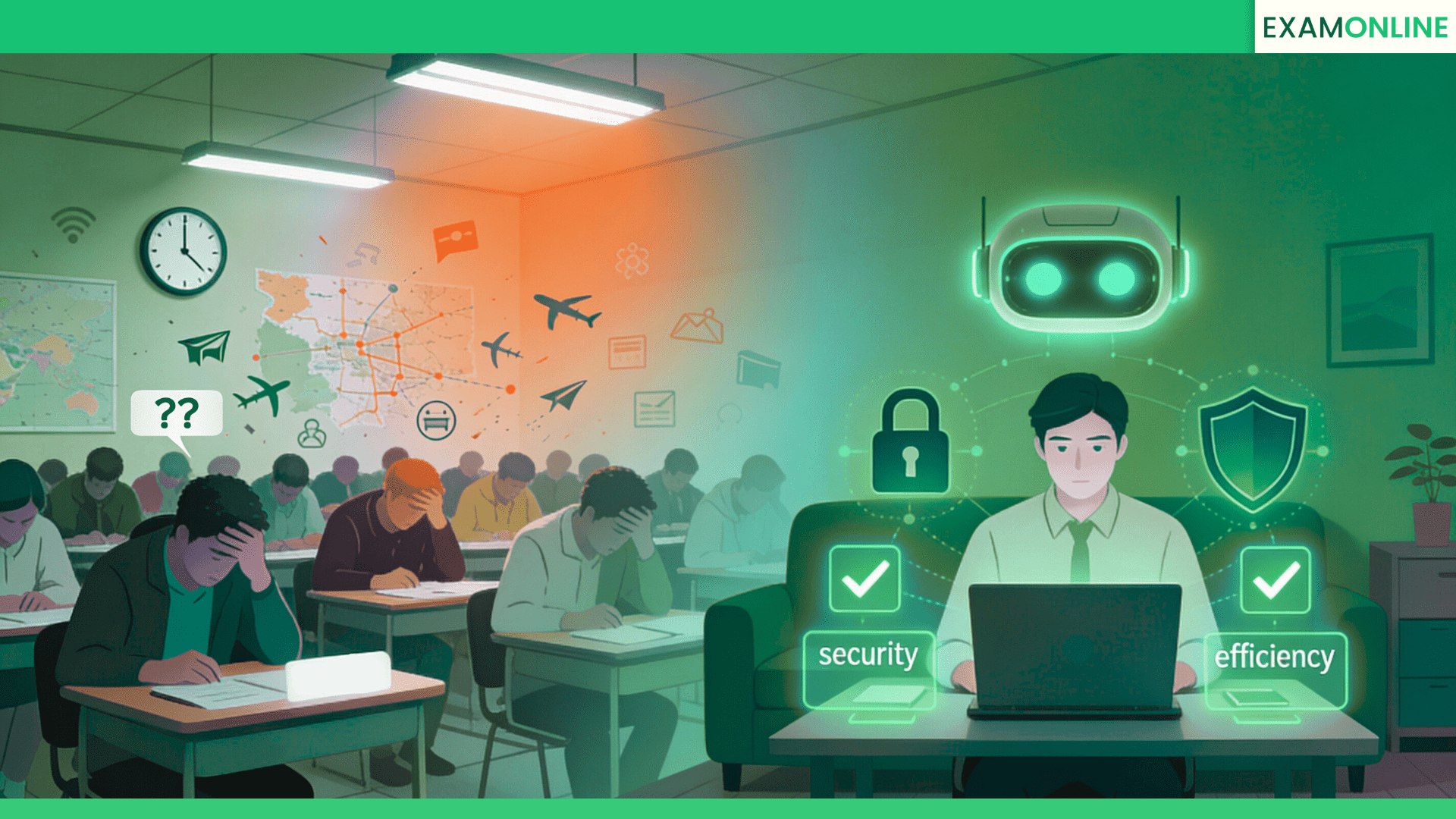
The transition from pen-and-paper exams to online exams was motivated by the need for flexibility, reach, and operational efficiency of exams. Physical test centres put hard limits on capacity, need extensive logistics and planning for months, and often force candidates to travel long distances with the risk of uncertainties at every step.
Before Proctored exams, non-proctored online exams countered these issues and problems but introduced serious integrity risks. Without any supervision or invigilation, organisations experienced identity fraud, collusion, the use of external aids, and question paper leakage from the candidates’ side.
In high-stakes situations such as degree programs, professional licence exams, hiring exams, and government exams, these risks quickly became dangerous, high-impact risks and unacceptable.Proctored exams came as a response to fill this gap. By combining examination engines with AI monitoring, secure browser environments, and remote proctoring, they reintroduced supervision and auditability into the online exam experience, crossing the integrity level of pen-and-paper exams, while resolving all the issues faced.
How Proctored Exams Work at the Candidate Level
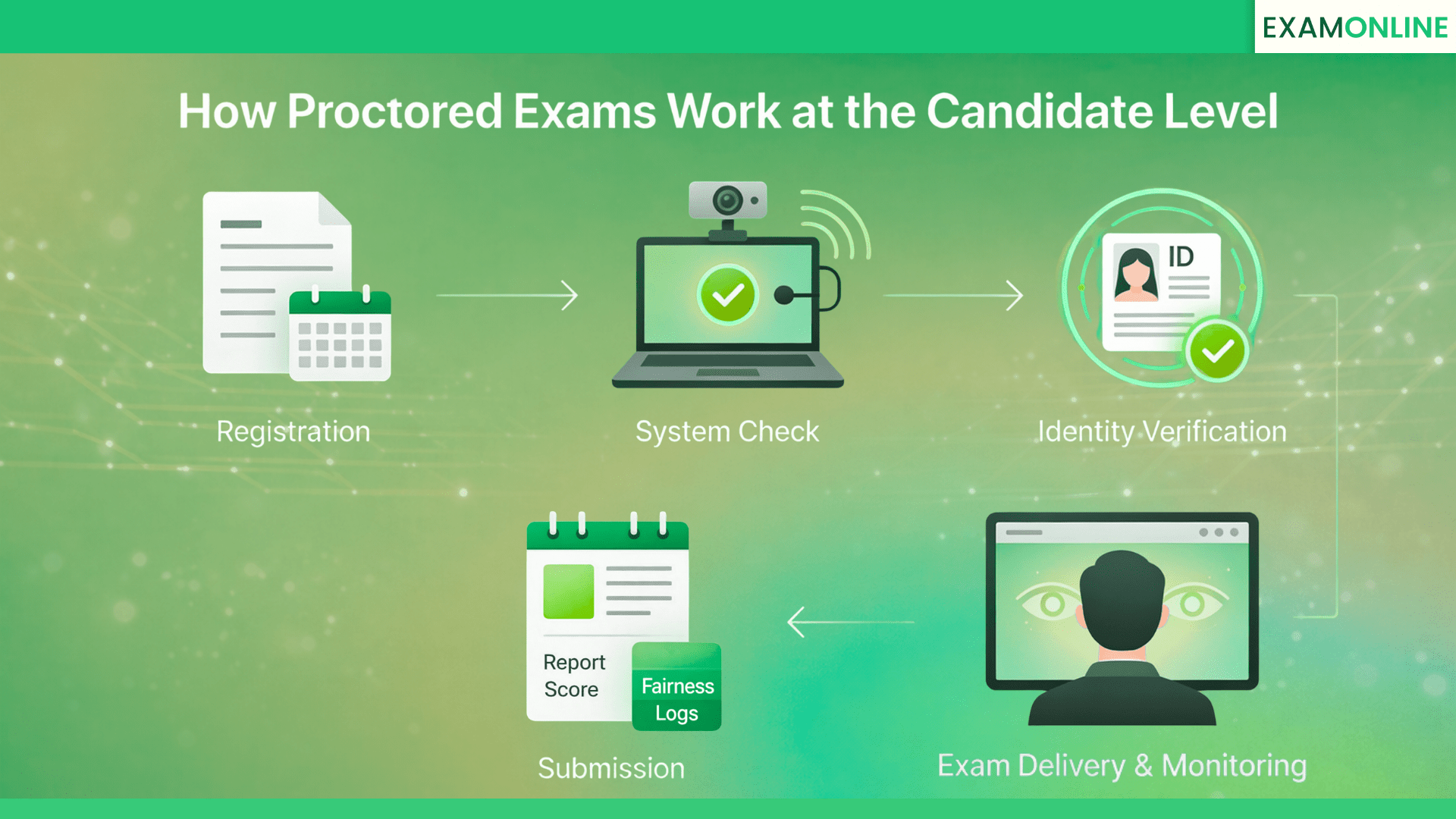
For candidates, a proctored exam should feel like a familiar, normal online test, with security and integrity checks happening only in the background, without hindering their seamless exam experience. The process should follow a clear, end-to-end flow from registration to result review with seamless communication and clarity.
Registration and Scheduling
The candidate journey begins with registration for their specific exams. Necessary Personal details, identity information, exam-specific data, and consent to policies are captured. Depending on the organisation’s requirement, candidates may be bulk-registered by administrators or allowed to self-enrol through secure forms, which should be worked on case-to-case basis.
Exam settings and configuration set the conditions under which the exam will and can be taken. This includes the exam date, time window, slot availability, late-login rules, and any special provisions such as extra time for accommodations and many exam-level details. These details are communicated clearly so candidates know exactly what to expect and are well prepared.
System Check and Environment Readiness
Before exam day, candidates receive a system compatibility check and complete a system check to ensure their device and network can support a proctored session. This process validates internet stability, browser and operating system compatibility, camera and microphone permissions, and any additional requirements such as secondary camera support or secure browser installation.
Allowing candidates to run these checks in advance reduces last-minute issues and anxiety. Many platforms also offer practice exams so candidates can familiarise themselves with the environment before the actual exam, removing a lot of unnecessary deviations and uncertainties.
Login, Identity Verification, and Authorization
At the scheduled time, candidates log in using secure credentials that were created and enter the exam platform. Identity verification is performed by capturing a live image and matching it against registration data, often alongside scanning a government-issued ID. Advanced systems use liveness detection and OCR-based matching to prevent spoofing or impersonation.
Authorisation may be fully automated or supported by a human proctor based on the organisation’s requirements and service provider capabilities. In higher-stakes scenarios, a live proctor can verify identity via two-way video and perform a brief environment scan before authorizing for the exam. Only after successful authorization can the candidate proceed to the exam screen.
Exam Delivery and Monitoring
Once the exam starts, candidates can attempt the questions, mark them for review, and perform various actions delivered by the examination engine. The interface should support multiple question types, section-wise timing, and configurable navigation rules, all designed to minimise distraction and load.
While the exam happens, the proctoring system tracks and analyzes the behaviour and environment through video and audio feeds, screen recording, and behavioural signals such as face presence, gaze direction, movement patterns, object detection, and sound analysis of the surroundings.
Proctoring is designed to be consistent and proportionate, preserving exam integrity without being unnecessarily intrusive. This is how proctoring happens in the case of AI or Automated Proctoring.
In contrast, in the case of Human proctoring, the Proctors can look into the details and logs at a candidate level, watch their camera feed, screen and understand their movements and activity, adding a layer of human judgement and context, improving the certainty and security of the exam.
Submission, Evidence Capture, and Fairness Indicators
When candidates submit the exam or time expires, responses are saved. Objective questions are evaluated automatically, while subjective answers or file upload questions are assigned to evaluators for manual scoring.
At the same time, the platform compiles an evidence set for each candidate. This typically includes recordings, time-stamped interaction logs, AI-generated alerts, and any other actions performed by the candidate. This data is stored at a candidate level and used for report generation and analysis, helping in evidence-backed decision-making in proctored exams.
Many systems also calculate a fairness or integrity score based on alert patterns during the session, which helps institutions prioritise reviews without relying purely on subjective judgment, saving both time and effort.
At the candidate level, proctored exams feel like standard online exams. At the same time, integrated identity checks and background monitoring protect the credibility of results, all while maintaining the seamless candidate experience and improved exam security and integrity over pen-and-paper exams, which are invigilated by humans.
How Proctored Exams Work at Admin Level

For Administrators, proctored exams are mainly about security, governance, control, and sound decision-making backed with evidence. Admin teams design the exam, define security controls, manage roles, and rely on reports and evidence to support the exam decision and outcomes.
Exam Configuration and Role Setup
Administrators begin by creating the exam within the admin portal. Whole control of the exam and all the related activity happens here. They configure question banks, difficulty levels, scoring logic and parameters, exam structure, section timings, randomisation rules, navigation behaviour, language options, instructions and every minute detail related to the exam.
They then apply proctoring settings, selecting the monitoring mode – Only AI proctoring, or AI+Human Proctoring, defining identity verification requirements, configuring screen and video recording, and enforcing secure browser rules if required.
Role-based access control allows administrators to assign permissions to exam owners, proctors, evaluators, reviewers, and other roles, ensuring that sensitive data is accessible only to authorised users, making the responsibilities well defined, activities seamless and also enables tracking at minute level.
Live Monitoring and Control
During the exam window, administrators and proctors use dashboards that provide real-time visibility into candidate sessions. Admins can look at the proctor status, student reports which contain details like attendance, exam status, question bank details etc.
Proctors can see live video thumbnails, system-generated alerts, technical issues, and overall session status.
Proctors may communicate with candidates, request environment clarification, pause or terminate exams when serious violations occur, and add contextual notes linked to specific timestamps. Super proctors or administrators oversee escalations and manage workloads across large exam cohorts.
Post-Exam Reporting and Evidence Management
After the exam concludes, focus shifts to reporting and analysis. Administrators can access candidate- and cohort-level score reports, proctoring summaries with alerts and fairness indicators, attendance metrics, detailed audit logs, and question bank analysis for quality improvement. Because all evidence is structured and time-stamped, institutions can confidently handle appeals, integrity reviews, and regulatory audits.
For admins, proctored exams provide a controlled, auditable environment where every critical step from setup to scoring is traceable.
Proctoring Excellence: AI + Live Models

Proctoring is best understood as a configurable spectrum, not a single fixed method. Modern proctoring systems are designed to adapt monitoring depth and human involvement based on exam context, scale, and risk, rather than forcing a one-size-fits-all approach.
AI (Automated) Proctoring
In AI-only proctoring, advanced algorithms continuously analyse candidate behaviour and environment throughout the exam. The system monitors video, audio, screen activity, and behavioural signals to identify patterns that may indicate policy violations or anomalous behaviour.
Alerts and logs generated by the AI form a structured evidence layer that can be reviewed post-exam where required. This model enables organisations to conduct large-scale exams with consistent monitoring standards, strong auditability, and minimal operational overhead. AI-only proctoring is commonly used where scale, standardisation, and efficiency are priorities, while still maintaining a high level of exam integrity through evidence-backed review.
AI + Human (Live) Proctoring
AI + human proctoring builds on the same automated monitoring foundation, with human proctors added to provide real-time supervision and contextual judgement. AI continues to analyse behaviour and surface alerts, while live proctors observe sessions, interact with candidates if necessary, and make informed decisions when nuanced interpretation is required.
This approach is particularly valuable in scenarios where exams carry heightened sensitivity, external scrutiny, or regulatory expectations for real-time oversight. Human involvement does not replace AI monitoring; instead, it complements it by adding situational awareness and immediate intervention capabilities.
These proctoring modes should be seen as different configurations of the same integrity framework. AI provides continuous, objective monitoring at scale, while human oversight can be layered in when exam context demands additional assurance or interaction.
AI-driven proctoring forms the core integrity layer across all exam types, with human oversight added selectively to meet specific contextual, regulatory, or risk-related requirements. This flexible configuration allows organisations to maintain consistent security standards while adapting supervision depth to the needs of each exam.
Proctored Exams vs Pen-and-Paper Exams

Pen-and-paper exams have long been the standard practice for exam integrity, relying on physical venues, printed materials, manual invigilation, and controlled environments. Even today, after extensive digital reach and adaptation, it is still the most widely and frequently used mode of examination.
However, there are severe operational constraints that limit their effectiveness in today’s global, digital-first world. Proctored online exams address these limitations while delivering superior security through digital delivery, remote supervision, AI-powered monitoring, and comprehensive time-stamped evidence that exceeds what traditional invigilator reports can provide.
The transformation when using Proctored exams is profound: candidates no longer need to travel to fixed test centres, organisations eliminate venue booking and printing costs, and institutions gain deep analytics that reveal not just performance but behavioural patterns and exam quality.
Data-based insights provide a continuous opportunity to improve existing processes, which are already superior to the traditional pen-and-paper exams.
Proctored exams preserve the core objective of fair evaluation and security while adding improved reach, scalability, and operational efficiency.
Comparison: Proctored vs Pen-and-Paper Exams
| Dimension | Pen-and-Paper Exams | Proctored Online Exams |
| Location | Fixed physical test centres or on campus | Remotely from anywhere |
| Candidate Reach | Very limited ( Requires travelling in many cases) | Accessible globally across timezones |
| Capacity Scaling | Restricted by venue size | Cloud scaling – supporting thousands of concurrent users |
| Security Evidence | Hand-written invigilator reports | Video/audio recordings, screen logs, AI alerts, timestamps |
| Operational Cost | Very High (venues, printing, transport, staffing and other logistics) | Optimized and controlled with no infra or physical costs involved |
| Exam Analytics | Manual scoring, forced insights manually | Automated scoring, exam analysis, fairness scores, Visual representations |
| Setup Time | Weeks of logistics planning | Hours of configuration on platform |
| Post-Exam Review | Physical scripts, subjective evaluation | Digital playback with precise timestamps and flags |
Pen-and-paper exams make exams hard for candidates with travelling a day prior, while proctored exams enable remote exam taking – making it easy for rural candidates, working professionals, and international applicants to participate as per their flexibility
Proctored exams deliver improved exam integrity with modern scalability, global reach, and evidence, making every result defendable and proof-backed.
Proctored vs non-proctored Online Exams
Non-proctored online exams prioritise speed and accessibility, allowing candidates to complete exams from anywhere using simple login credentials. They work very well for low-stakes exams like practice quizzes, self-exams, or formative learning where the primary goal is skill development and self testing, rather than certification, or testing the knowledge of candidates at an institute or organisation level.
However, they lack the security features needed for better decision making, leaving organisations vulnerable to identity fraud, collaboration, external assistance, and unverifiable results, which make non-proctored exams limited for high-stakes use cases. Addition of Online Proctoring to Non-Proctored exams has completely transformed the way online exams are taken.
Proctored exams solve these integrity gaps by introducing multi-layered identity verification, real-time behavioural monitoring, secure browser lockdowns, comprehensive evidence generation, and other security and reporting features.
This structured oversight ensures that high-stakes outcomes, academic grades, professional certifications, hiring decisions, or regulatory compliance carry the same weight and credibility as in-person testing.
Comparison: Proctored vs non-proctored Online Exams
| Critical Factor | Non-proctored Online Exams | Proctored Online Exams |
| Identity Verification | Credential based login | Photo verification/Live authorization |
| Behaviour Monitoring | No monitoring | AI video/audio analysis + human Proctoring |
| Environment Control | No control – open to all resources | Secure browser lockdown (case basis) no external apps allowed |
| Evidence Generation | Only activity logs | Full recordings, timestamps, fairness scores, with activity logs |
| Cheating Risk | Very High (impersonation, collusion, aids) | None (multi-layer detection + intervention) |
| Result Credibility | Questionable for high-stakes use | Highly Credible |
| Best Applications | Practice tests, low-stakes quizzes, self-paced learning | Certifications, hiring, grading, licensing |
| Audit Capability | No defense | Complete evidence trail for disputes/regulators |
If results affect careers, admissions, compliance, or public trust – Proctored Exams should be used. If the goal is learning measurement – non-proctored works well.
Non-proctored exams accelerate learning; proctored exams certify competence. Choose based on whether outcomes need to be legally, professionally, or academically defensible.
Industry Applications of Proctored Exams

Proctored exams support high-stakes decision-making across education, employment, certification, and the public sector.
Higher Education and Universities
Universities use proctored exams for semester evaluations, entrance tests, make-up exams, and fully online programs. Proctoring allows institutions to support remote learners while upholding academic integrity and accreditation standards.
Certification and Professional Licensing
Certification bodies and licensing authorities depend on secure exams to protect the value of their credentials. Remote proctoring enables global exam delivery while maintaining strong audit trails for regulators and stakeholders.
Corporate Hiring and Talent exam
In recruitment, proctored exams help organisations validate skills and knowledge remotely. They reduce impersonation risk, support fair comparisons across candidates, and strengthen confidence in hiring decisions.
Government and Public Sector Examinations
Government exams involve large candidate volumes and intense scrutiny. Proctored online exams enable decentralised testing while generating the evidence required to address grievances, RTI requests, or legal challenges.
EdTech Platforms, LMS, and Training Providers
EdTech and training providers integrate proctoring to enhance the credibility of their exams. Secure exams help them meet enterprise and institutional expectations while preserving a seamless learner experience.
Across industries, proctored exams make remote exams viable even for sensitive and high-stakes use cases.
Data Privacy and Governance in Proctored Exams
Proctored exams involve the collection of sensitive data, making privacy and governance foundational. Mature implementations clearly define what data is collected, why it is collected, who can access it, and how long it is retained.
Typical data includes video and audio streams, screen recordings, system metadata, and time-stamped interaction logs. This data is used strictly for exam integrity, audit, and dispute resolution.
Strong governance includes encryption, role-based access, detailed access logs, defined retention policies, and alignment with recognised standards such as ISO 27001 and ISO 9001. Transparent communication with candidates about data use is essential for trust.
Effective proctoring depends as much on robust data governance as on monitoring technology.
ExamOnline Advantage for Proctored Exams
ExamOnline delivers a unified platform that combines exam delivery, proctoring, reporting, and integrations into a single system. It supports flexible exam configuration, multiple proctoring modes, secure browser controls, advanced AI detection, fairness scoring, and detailed reporting.
With strong security practices, industry-recognised certifications, and deployments across multiple countries and sectors, ExamOnline enables universities, certification bodies, corporates, and public sector organisations to conduct secure, scalable proctored exams.
ExamOnline aligns directly with the operational, integrity, and governance needs of modern proctored exams.
Frequently Asked Questions (FAQ)
What is a proctored exam?
A proctored exam is an online exam with proctoring, where candidate identity and behaviour are invigilated using AI, technology and rules to maintain exam security, integrity, better than invigilated pen-and-paper exams.
How does remote proctoring work?
Candidates take exams in a controlled environment remotely, from their comfortable location, while being monitored by AI, mechanisms which detect Audio/Video, Screen tracking, Surrounding noise detection, and with evidence.
What are the main types of proctoring?
The main types of proctoring are AI-only Proctoring (automated), and AI+Human Proctoring, where there is an extra layer of Human Supervision and judgement.
When should exams be proctored?
Exams should be proctored whenever the exams are high-stakes, and results influence high-stakes outcomes such as grades, certifications, hiring decisions, promotions, and others.
What equipment do candidates need?
For Proctored exams candidates need an electronic device like laptop, desktop, mobile or tablet with working webcam, microphone and stable internet connection.
Are candidates recorded during proctored exams?
Yes, candidates are recorded during proctored exams. Proctored exams from reputed providers record video, audio, and screen activity to create evidence-backed reports and decisions that support integrity checks and dispute resolution.
Are proctored exams fair to all candidates?
Yes, Proctored exams apply the same rules, monitoring standards, and evaluation logic across candidates, helping ensure consistent and unbiased exam conditions removing the invigilator bias which is present in Pen-and-Paper exams.
Is remote proctoring compliant with data privacy requirements?
Remote Proctoring providers should be compliant with various data certification, proving that they handle highly sensitive candidate data securely.
Can proctoring be integrated into existing LMS or exam platforms?
Yes, modern proctoring solutions integrate via APIs or learning tools integrations, allowing secure proctoring without changing existing LMS or exam workflows.


