

Table of Contents
Introduction
E-learning has become a defining force in modern education, training and certification. What began as an alternative to classroom learning has now evolved into a dominant method of delivering structured knowledge across the world. From universities and schools to enterprises and professional training providers, digital learning environments have transformed how learners study, how instructors teach and how institutions measure progress.
This transformation, however, brings a critical challenge: ensuring that online assessments remain secure, credible and reflective of actual learner competency.
This is where AI proctoring plays a decisive role.
AI proctoring bridges the gap between flexible digital learning and trustworthy certification, enabling institutions to uphold the same standards of integrity expected in physical exam settings, and often surpassing them.
The Evolution of E-Learning and the Rise of Digital Assessments
E-learning today encompasses multiple formats, including structured LMS-driven programs, on-demand learning platforms, skill-based training modules, corporate learning systems and large-scale open courses. Despite the diversity of formats, they share a common advantage: learning can now happen anywhere, anytime and at any pace.
Several factors have led to the rise of e-learning:
- Greater internet accessibility
- Mobile-first learning experiences
- The need for continuous upskilling
- Flexibility in learning schedules
- Cost-effective delivery models
As the global community increasingly adopts digital learning, the volume of online assessments has grown proportionally. Exams, quizzes, assignments, certifications and competency checks are now all administered digitally.
Yet with this shift, institutions face a fundamental question:
How can we maintain credible assessments in an environment that is inherently remote and unmonitored?
The answer lies in intelligent, automated and scalable integrity solutions – particularly AI proctoring.
How Modern E-Learning Ecosystems Operate
E-learning platforms typically rely on a structured learning journey:
content delivery → learner engagement → assessment → certification.
Across different models:
LMS-driven education (Moodle, Canvas, Blackboard, TalentLMS, etc.)
Students access modules, participate in discussions, submit assignments and complete assessments within an integrated environment.
MOOCs (Coursera, Udemy, edX, FutureLearn)
Learners follow self-paced instruction, quizzes and capstone projects with global-scale certification outcomes.
Corporate L&D systems
Employees undergo skill assessments, mandatory training and competency evaluations tied to workplace performance.
Certification bodies
High-stake exams determine eligibility for professional credentials. These diverse environments share a common requirement: credible, secure and auditable assessments that protect brand value and learner progression. Without exam integrity, the entire digital learning model is compromised.
The Credibility Challenge in Online Examinations
Online learning provides unmatched flexibility, but assessments within these systems can be vulnerable if not adequately secured. Without proper monitoring, risks such as impersonation, external assistance, multi-device misuse, screen switching, tab browsing or collaborative cheating increase significantly.
When exam integrity is compromised, the consequences are far-reaching:
- The authenticity of scores becomes questionable
- Certificates lose credibility in academic or professional contexts
- Learner trust reduces
- Institutional reputation suffers
- Stakeholders doubt the value of digital learning
Credibility issues do not merely affect assessments, they influence the perceived value of the entire learning ecosystem.
A secure assessment environment, therefore, becomes central to maintaining trust, recognition and brand reputation.
Why Proctoring Matters in Online Assessments
Proctoring is the digital equivalent of invigilation. It ensures that assessments are conducted fairly and that results genuinely reflect learner competence.
As learners complete assessments from remote locations, proctoring helps ensure that the conditions remain consistent, controlled and unbiased.
In the digital context, proctoring serves three essential purposes:
a. Authenticity
Verifying that the candidate taking the exam is the same individual registered for the course.
b. Fairness
Ensuring that every learner completes the assessment under similar conditions without external support.
c. Integrity
Maintaining exam standards that protect the value of certifications and prevent reputational damage.
Without reliable proctoring, online assessments risk losing academic and professional relevance.
How AI Proctoring Works: A Deep Dive Into Technology and Capabilities

AI proctoring uses computer vision, behavioural analytics and intelligent monitoring techniques to detect suspicious activities during online exams.
Its capabilities extend far beyond simple webcam monitoring. AI proctoring typically includes:
Identity Verification
Face recognition and ID matching ensure that the rightful learner is attempting the test.
Webcam Monitoring
Continuous observation detects unusual behaviors such as face absence, additional persons, or irregular movements.
Audio Analysis
Background sound detection identifies conversations or external guidance.
Screen and Device Monitoring
AI watches for attempts to switch tabs, open new applications, use external devices or navigate away from the exam interface.
Multiple Display Detection
This is one of the most critical modern proctoring features.
AI identifies extended screens, multiple displays, screen mirroring or secondary monitors — all of which could be used to access unauthorized content.
Behavioral Analytics
Unusual eye movement, repeated looking away, suspicious head angles or inconsistent behavior patterns are flagged automatically.
Real-Time Alerts & Evidence Logging
Instead of relying solely on human invigilators, the AI system captures evidence such as snapshots, anomaly logs and event timelines.
Combined, these capabilities create a secure, controlled digital exam environment that can function at any scale.
Integrating AI Proctoring Into E-Learning Systems
For proctoring to be effective, it must integrate seamlessly into existing learning workflows. Modern AI proctoring platforms provide flexible integration approaches that allow institutions to embed security into their assessment process without restructuring their systems.
The three major integration methods used are API / LTI, and SSO.
API/LTI Integrations
API (Application programming interface), Learning Tools Interoperability (LTI) are widely used by LMS platforms, ERPs, HRMS and other 3rd party applications.
Through these integrations:
- Exams can be launched from within the assessment platform
- Learners remain inside their familiar learning environment
- Authentication is secured automatically
- No separate login or manual navigation is required
- Required data can be pushed into the LMS systems to maintain a centralized repository
API / LTI provides a unified user experience and is preferred by academic institutions and formal education programs.
SSO (Single Sign-On) Integrations
SSO streamlines the user journey by allowing learners to login once and access both the LMS and assessment platform without repeated credentials.
SSO ensures:
- The learner logs into the LMS or 3rd party application.
- They reach the assessment page.
- Through SSO, they are redirected securely to the ExamOnline exam window.
- AI proctoring initiates identity verification and monitoring.
- After completion of verification, they complete the assessment on same platform and exit.
This integrated flow preserves the learning journey, enhances exam security and maintains operational simplicity.
How AI Proctoring Enhances the Learner Experience
Contrary to the belief that proctoring feels restrictive, AI proctoring actually improves the learner experience when implemented well.
Learners benefit from:
- The convenience of remote assessment
- A frictionless identity verification process
- A consistent, unbiased monitoring system
- Reduced anxiety from unpredictable human interventions
- A structured and professional exam environment
When exams are monitored transparently and fairly, learners feel confident that their certification reflects genuine effort and holds real value.
AI proctoring ensures fairness not only between individuals but also across large and diverse batches of learners.
Evidence, Reports and Fairness Scores – Building the Backbone of Assessment Governance
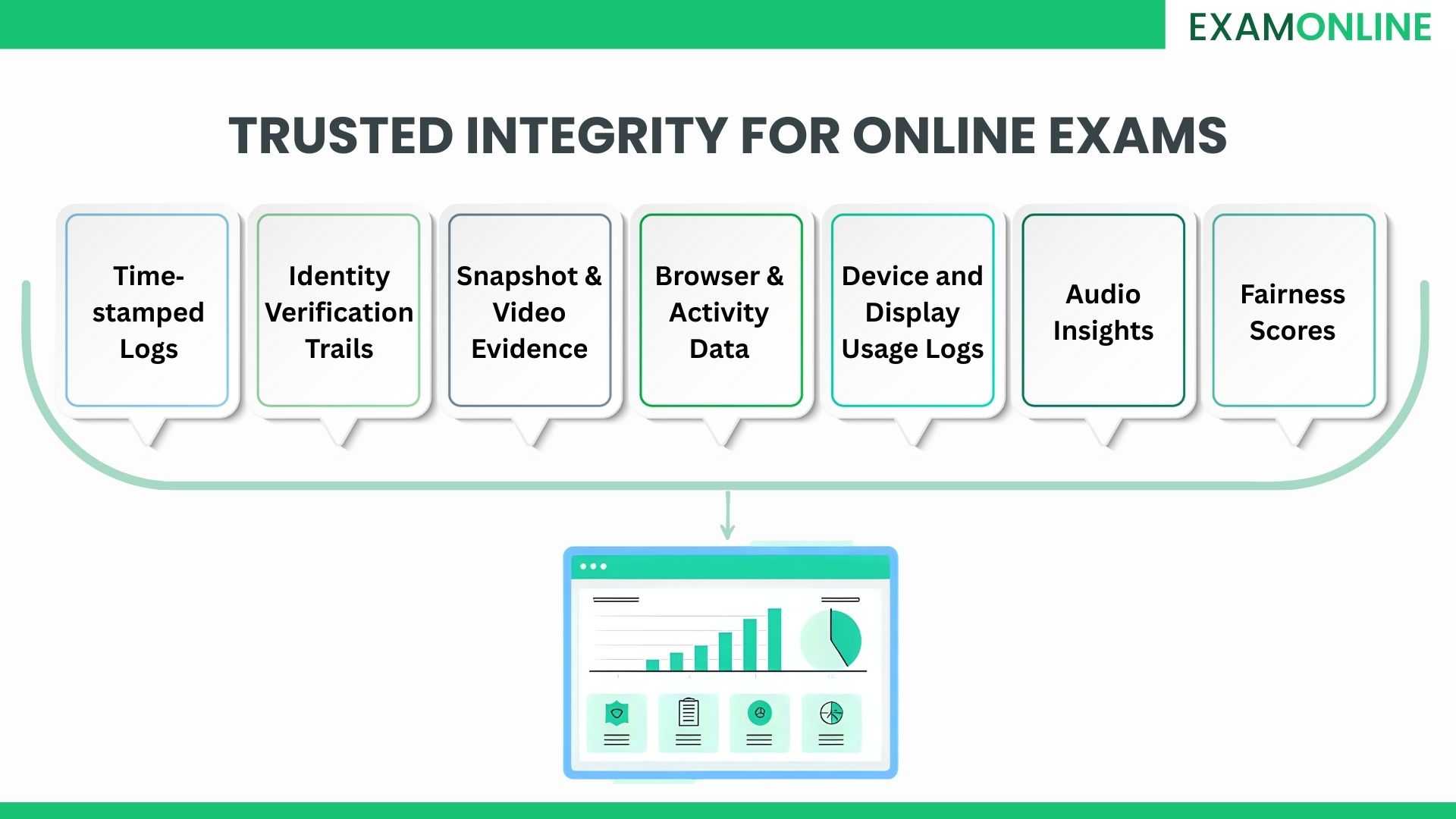
AI proctoring is not limited to real-time monitoring. Its true strength lies in how it captures, analyses and presents assessment behaviour through a structured set of reports and evidence trails. These reports form the foundation of transparent, credible and governable online assessments.
AI proctoring systems typically generate the following layers of evidence:
• Time-stamped Incident Logs: Every suspicious action — such as unusual head turns, eye movement patterns, leaving the screen, or interacting with external objects — is recorded with precise timestamps.
These logs help institutions trace behaviour during the exact moments anomalies occur, providing clarity and eliminating ambiguity.
• Identity Verification Trails: The AI system documents the full identity verification process, including face scans, ID matching steps and validation outcomes.
This ensures unquestionable confirmation that the correct learner attempted the exam and strengthens authenticity for certification.
• Snapshot and Video Evidence: When anomalies occur, the system automatically captures still images or short video clips.
These visual proofs become crucial in reviewing violations, resolving disputes and defending institutional decisions with confidence.
• Browser and Application Activity Data: AI records attempts to switch tabs, open new applications, launch external windows or navigate away from the exam environment.
This provides a transparent overview of how the learner interacted with their computer during the test.
• Device and Display Usage Logs: The system detects events such as device switching, plugging in peripherals and importantly – multiple display usage.
Multiple display detection prevents learners from using extended screens, mirrored displays or secondary monitors to access unauthorized content.
• Environmental Audio Insights: AI analyses background audio to detect conversation sounds, external voices or unusual noises that may indicate assistance or collaboration.
This adds a contextual layer to the visual and behavioural data.
• Fairness Scores for Integrity Evaluation: Fairness scores provide a consolidated, quantitative measure of the integrity of each exam attempt.
They reflect factors such as frequency of anomalies, severity of violations, behavioural consistency and environmental irregularities.
These scores help administrators quickly distinguish clean attempts from suspicious ones — without reviewing every recording manually.
How These Evidence Layers Support Institutions
Each of these reporting components plays a crucial role in strengthening the governance and credibility of online examinations:
• Accreditation and Audit Compliance: Regulatory bodies want assurance that examinations are conducted with strict integrity controls.
Evidence logs offer verifiable, time-stamped proof that institutions can present during inspections or audits.
• Efficient and Transparent Dispute Resolution: When learners challenge exam outcomes or violation decisions, institutions can rely on objective evidence — not subjective judgment.
This leads to faster, fairer resolutions and reduces administrative burden.
• Institutional Quality Assurance: Patterns of behaviour across multiple exams help quality teams identify whether issues arise from candidate misconduct, unclear instructions, environmental factors or exam design flaws.
• Improved Exam Design and Policy Refinement: If certain types of questions or formats repeatedly trigger anomalies, institutions can refine workflows, durations or guidelines.
Proctoring data becomes a feedback loop for continuous assessment improvement.
• Greater Trust Among Stakeholders: Learners, instructors, employers and accreditation bodies gain confidence knowing that exams are governed by evidence-based monitoring rather than subjective or inconsistent oversight.
From Monitoring to a Complete Integrity Management System
With such detailed reporting capabilities, AI proctoring evolves far beyond simple invigilation.
It becomes a comprehensive integrity management framework, enabling institutions to strengthen credibility, protect certification value and establish a transparent, defensible governance model for all online assessments.
This holistic approach not only ensures fair examinations today but also builds a sustainable foundation for trustworthy digital education in the future.
Benefits of AI Proctoring for E-Learning Providers
AI proctoring delivers multidimensional advantages across operational, academic and strategic layers. Institutions benefit from:
- Scalable assessments: Conduct large-volume online exams without needing physical centres or logistics.
- Reduced administrative load: Automates identity checks, monitoring and reporting, easing staff workload.
- Consistent monitoring: Ensures every learner is monitored uniformly without human bias or variability.
- Higher certification credibility: Strengthens trust in exam results and enhances the value of issued certificates.
- Secure remote evaluations: Provides exam integrity equal to physical centres through multi-layered AI monitoring.
- Audit-ready evidence: Generates detailed logs and reports that support audits, compliance and dispute resolution.
- Stronger stakeholder trust: Builds confidence among learners, employers and accreditation bodies through transparent and fair assessments.
As organisations embrace larger digital cohorts, proctoring becomes a pillar of institutional reliability and competitive differentiation.
ExamOnline Advantage
ExamOnline is trusted by 250+ organisations across 25+ countries for delivering secure, scalable and credible digital examinations. The platform offers AI-powered proctoring with advanced monitoring capabilities, including identity verification, multiple device and display detection and continuous behavioural analysis. It provides institutions with comprehensive reporting and fairness scoring, enabling transparent and evidence-backed assessment governance.
ExamOnline integrates seamlessly with existing LMS systems through API, LTI and SSO, ensuring that proctored exams fit naturally into the organisation’s learning workflow without technological friction. Supporting all major exam formats — from objective tests to descriptive answers and coding-based assessments — ExamOnline functions as a complete, end-to-end assessment platform. By combining cutting-edge AI technologies with practical and reliable workflows, it strengthens online exam integrity and enhances the value of certifications across diverse learning environments.

Frequently Asked Questions (FAQs)
Can AI proctoring integrate with my existing learning system?
Yes, through API, LTI or SSO workflows, proctoring can be seamlessly embedded into most platforms.
Does AI proctoring work for large-scale exams?
Yes, AI systems can support thousands of simultaneous users.
Is it suitable for subjective or coding tests?
Yes, AI focuses on environment monitoring, allowing any exam type to run smoothly.
How accurate is the monitoring?
AI models reliably detect suspicious activity with captured evidence for review.
Does the system monitor external devices?
Yes, including multiple display detection and device change monitoring.
Are fairness scores used for grading?
No, they reflect exam integrity, not learner performance.
How does AI proctoring protect certificate value?
It ensures authenticity at every step, making online certifications credible and respected.


