

Table of Contents
Introduction: How Remote Hiring Exposed the Limits of Traditional Interviews
Hiring has changed significantly over the last few years. Work from home, hybrid roles, and distributed teams have made employers and hiring teams to innovate, which made remote hiring the norm. Companies can now interview candidates from anywhere, saving time and cost.
However, this shift has also highlighted a major problem. Interviews alone are not enough to judge whether a candidate can actually do or has the skills to do the job. Most interviews focus on how well someone speaks, explains ideas, or presents themselves. These factors do not always reflect real skills.In remote interviews, this problem intensifies. Recruiters cannot fully verify who the candidate is, how they are responding, or whether the answers truly reflect their own ability, as the cheating methods are completely and continuously evolving. To hire accurately in a remote setup, organisations need objective and trustworthy ways to test real and technical skills required to do the job. This made the adoption of Proctored Exams at a global level necessary.
Why Interviews Alone Fail in Remote and High-Volume Hiring
Interviews are useful for understanding communication, attitude and presentation, but they are highly subjective. Different interviewers judge the same candidate in various ways and on other parameters. This makes decisions inconsistent.
Interviews also cannot test the real capabilities of a candidate. It is not easy to check how well a candidate codes, analyses data, works on spreadsheets, or applies domain knowledge during a conversation. As hiring volume increases, interviews become time-consuming and hard to manage.
In remote hiring cases, additional issues appear. Identity verification is difficult, taking outside help has become common, use of AI tools to cheat in interviews has increased, resulting in new cheating methods, and technical issues interrupt the process. Without an initial skill check, many unsuitable candidates reach the interview stages, slowing down hiring.
Because of this, proctored exams are now being used before interviews to ensure only capable and tested candidates move forward, allowing the interviewers to concentrate more on personality traits.
The Rise of Data-Driven Skill Assessment in Modern Recruitment
Hiring decisions today are increasingly based on data rather than intuition. Organisations want clear proof of a candidate’s ability before making decisions.
Skill assessments provide measurable results. They allow fair comparison between candidates and reduce bias. When these assessments are conducted as proctored exams, organisations can trust that the scores reflect genuine performance.
Instead of relying on impressions, recruiters can make decisions based on verified skill data.
Types of Hiring Assessments Essential for Validating Real Skills

Different job roles require different skills like language, Critical thinking, situational awareness, coding and many others. So, organisations have improved their proctoring tools to make sure only relevant skills are measured, moving away from one size fits all type of approach.
Aptitude Testing
Measures logical reasoning, numerical ability, and problem-solving skills.
Technical and Coding Assessments
Test coding logic, debugging ability, and how candidates solve real technical problems, especially used to evaluate technical and developer skills.
Domain Knowledge Tests
Check understanding of specific fields such as finance, HR, marketing, or operations based on the job requirements.
Excel and Analytics Tasks (File Upload Enabled)
Assess practical spreadsheet and presentation skills, such as using tools like Excel, PowerPoint, word etc.
Role-Based MCQ and Subjective Assessments
Validate job-specific knowledge through structured questions.
Basic Writing Ability Tests
Check grammar, clarity, and professional written communication.
When delivered as proctored exams, these assessments give reliable results that reflect true capability and skills.
Non-Proctored Online Tests: How Candidates Cheat in Remote Environments
Non-proctored tests do not monitor how candidates attempt the exam. This makes cheating easy in remote settings.
Candidates may search for answers online, use AI tools or code generators, or seek help from someone nearby. Some use a second device like a mobile phone. Others allow remote access so that another person can complete the test. Notes placed outside the camera view or impersonation are also common.
Because these actions are not detected, non-proctored test results cannot be trusted. Hiring decisions based on such tests often lead to poor outcomes.
The Business Impact of Skill Misrepresentation and Hiring Fraud
When candidates cheat during assessments, organisations face long-term problems. Unqualified hires struggle to perform their roles. Teams lose time supporting them, and managers spend more effort correcting mistakes.
Training and supervision costs increase. Many such hires leave early, forcing companies to restart the hiring process. In sensitive roles, skill gaps can also lead to compliance or operational risks.
Over time, leadership loses trust in hiring data. This makes recruitment less effective and more expensive. These risks make non-proctored assessments unsuitable for modern hiring.
Why Remote Hiring Requires Secure Proctored Assessments
Remote hiring removes the controlled environment of in-person tests. Organisations cannot see who is taking the test or how it is being attempted.
Proctored exams bring back control and fairness. They verify candidate identity, monitor behaviour during the test, and enforce exam rules. This prevents external help and ensures all candidates are evaluated under the same conditions.
With remote hiring becoming permanent, proctoring is now essential to maintain hiring accuracy.
What a Proctored Assessment Is and How It Works
A proctored assessment is an online exam that is monitored to ensure the candidate completes it independently.
AI Proctoring
AI monitors the webcam, microphone, and screen. It checks face presence, eye movement, background changes, and attempts to open other applications. Any unusual activity is recorded.
Live Human Proctoring
Human proctors supervise candidates in real time. They can understand context, speak to candidates, request environment checks, and take action if rules are violated.
Together, these methods make proctored exams secure and reliable at scale.
How Proctoring Strengthens Test Integrity Through Evidence and Audit Trails
Proctoring systems also create clear records of how an exam was taken.
A. Continuous Tracking During the Test
Video, audio, and screen activity are recorded. Events like window switching or connectivity issues are logged.
B. Evidence Capture for Suspicious Actions
Screenshots, short video clips, and proctor notes are captured when irregular behaviour is detected.
C. Alerts, Violations, and Post-Test Evaluation
All data is combined into an integrity report with alerts and a fairness or risk score. This helps recruiters judge how trustworthy the attempt was.
This evidence-based approach supports confident hiring decisions.
Integrating Assessments with ATS and HRMS for Faster and Smarter Hiring
When assessment systems are not integrated with HR tools, recruiters spend time downloading reports and updating records manually. This slows down hiring and increases errors.
With ATS and HRMS integration, proctored exam results and reports are automatically linked to each candidate profile. Recruiters can review performance, collaborate, and shortlist candidates from one system. Integration improves speed, accuracy, and transparency across the hiring process.
Security, Compliance, and Infrastructure Standards for Online Assessments
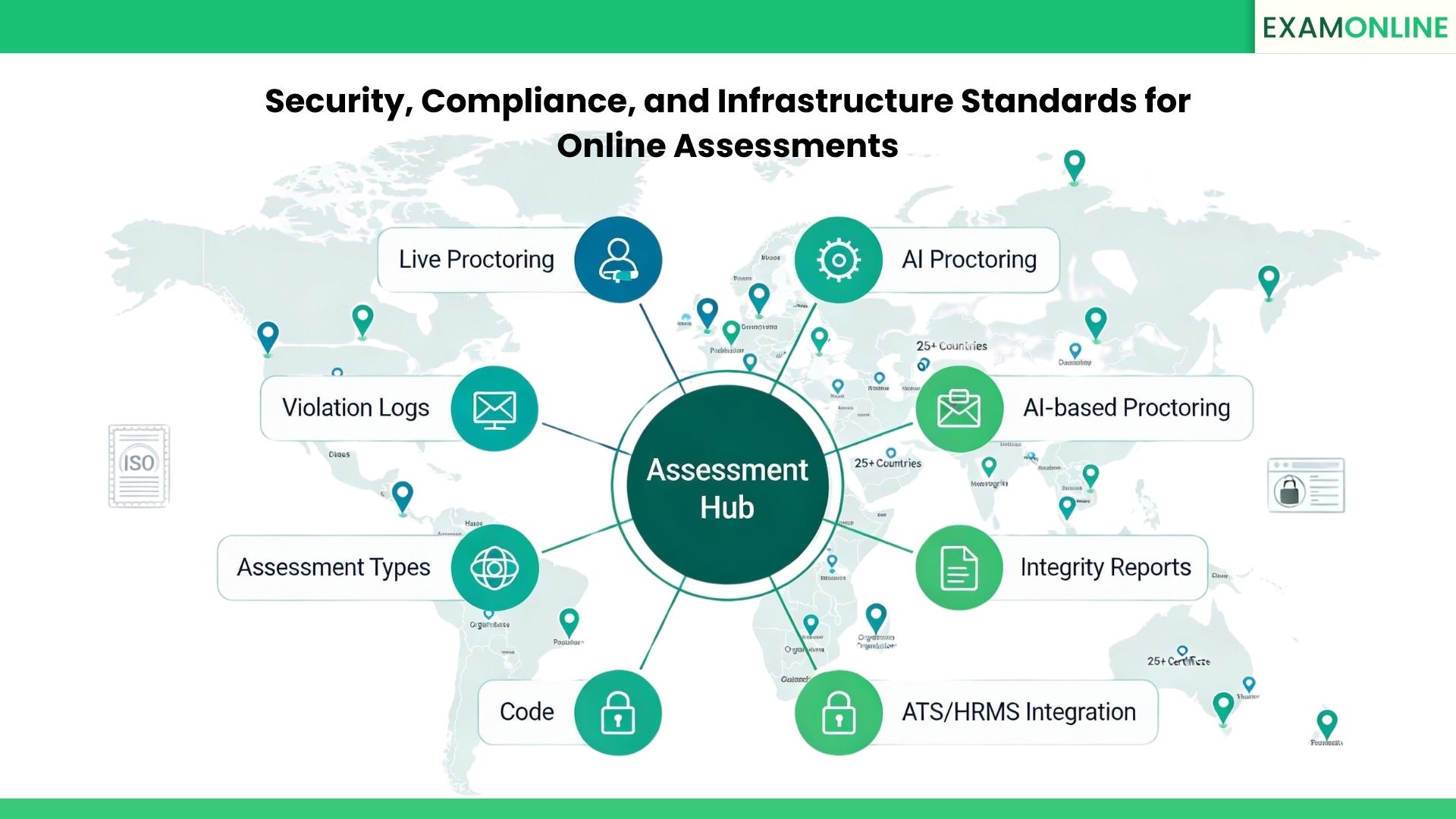
Online assessments handle sensitive data such as identity documents and video recordings. Strong security is required to protect this information.
ISO 27001 focuses on information security practices like encryption and access control. ISO 9001 ensures consistent quality in assessment delivery. End-to-end encryption protects data, and role-based access ensures only authorised users can view sensitive information. Regular security audits further strengthen the system.
These standards ensure assessments are delivered on a secure and compliant infrastructure.
ExamOnline Advantage
ExamOnline works with 250+ organisations across 25+ countries to deliver secure, end-to-end proctored exams for hiring. The platform supports live and AI-based proctoring, violation logs, integrity reports, and a wide range of assessments, including technical, domain, Excel, and writing tests.
With seamless ATS and HRMS integrations and compliance with ISO 27001 and ISO 9001, ExamOnline ensures secure data handling and reliable hiring workflows. This helps organisations hire with confidence and accuracy.

Frequently Asked Questions (FAQs)
What are proctored exams?
Online exams that are monitored through AI or human proctors to ensure fairness.
How do proctored exams prevent cheating?
By monitoring webcam, audio, and screen activity and recording violations
What assessments are used in hiring?
Aptitude, technical, domain, Excel, role-based, and writing assessments.
Why is ATS/HRMS integration important?
It centralizes data, reduces manual work, and speeds up hiring decisions.
Is candidate data secure during online assessments?
Yes, when platforms follow ISO standards, encryption, and access controls.
Why are proctored exams important for remote hiring?
They ensure authenticity, prevent impersonation, and support fair evaluation


