
Table of Contents
Introduction: Why Exam Security Cannot Depend on Assessment Platforms Alone
Assessment platforms and learning management systems (LMS) are widely used to deliver exams at scale. They manage scheduling, candidate registration, content delivery, and results efficiently across organisations.
What they do not do is verify identity during an exam, monitor candidate behaviour, or produce a defensible session record.
Proctoring tool integration closes this gap. It connects a monitoring layer to the existing platform, enabling identity verification, behavioural tracking, and audit-ready records without replacing the core system.
Organisations that rely only on platform-level controls are not securing exams – they are only delivering them, without the ability to defend outcomes when challenged.
What Assessment Platforms Do vs Where Proctoring Integration Becomes Critical
Assessment platforms and LMS are built for delivery and administration. They handle:
- Candidate registration
- Exam scheduling
- Question delivery
- Time tracking
- Result storage
These systems are reliable at scale, but they are not designed to monitor exam sessions.
Once a candidate logs in:
- Credentials are verified
- Identity is not continuously validated
- Behaviour is not tracked
- Environment is not monitored
This is not a flaw – it is a scope boundary.
- The platform delivers the exam
- Proctoring integration secures the session
For a system-level understanding of this separation, see LMS and proctoring architecture interaction.
Organisations that treat login authentication as sufficient security operate non-proctored environments, creating exposure that is operational, reputational, and in regulated cases, legal.
Why Non-Proctored Exams Create Governance, Compliance, and Integrity Risks
When exams run without proctoring integration, the same failure patterns emerge across use cases:
Identity cannot be verified beyond login
There is no mechanism to confirm that the person taking the exam remains the registered candidate throughout the session.
Assistance goes undetected
External help – second devices, additional individuals, or materials – leaves no trace in platform records.
No session-level audit trail exists
Logs show access and completion, but not what occurred during the exam. Organisations cannot reconstruct events they did not monitor.
Compliance gaps become visible
In regulated environments, absence of monitoring is treated as a failure of oversight, not a technical limitation.
The core issue is not cheating alone – it is the inability to produce defensible evidence when required. Defensible evidence is the core of credible and secure exams which is achieved by using proctoring software while delivering exams.
How Proctoring Tool Integration Works: LTI, API, and SSO Explained

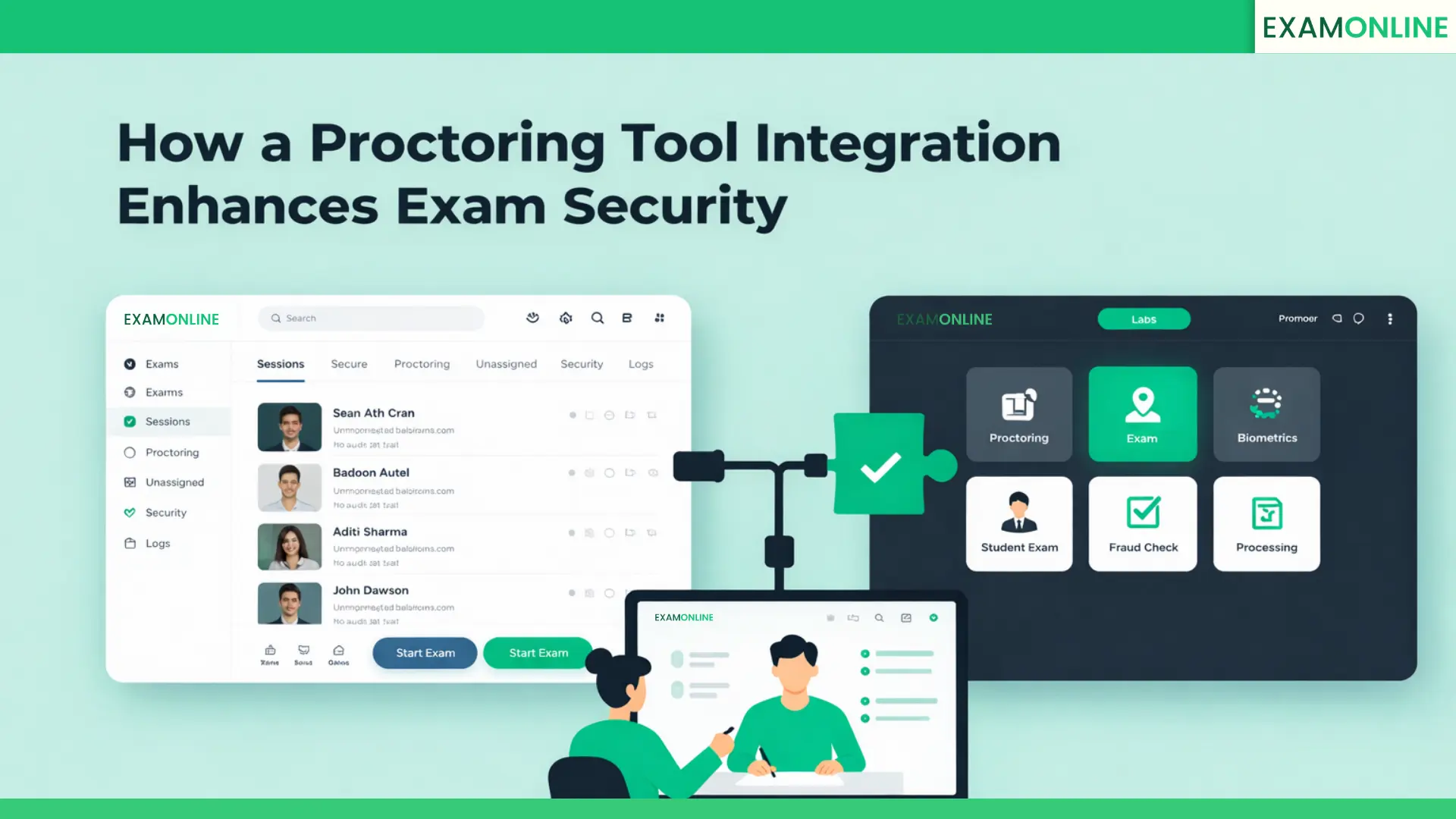
Proctoring integration connects a proctoring system with an assessment platform so both share identity, session state, and incident data in real time.
The platform continues to deliver the exam. The proctoring layer adds monitoring, verification, and recording.
Common integration methods:
LTI (Learning Tools Interoperability)
- Launches proctoring within the platform
- Eliminates separate login
- LTI 1.3 provides stronger security
API Integration
- Enables real-time data exchange
- Supports custom workflows and automation
- Offers highest flexibility
SSO (Single Sign-On)
- One authentication across systems
- Reduces impersonation risk
- Improves user experience at scale
According to industry estimates, the online proctoring market is projected to grow from USD 1.1 billion in 2023 to USD 4.8 billion by 2028, driven by demand for integrated, API-compatible assessment security systems.
The correct integration pathway depends on platform capability, IT architecture, and compliance requirements.
Integration architecture is not an implementation detail – it is a procurement decision that directly impacts exam integrity.
What Proctoring Integration Changes: From Visibility to Defensible Audit Trails
Integrating proctoring transforms what organisations can observe, record, and defend.
Continuous identity verification
Identity is validated throughout the session, not just at login, creating a verifiable chain of identity.
Real-time behavioural monitoring
- Face detection anomalies
- Gaze deviation
- Audio signals
- Tab switching
- Environmental changes
All signals are detected, timestamped, and linked to the candidate session.
Centralised incident reporting
All flags, recordings, and behavioural events are stored alongside exam results, eliminating system fragmentation.
Defensible audit trail
Each session produces a complete, reviewable record.
For a governance perspective on how automated monitoring decisions are evaluated, see AI accountability in proctoring systems.
For regulated assessments, this is not an enhancement – it is the minimum evidentiary standard required. Regulators do not accept the absence of records as neutrality; they treat it as a failure of control.
Integrated vs Non-Proctored Exams: A Governance-Level Comparison
| Criterion | Non-Proctored Platform | Integrated Proctoring |
| Identity verification | Login only | Continuous verification |
| Behaviour monitoring | None | Real-time tracking |
| Audit trail | Basic logs | Full session record |
| Dispute resolution | No evidence | Reviewable recordings |
| Compliance readiness | Limited | Documented controls |
| Scalability | Risk increases | Monitoring scales |
The most critical difference is the audit trail.
Without it, organisations cannot validate outcomes, resolve disputes, or defend certifications under audit or legal scrutiny.
How to Evaluate Proctoring Software for Seamless Integration
Integration capability should be evaluated before features.
Key evaluation criteria:
- API quality – well-documented, versioned, actively maintained
- LTI support – LTI 1.3 preferred
- SSO compatibility – SAML 2.0, OAuth, OpenID Connect
- Data residency – alignment with regulatory requirements
- Scalability – proven under real usage conditions
- Compliance certifications – ISO 27001, SOC 2, GDPR
For a structured evaluation framework, refer to proctoring platform selection criteria.
Organisations should validate these criteria against their existing systems before procurement. Integration determines whether security is enforceable or only assumed.
A Practical View: Why Integration Extends Rather Than Replaces Platforms
Proctoring integration does not replace an assessment platform.
It extends it.
- The platform manages exam delivery
- The proctoring layer ensures session integrity
This separation allows each system to operate within its designed role while producing a unified, secure assessment environment.
ExamOnline: Integrated Proctoring Built for End-to-End Assessment Security

ExamOnline delivers proctoring as a native layer within a complete assessment ecosystem, deployed across 25+ countries and used by 250+ organisations.
The platform manages the full certification workflow within a single environment – including candidate registration, slot booking, multiple attempts, payment gateway processing, identity verification, proctored session delivery, and certificate generation with automatic distribution.
Proctoring operates within the same identity and session context as the assessment itself, ensuring that every action is recorded and traceable without system fragmentation.
Integration of proctoring software with existing LMS or assessment platforms is supported via LTI, API, and SSO, allowing organisations to retain their infrastructure while implementing a defensible security layer.
For organisations where exam integrity must withstand audit, dispute, and regulatory scrutiny, integrated proctoring is not an enhancement – it is the system requirement.
Proctoring integration does not enhance exam delivery – it makes exam outcomes defensible.

Frequently Asked Questions (FAQs)
What is proctoring tool integration?
It is the connection between a proctoring system and an assessment platform that enables real-time monitoring, identity verification, and session recording.
Why are non-proctored exams a risk?
Because they cannot verify identity during the session or provide evidence if results are challenged.
How does proctoring improve exam security?
By continuously verifying identity, tracking behaviour, and generating a complete session record.
What is LTI in proctoring integration?
For students, it provides a frictionless process with a single sign-on and a fA standard that allows external tools to integrate directly into assessment platforms without separate authentication.
Can proctoring integrate with systems other than LMS?
Yes, including assessment platforms, certification systems, and custom-built environments.
Is proctoring required for compliance?
In many regulated environments, it is necessary to demonstrate that assessment controls were active and enforceable.


