

Table of Contents
Introduction
Certification programs have become an important mechanism for validating professional skills and industry knowledge. Professional associations, certification bodies, and industry councils use certification frameworks to establish competency standards, ensure consistent evaluation across candidate groups, and also a part of decision making mechanism.
As certification programs gain recognition, candidate demand grows. Programs that initially served regional audiences often begin attracting participants from multiple cities, countries, and professional sectors. This expansion creates operational challenges related to exam delivery, candidate management, and credential governance.
Scaling a certification program therefore involves more than increasing the number of candidates. Certification bodies must build systems capable of managing assessments, maintaining exam integrity, and issuing credentials reliably across distributed candidate bases.
Online exam platforms have emerged as the infrastructure that enables certification bodies to deliver exams globally while maintaining standardized evaluation processes. These platforms support centralized exam management, candidate scheduling, and secure exam environments that allow certification programs to scale without compromising credibility.
For certification bodies, scaling certification programs largely depends on secure exam infrastructure that can manage candidate participation, maintain exam integrity, and distribute credentials efficiently.
Why Certification Programs Are Expanding Across Industries
Across industries, employers increasingly require verifiable credentials that demonstrate job-ready knowledge and practical competence. Certifications allow professional bodies to establish standardized benchmarks that employers can trust when evaluating candidates.
Associations and certification authorities therefore play a crucial role in defining professional competency frameworks. Through structured certification programs, they create pathways that help professionals validate their expertise and progress within their careers.
Certification programs are expanding because they address several market needs:
- Standardized skill validation across industries
- Independent credential verification for employers
- Structured professional development pathways
- Recognition of specialized or emerging skill sets
As industries evolve rapidly, certifications also allow organizations to update evaluation frameworks more frequently than traditional academic systems.
Many associations therefore invest in structured certification pathways that define competency standards, assessment models, and credential issuance mechanisms. These frameworks ensure that certification programs remain relevant to industry requirements while maintaining consistent evaluation standards.
However, as certification demand grows, organizations must manage increasing candidate volumes while ensuring that assessments remain fair, standardized, and secure.
Types of Certification Programs Organizations Offer

Certification bodies typically offer multiple certification types to address different professional needs. Each certification category introduces distinct requirements for assessment design, candidate evaluation, and credential management.
Common certification categories include:
Professional Certifications
Professional certifications validate expertise within a specific profession or industry domain. Examples include certifications in project management, accounting, cybersecurity, and financial analysis.
These certifications often require rigorous and highly secure exams and periodic recertification to ensure continued professional competency.
Technical Certifications
Technical certifications focus on validating specific technology or platform skills. These programs are common in IT, cloud computing, software development, and data analytics.
Technical certifications often require candidates to demonstrate practical knowledge through structured assessments.
Industry Compliance Certifications
Certain industries require certifications that validate compliance with regulatory or safety standards. These certifications ensure that professionals meet legal or operational requirements within regulated sectors.
Examples include certifications in healthcare compliance, safety management, and financial regulation.
Skill Validation Certifications
Organizations increasingly offer certifications that validate specific competencies such as data analysis, digital marketing, or specialized technical skills.
These certifications are often used by professionals to demonstrate expertise in niche areas.
Continuing Professional Education Certifications
Many professional bodies offer certifications linked to continuing education programs. These certifications allow professionals to update their knowledge while maintaining active industry credentials.
Different certification types introduce varying operational requirements. Some programs involve small candidate groups and infrequent exam sessions, while others attract thousands of candidates globally.
As certification programs expand, delivering assessments consistently across these diverse candidate groups becomes a significant operational challenge.
For example, cloud certification programs often attract thousands of candidates globally, requiring organizations to deliver assessments across multiple time zones while maintaining standardized evaluation environments.
Traditional Offline Delivery of Certification Courses and Exams
Historically, certification programs relied on physical training environments and in-person examinations. Candidates attended classroom sessions, completed training modules, and appeared for certification exams at designated exam centers.
In this model, exam delivery required coordination across multiple operational elements:
- Physical examination venues
- Invigilators or exam supervisors
- Printed question papers or local computer systems
- Manual identity verification procedures
While this approach worked effectively when certification programs served limited regional audiences, it becomes increasingly complex as candidate numbers grow.
Certification bodies often encounter several operational limitations when relying on offline exam delivery.
Constraints for Offline Certification Exams
Traditional certification programs have long relied on physical examination centers and in-person invigilation. While this model can maintain structured exam environments, it introduces several operational constraints when certification programs begin expanding across regions or countries.
As candidate demand grows, certification bodies must coordinate venues, personnel, scheduling, and exam materials for every exam session. Managing these operational requirements becomes increasingly complex when candidate volumes rise or when participants are distributed across multiple locations.
Offline exam delivery therefore creates structural limitations that restrict how efficiently certification programs can scale. Certification bodies often encounter challenges related to accessibility, capacity, logistics, and operational costs when relying exclusively on physical examination environments.
Geographical Constraints
Candidates must travel to designated exam centers, limiting participation for individuals located in remote or international regions.
Capacity Restrictions
Physical exam venues restrict the number of candidates who can take exams simultaneously, slowing program expansion.
Logistical Complexity
Coordinating venues, invigilators, scheduling, and exam materials introduces administrative overhead and operational risk.
Higher Operational Costs
Venue rentals, staff coordination, and logistical arrangements significantly increase the cost of conducting certification exams.
These limitations make it difficult for certification bodies to scale programs efficiently. As certification demand grows across industries, organizations increasingly explore digital assessment models that allow exams to be delivered securely without relying on physical testing infrastructure.
Online Delivery Models for Certification Programs
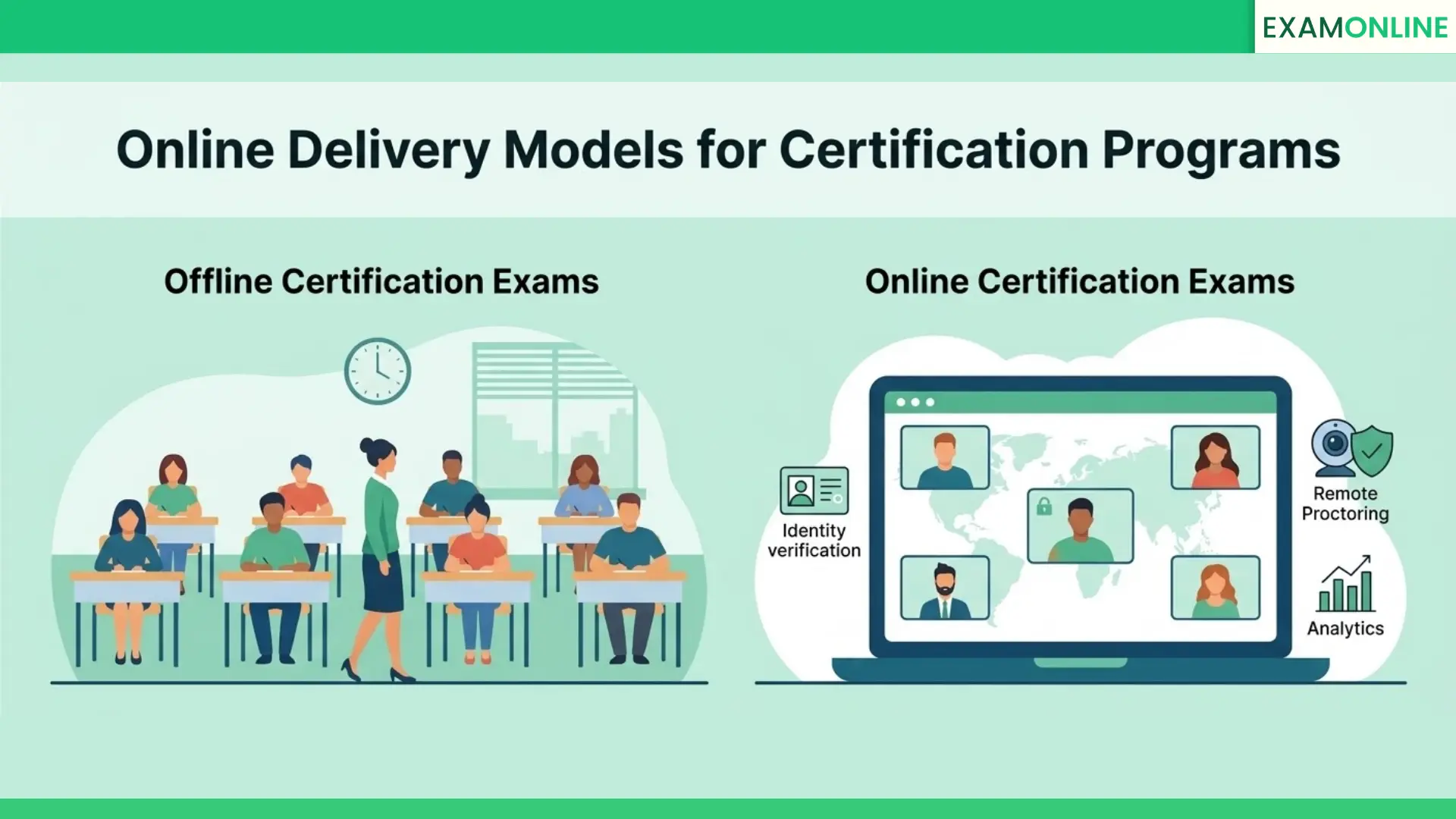
Certification bodies increasingly adopt online delivery models to overcome the limitations of physical exam infrastructure. Digital learning environments and online assessment platforms allow organizations to deliver certification courses and exams to candidates across different regions without requiring centralized exam centers.
Online delivery expands candidate access while maintaining standardized evaluation frameworks. Certification bodies can administer exams to larger candidate groups while reducing logistical complexity associated with venue-based examinations.
Online certification ecosystems typically include several operational components:
- Digital learning platforms for certification preparation
- Online exam platforms for candidate assessments
- Remote identity verification mechanisms
- Secure exam monitoring environments
- Post exam analysis and certification
These systems allow certification authorities to manage candidate participation across different locations while ensuring consistent evaluation standards.
Online delivery models also improve scheduling flexibility. Certification bodies can offer multiple exam windows, allowing candidates to take certification assessments at convenient times without depending on fixed exam center availability.
| Factor | Offline Certification Exams | Online Certification Exams |
| Candidate Access | Limited to physical exam centers | Global participation possible |
| Scheduling | Fixed exam dates | Flexible exam scheduling |
| Infrastructure | Physical venues and staff required | Platform-based delivery |
| Security Monitoring | Manual invigilation | Automated and proctored monitoring |
| Scalability | Limited by venue capacity | Easily scalable |
As certification programs expand globally, organizations increasingly rely on remote proctored certification exams to deliver secure assessments to distributed candidate groups while maintaining standardized exam conditions.
How Online Exam Platforms Scale Certification Programs
Scaling certification programs require operational infrastructure capable of managing increasing candidate participation without introducing administrative complexity. Online exam platforms provide centralized systems that allow certification bodies to administer assessments efficiently across large candidate groups.
Online exam platforms make it possible for certification bodies to scale certification programs by managing candidate registration, exam delivery, proctoring, and credential distribution through centralized systems.
These platforms simplify the operational aspects of certification delivery by consolidating exam management functions within a single environment. Certification administrators can design assessments, schedule exam sessions, and monitor exam activity through unified systems.
Online exam platforms support certification scalability through several capabilities:
- Centralized exam creation and administration
- Automated candidate registration and scheduling
- Standardized testing environments for all candidates
- Secure exam session monitoring and activity tracking
- Digital evaluation and result management
Centralized exam infrastructure ensures that certification bodies maintain consistent assessment standards regardless of candidate location. This becomes particularly important when certification programs expand beyond regional markets.
Operational efficiency also improves when exam administration processes become automated. Certification administrators spend less time coordinating exam logistics and more time focusing on maintaining assessment quality and certification standards.
As candidate participation increases, centralized exam management systems allow certification programs to expand without requiring proportional increases in administrative resources.
Online exam platforms help certification bodies scale programs through:
- centralized exam administration
- automated candidate registration and scheduling
- secure proctored assessment environments
- digital evaluation and result management
- integrated credential distribution
How Do Proctored Exams Protect Certification Credibility?
The value of a certification program depends on the credibility of its assessments. Employers and industry stakeholders rely on certifications as indicators of professional competence, and this trust depends on the integrity of the examination process.
Certification exams must therefore prevent activities that compromise exam fairness. Common risks include impersonation, unauthorized collaboration, and access to external resources during exams. Without proper monitoring mechanisms, these risks can undermine the credibility of certification credentials.
Proctored exam environments allow certification bodies to monitor candidates during exams, verify identities, and detect suspicious behavior that may compromise exam integrity.
Proctored exams help maintain exam integrity by monitoring candidate behavior during assessments. Proctoring mechanisms ensure that candidates follow established exam rules and that certification results reflect genuine knowledge and competence.
Secure exam monitoring environments typically focus on key areas such as:
- Candidate identity verification before exam access
- Monitoring candidate activity during exams
- Detecting suspicious behavior patterns
- Preventing access to unauthorized resources
Certification bodies increasingly rely on secure proctored exams to ensure that certification assessments remain defensible. These monitoring systems protect the credibility of certification programs while enabling organizations to deliver exams remotely.
Maintaining exam integrity is particularly important when certification programs scale globally. As candidate volumes increase and exams move beyond physical centers, structured monitoring mechanisms become essential to preserve employer trust in certification credentials.
Credential Distribution and the Rise of Digital Certification

Certification programs traditionally issued printed certificates as proof of candidate achievement. Over time, many organizations transitioned to digital certificate formats such as PDF documents to simplify distribution and storage.
However, as certification programs expanded and employer verification requirements increased, credential distribution methods also evolved. Digital credential systems now provide more structured and verifiable formats for issuing certification achievements.
Modern certification programs increasingly adopt digital credential formats such as digital badges. These credentials provide advantages beyond simple certificate distribution.
Digital credentials support:
- Online verification of certification authenticity
- Easy sharing of credentials on professional platforms
- Integration with digital professional profiles
- Persistent and tamper-resistant certification records
Digital credential formats also help certification bodies manage credential lifecycles more effectively. Certifications can be updated, renewed, or verified through centralized credential systems without relying on static certificate files.
Many organizations are therefore transitioning toward verifiable digital credentials as part of their certification infrastructure. These systems improve credential verification while making it easier for professionals to showcase their certifications within digital career ecosystems.
As certification programs scale globally, digital credential distribution mechanisms become an essential component of modern certification program management.
Governance and Risk Considerations in Scalable Certification Programs
As certification programs expand, maintaining governance standards becomes increasingly important. Growth in candidate participation introduces operational risks that can affect the credibility and long-term value of certification credentials.
Certification bodies must ensure that evaluation processes remain consistent, secure, and defensible even as exam volumes increase. Without strong governance structures, certification programs risk losing employer trust and industry recognition.
Several risks commonly emerge when certification programs scale rapidly:
- Credential dilution – inconsistent evaluation standards can weaken the perceived value of certifications.
- Exam security vulnerabilities – poorly managed assessments increase the risk of question leaks or unauthorized access.
- Identity verification gaps – insufficient candidate verification can lead to impersonation during exams.
- Fragmented exam administration – using multiple disconnected systems can introduce inconsistencies in exam delivery and evaluation.
Certification bodies must therefore establish governance frameworks that define clear assessment policies, exam administration procedures, and credential validation mechanisms.
Online exam platforms help certification authorities enforce these governance standards by providing centralized control over exam delivery, candidate verification, and monitoring processes. When certification programs operate through structured assessment systems, organizations can scale their programs while maintaining consistent evaluation practices.
Certification programs that lack strong governance frameworks risk losing industry recognition, which can significantly reduce the perceived value of the credentials they issue.
Operational Infrastructure Required to Scale Certification Programs
Scaling certification programs requires more than delivering exams digitally. Certification bodies must manage a complete certification lifecycle that includes candidate onboarding, exam administration, and credential issuance.
When certification programs grow, manual administrative processes become difficult to manage. Organizations therefore rely on integrated exam management systems that streamline certification operations.
A scalable certification infrastructure typically supports several operational components:
- Candidate registration systems to manage applicant data and eligibility verification
- Exam scheduling tools that allow candidates to select convenient exam slots
- Secure exam delivery environments that maintain standardized testing conditions
- Evaluation and scoring mechanisms that ensure consistent grading standards
- Credential issuance systems that generate and distribute certification records
These systems allow certification bodies to manage the entire certification lifecycle through a single operational framework.
Integrated infrastructure also improves transparency and accountability within certification programs. Administrators can track exam participation, monitor candidate activity, and maintain audit trails that support certification governance.
As certification programs expand across industries and regions, organizations increasingly rely on structured exam platforms to manage certification workflows efficiently.
How ExamOnline Supports Scalable Certification Programs

Certification bodies require infrastructure that supports the full certification lifecycle while maintaining secure exam environments. As certification programs expand across industries and geographies, managing candidate registration, exam delivery, and credential issuance through fragmented systems becomes difficult.
ExamOnline provides a secure certification exam platform that enables organizations to manage certification programs through a centralized assessment environment. The platform supports certification bodies operating across 25+ countries and is used by 250+ organisations to deliver structured certification assessments.
Certification administrators can manage candidate workflows that include registration, slot booking, payment gateway integration, and multiple exam attempts through a unified exam management system. Identity verification and secure exam delivery mechanisms ensure that certification assessments remain credible even when delivered remotely.
Once certification exams are completed, the platform supports automated certificate generation and distribution, allowing certification bodies to issue credentials efficiently while maintaining consistent record management.
By enabling certification organizations to manage assessments, candidate workflows, and credential distribution within a single system, ExamOnline helps certification bodies scale their programs while preserving exam integrity and governance standards.
Conclusion
Certification programs are expanding rapidly as industries seek reliable mechanisms for validating professional skills and competencies. Associations and certification authorities increasingly operate programs that serve candidates across multiple regions and professional sectors.
Scaling these programs requires more than increasing exam frequency or candidate participation. Certification bodies must build operational systems capable of managing assessments, maintaining exam integrity, and distributing credentials efficiently.
Online exam platforms provide the infrastructure that enables certification programs to expand without introducing operational complexity. Through centralized exam management, secure monitoring environments, and digital credential systems, certification bodies can deliver standardized assessments to distributed candidate groups.
Certification programs scale when secure exam infrastructure protects credential integrity while enabling consistent assessment across global candidate groups.

Frequently Asked Questions (FAQ)
How do online exam platforms help in scaling certification programs?
Online exam platforms help certification bodies scale certification programs by managing candidate registration, exam scheduling, proctored assessments, and credential issuance through centralized systems.
How can certification bodies scale certification exams globally?
Certification bodies can scale exams globally by adopting digital assessment platforms that allow candidates to participate remotely while maintaining standardized evaluation environments.
Why are proctored exams important for certification programs?
Proctored exams help maintain exam integrity by monitoring candidate behavior during assessments. This prevents impersonation and cheating while protecting the credibility of certification credentials.
What are digital certification credentials?
Digital certification credentials are electronic certificates or badges that verify candidate achievements. These credentials allow organizations to distribute certifications efficiently while enabling easy verification and sharing.
Can online certification exams maintain credibility?
Yes. When delivered through secure exam platforms with identity verification and monitoring mechanisms, online certification exams can maintain the same credibility as traditional in-person exams.

