
Introduction
Every hiring season brings the same familiar pressure. Thousands of resumes land in a shared inbox, recruiters juggle spreadsheets, and department heads keep asking for updates that nobody has time to prepare. Campus recruitment has always carried this weight, and the pressure only grows heavier as companies expand their graduate intake year after year.
This is exactly where campus recruitment software steps in. Instead of manually sorting resumes and running walk in aptitude rounds across a dozen campuses, HR teams now rely on a single platform that tests, scores and ranks candidates in one clean workflow. Campus recruitment software has quietly become the backbone of modern graduate hiring, and businesses that still run everything on paper are falling behind faster than they realise.
This guide walks you through everything a hiring leader, HR head or talent acquisition manager needs to know before choosing campus recruitment software for their organisation. You will find real signs of a broken hiring process, a feature by feature breakdown, a working comparison table, a practical checklist and honest guidance on what actually matters when evaluating a recruitment platform.
By the time you finish reading, picking the right campus recruitment software for your business should feel simple rather than overwhelming.

Why Campus Hiring Feels Like A Race Against Time
Ask any campus recruiter what keeps them awake during placement season and the answer is almost always the same. Thousands of applications arrive within days, interview panels get booked months in advance, and every delay risks losing a promising candidate to a competing offer. The pressure to move fast while staying fair creates a tension that manual hiring genuinely struggles to resolve.
Universities across India report record enrolment numbers year after year, according to the Ministry of Education’s own All India Survey on Higher Education. With a growing pool of graduates entering the workforce every single year, companies that still rely on physical aptitude rounds and paper based screening are stretching their HR teams far beyond a healthy capacity. Recruiters end up spending weeks on activities that a proper recruitment platform could finish within hours.
Government labour data adds useful context here too. The Ministry of Statistics’ Periodic Labour Force Survey tracks how a large share of young graduates enter the job market every year, reinforcing just how much pressure sits on hiring teams during every campus season. Volume hiring adds another layer of complexity. A single campus drive can attract hundreds of applicants for a handful of open roles, and reviewing each resume manually invites human error, bias and fatigue. Talent acquisition teams frequently admit that strong candidates slip through simply because a tired recruiter skimmed a resume too quickly during a late evening review session.
The good news is that these struggles are entirely solvable. Campus recruitment software brings structure, speed and fairness to a process that used to run purely on manual effort. Recruiters gain hours back in their week, candidates enjoy a smoother experience, and hiring managers finally get comparable data across every applicant instead of scattered notes from different interviewers.

What Is Campus Recruitment Software
Campus recruitment software is a digital platform built specifically to help organisations source, test, screen and shortlist graduate candidates from universities and colleges. Rather than depending on physical exam halls, printed question papers and manual evaluation sheets, this recruitment technology delivers assessments online, scores them automatically and presents ranked results to the hiring team within minutes.
At its core, campus recruitment software combines several capabilities that used to exist as separate, disconnected tools. Aptitude testing, technical assessment, coding assessment and behavioural assessment all run through one exam platform. Candidate data, scorecards and assessment reports live inside a single recruitment dashboard, which finally gives recruiters a complete picture instead of fragments spread across emails and spreadsheets.
Businesses across industries, from IT services firms to manufacturing companies and BFSI organisations, rely on campus recruitment software to run their graduate hiring programs. The platform works equally well for a company hiring twenty entry level engineers and one hiring two thousand candidates across fifty campuses in a single season. This scalability is precisely why recruitment automation has become such a widely adopted hiring technology among growing businesses.
For organisations exploring their options, ExamOnline’s hiring and recruitment solution brings aptitude testing, skill assessment and behavioural profiling together in a single recruitment platform built for scale. Companies running large graduate intake programs can also explore purpose built corporate hiring solutions designed around real recruitment workflows rather than generic testing tools.

Signs Your Campus Hiring Process Is Failing You
Many hiring teams assume their process works fine simply because offers eventually go out. However, a few warning signs usually reveal deeper cracks that quietly push strong candidates toward competitors while weaker candidates slip through unnoticed.
Watch out for these common red flags across your current campus hiring workflow:
- Recruiters spend more hours screening resumes than actually evaluating skills
- Candidates from different campuses face inconsistent question papers or difficulty levels
- Aptitude test results arrive days after the exam instead of instantly
- Interview panels rely purely on gut feeling rather than measurable assessment data
- Strong candidates drop out because the process drags on for weeks
- HR teams struggle to compare candidates across multiple campuses fairly
- Cheating during remote rounds goes undetected until far too late
- Hiring managers keep requesting reports that take days to compile manually
- Every recruitment cycle repeats the same manual mistakes from the last one
- Data from previous hiring seasons sits unused instead of guiding future decisions
If even three or four of these sound familiar, your organisation is likely losing strong graduate talent purely because of process gaps rather than a shortage of good candidates. Campus recruitment software directly resolves each of these pain points by standardising tests, automating scoring and centralising every result inside one recruitment dashboard.
The cost of ignoring these gaps compounds every year. A slow, inconsistent hiring cycle frustrates recruiters and actively damages the employer brand among students who talk to each other across campuses and social platforms. Fixing this early through proper recruitment software protects both hiring outcomes and the company’s reputation among future graduate applicants.

Traditional Hiring Versus Campus Recruitment Software
Traditional campus recruitment involved travelling to universities, printing question papers, arranging invigilators and manually grading answer sheets. This approach worked reasonably well decades ago when companies hired from two or three nearby campuses. Today, with organisations recruiting from dozens of institutions across multiple cities simultaneously, this model struggles to keep pace with modern hiring volumes.
Here is a straightforward comparison between the two approaches:
| Factor | Traditional Campus Drives | Campus Recruitment Software |
| Candidate reach | Limited to nearby campuses | Multiple campuses and cities at once |
| Test consistency | Varies by location and invigilator | Identical standardised assessments |
| Result turnaround | Days to weeks | Instant automated scoring |
| Cheating prevention | Manual invigilation only | AI proctoring and secure browser |
| Data visibility | Scattered spreadsheets | Centralised recruitment dashboard |
| Scalability | Difficult beyond a few campuses | Built for volume hiring |
| Cost per candidate | High due to travel and logistics | Significantly lower at scale |
This comparison makes the shift toward digital hiring technology fairly obvious. Companies can finally choose both reach and quality together instead of picking one over the other. A properly built recruitment platform delivers both, allowing HR teams to test thousands of candidates across regions while keeping evaluation standards perfectly consistent.
Many organisations that once relied entirely on physical drives have already transitioned toward structured remote campus hiring programs, and the shift continues to accelerate every season. As universities themselves lean further into digital learning environments, candidates increasingly expect their recruitment journey to feel just as modern and convenient.

Core Features Every Campus Recruitment Software Must Have
Only a handful of recruitment platforms on the market offer the depth a serious hiring program actually needs. Before signing a contract, hiring teams should confirm the campus recruitment software includes the following capabilities.
A strong campus recruitment software should offer:
- Aptitude testing covering numerical, verbal and logical reasoning
- Technical assessment and coding assessment for role specific roles
- Behavioural assessment to evaluate communication style and team fit
- AI proctoring with facial recognition and browser lockdown
- A recruitment dashboard showing live candidate rankings
- Bulk candidate upload and automated invite scheduling
- Customisable question banks mapped to specific job roles
- Detailed assessment reports for every candidate
- Integration with existing applicant tracking systems
- Support for high volume hiring without performance lag
Beyond these core features, platform security deserves special attention. Candidate data, including personal details and test performance, needs protection through encryption, secure servers and compliance with recognised data protection standards. A platform lacking proper security measures introduces legal and reputational risk that far outweighs any convenience it offers.
Ease of use matters just as much as functionality. Recruiters juggling multiple campus drives simultaneously need a system that feels intuitive rather than one requiring weeks of training. The best recruitment software strikes a balance between powerful assessment capability and a genuinely simple day to day experience for the hiring team.
How Campus Recruitment Software Actually Works
Understanding the mechanics behind campus recruitment software helps hiring teams set realistic expectations before rollout. The process generally follows a consistent workflow regardless of company size or industry.
Here is how a typical hiring cycle runs through a recruitment platform:
- HR teams create job specific assessments covering aptitude, technical and behavioural dimensions
- Candidates receive invitations through email or campus placement portals
- Candidates complete assessments remotely under AI proctoring and secure browser conditions
- The platform automatically evaluates objective sections and flags subjective ones for reviewer scoring
- Results populate instantly inside the recruitment dashboard with candidate rankings
- Hiring managers shortlist candidates directly from ranked assessment reports
- Shortlisted candidates move to interview rounds with performance data already visible to panels
- Final selections sync back into the company’s applicant tracking system for offer processing
This structured workflow removes guesswork from nearly every stage of graduate hiring. Recruiters finally leave spreadsheets behind, and hiring managers receive comparable, standardised data instead of subjective interview notes that vary wildly between panels.
Companies exploring this workflow for the first time often start with a smaller pilot batch before scaling to their full campus hiring calendar. ExamOnline supports both approaches, allowing businesses to test the platform on a single campus drive before expanding into a full hiring assessment software rollout across their entire graduate recruitment program.
Aptitude, Skill And Behavioural Assessment Explained
Many hiring teams use these three terms interchangeably, yet each measures a genuinely different dimension of candidate potential. Understanding the distinction helps recruiters build a more balanced evaluation strategy through their campus recruitment software.
Aptitude testing measures a candidate’s natural reasoning ability rather than acquired knowledge. Numerical reasoning, verbal comprehension and logical puzzles reveal how quickly and accurately someone processes new information. Since most graduates enter the workforce without deep industry experience, aptitude assessment remains one of the strongest early predictors of job performance across entry level roles.
Skill assessment, on the other hand, evaluates whether a candidate can actually apply academic knowledge to practical, job relevant scenarios, an approach closely related to the traditional assessment centre method long used in structured recruitment. Coding assessment for engineering roles, spreadsheet based tasks for finance roles and case study exercises for consulting roles all fall under this category. A strong skill assessment component ensures candidates possess genuine capability rather than theoretical familiarity alone.
Behavioural assessment adds a third dimension that sits entirely beyond what pure aptitude and skill testing capture. These evaluations examine communication style, adaptability, collaboration tendencies and working preferences. Behavioral assessments help hiring managers predict how a candidate might integrate into a specific team culture, which becomes especially valuable for roles requiring close collaboration or client facing responsibilities.
Combining all three creates a genuinely complete evaluation framework. Organisations that rely purely on aptitude testing risk hiring candidates who reason well but struggle with practical execution. Those focusing only on skill assessment sometimes overlook candidates whose raw potential exceeds their current technical polish. A balanced recruitment platform lets HR teams weigh each dimension according to the specific role being filled, resulting in far more accurate hiring decisions.
AI Proctoring Closes The Biggest Hiring Loophole
Remote assessments unlock incredible scale, yet they introduce a genuine concern that keeps many hiring leaders hesitant. How does a company trust results from a test taken entirely outside its own walls? This exact worry has historically slowed the adoption of digital hiring technology among cautious organisations.
AI proctoring directly answers this concern. Modern proctoring software uses facial recognition, eye movement tracking, audio monitoring and browser lockdown to maintain exam integrity throughout a remote assessment. Suspicious behaviour, such as a second face appearing on camera or repeated tab switching, gets flagged automatically for human review rather than silently ignored.
Video proctoring adds an additional layer of confidence for high stakes hiring rounds. Recorded sessions allow hiring teams to review flagged incidents after the exam rather than relying solely on real time monitoring, which strengthens both fairness and defensibility if a candidate later disputes a result. Companies scaling their graduate hiring programs across dozens of campuses increasingly treat proctoring capability as a non negotiable requirement rather than a nice to have feature.
Academic research around online assessment integrity, including studies referenced through general psychometric testing literature, consistently shows that structured monitoring measurably reduces malpractice compared to entirely unsupervised remote testing. This reinforces why serious campus recruitment software vendors invest heavily in proctoring infrastructure rather than treating it as an afterthought.
ExamOnline’s remote proctoring solution brings exactly this level of monitoring into every campus assessment, giving hiring teams the confidence that scores reflect genuine candidate ability rather than shortcuts taken during an unsupervised test.
Recruitment Dashboard: Hire On Real Evidence
A recruitment dashboard transforms raw assessment data into decisions hiring managers can actually act on. Instead of digging through hundreds of individual scorecards, recruiters view ranked candidate lists, performance distributions and comparative benchmarks within a single screen.
Talent analytics extends this value further by revealing patterns across entire hiring seasons. Which campuses consistently produce top performing candidates? Which assessment sections best predict eventual on the job success? Which departments experience the highest early attrition among campus hires? These questions become answerable once assessment data accumulates inside a structured hiring dashboard rather than scattered spreadsheets from previous years.
Assessment reports generated automatically by the platform also simplify communication with stakeholders outside the HR function. Department heads requesting updates receive clear, visual summaries instead of raw numbers requiring manual interpretation. This transparency builds trust across the organisation and speeds up final hiring approvals considerably.
Over multiple hiring cycles, this accumulated data becomes a genuine strategic asset. Talent management teams can identify which universities consistently deliver strong hires, refine question difficulty based on historical performance patterns, and continuously sharpen their entire campus recruitment strategy using real evidence rather than assumptions carried over from previous seasons.
Campus Recruitment Software Versus Manual Hiring
Choosing between manual processes and a dedicated recruitment platform becomes far easier once the practical differences sit side by side. The comparison below highlights exactly where each approach helps or hurts a growing hiring program.
| Aspect | Manual Hiring Process | Campus Recruitment Software |
| Speed of screening | Slow, resume by resume review | Automated scoring within minutes |
| Consistency | Varies by recruiter and location | Standardised across every candidate |
| Volume capacity | Struggles beyond a few hundred candidates | Handles thousands simultaneously |
| Bias risk | Higher due to subjective judgement | Reduced through objective scoring |
| Data for decisions | Fragmented across spreadsheets | Centralised recruitment dashboard |
| Cheating detection | Limited to physical invigilation | AI proctoring and behaviour tracking |
| Candidate experience | Long waiting periods, unclear timelines | Fast, mobile friendly assessments |
| Cost efficiency at scale | High recurring logistics cost | Lower cost per candidate at volume |
The pattern across every row points in the same direction. Manual hiring can work for small, occasional recruitment needs, yet it becomes genuinely unsustainable the moment a business scales its graduate intake beyond a handful of campuses. Campus recruitment software removes friction precisely where manual processes struggle the most.
Do’s And Don’ts When Choosing Campus Recruitment Software
Selecting the right platform matters just as much as adopting one at all. A few practical guidelines can save hiring teams from expensive mistakes down the line.
Do consider these practices while evaluating options:
- Confirm the platform supports the specific assessment types your roles require
- Ask for a live demo using your actual job descriptions and difficulty levels
- Check whether AI proctoring works reliably across varied internet conditions
- Request sample assessment reports before committing to a contract
- Verify integration capability with your existing applicant tracking system
- Involve hiring managers early so the platform matches their evaluation style
- Ask vendors about data security certifications and compliance standards
- Pilot the platform with a smaller campus batch before a full rollout
Avoid these common mistakes that hurt hiring outcomes later:
- Choosing a platform purely based on price without testing actual functionality
- Overlooking candidate experience and mobile compatibility during evaluation
- Assuming every recruitment platform includes proctoring as standard
- Ignoring vendor support quality during peak hiring season
- Signing long term contracts before running a proper pilot batch
- Underestimating the training time your HR team may need
- Skipping reference checks with other businesses already using the platform
Following these guidelines keeps the selection process grounded in practical evidence rather than sales pitches alone. A short pilot phase, in particular, reveals far more about a platform’s real world reliability than any product demo possibly can.
A Quick Checklist To Evaluate Any Recruitment Platform
Hiring teams comparing multiple vendors often benefit from a simple scoring checklist rather than relying purely on memory across several sales calls. Use the checklist below during vendor evaluation meetings.
Confirm each item before finalising your recruitment software decision:
- Supports aptitude testing, skill assessment and behavioural assessment together
- Provides AI proctoring with facial recognition and browser lockdown
- Offers a live recruitment dashboard with real time candidate rankings
- Generates detailed assessment reports automatically after every test
- Scales comfortably for volume hiring across multiple campuses
- Integrates smoothly with existing applicant tracking and HR systems
- Maintains strong platform security and recognised compliance certifications
- Delivers responsive vendor support during actual hiring season, well beyond the sales calls
- Allows customisation of question banks for different job roles
- Comes backed by verifiable case studies from similar businesses
Vendors clearing most items on this checklist deserve a genuine pilot run with your organisation’s real hiring data. Those falling short on several points may introduce operational risk once your hiring volume actually scales up during peak season.

What Businesses Gain From Campus Recruitment Software
The value of adopting campus recruitment software extends well beyond faster resume screening. Organisations that make the switch typically report measurable improvements across several dimensions of their hiring function within a single recruitment cycle.
Recruiters gain back significant time that previously went into manual sorting and paper based evaluation. This freed capacity allows talent acquisition teams to focus on higher value activities such as candidate engagement, employer branding and structured interview design rather than administrative grunt work.
Hiring quality improves measurably as well. Standardised aptitude testing and skill assessment reduce the variance that once existed between different campuses and interview panels. Candidates selected through consistent, data backed evaluation tend to show stronger on the job performance compared to those chosen purely through subjective interview impressions.
Talent management benefits extend beyond the immediate hiring cycle too. Assessment data collected during campus recruitment becomes valuable input for onboarding programs, early performance tracking and future internal mobility decisions. Businesses effectively build a rich talent profile for every new hire well before their first working day even begins.
Candidates themselves report a noticeably better experience as well. A fast, mobile friendly, transparent assessment process reflects positively on the employer brand among students who frequently compare notes with peers across campuses. In a market where top graduates often juggle multiple offers, this improved candidate experience genuinely influences acceptance rates.

How ExamOnline Powers Campus Recruitment Software
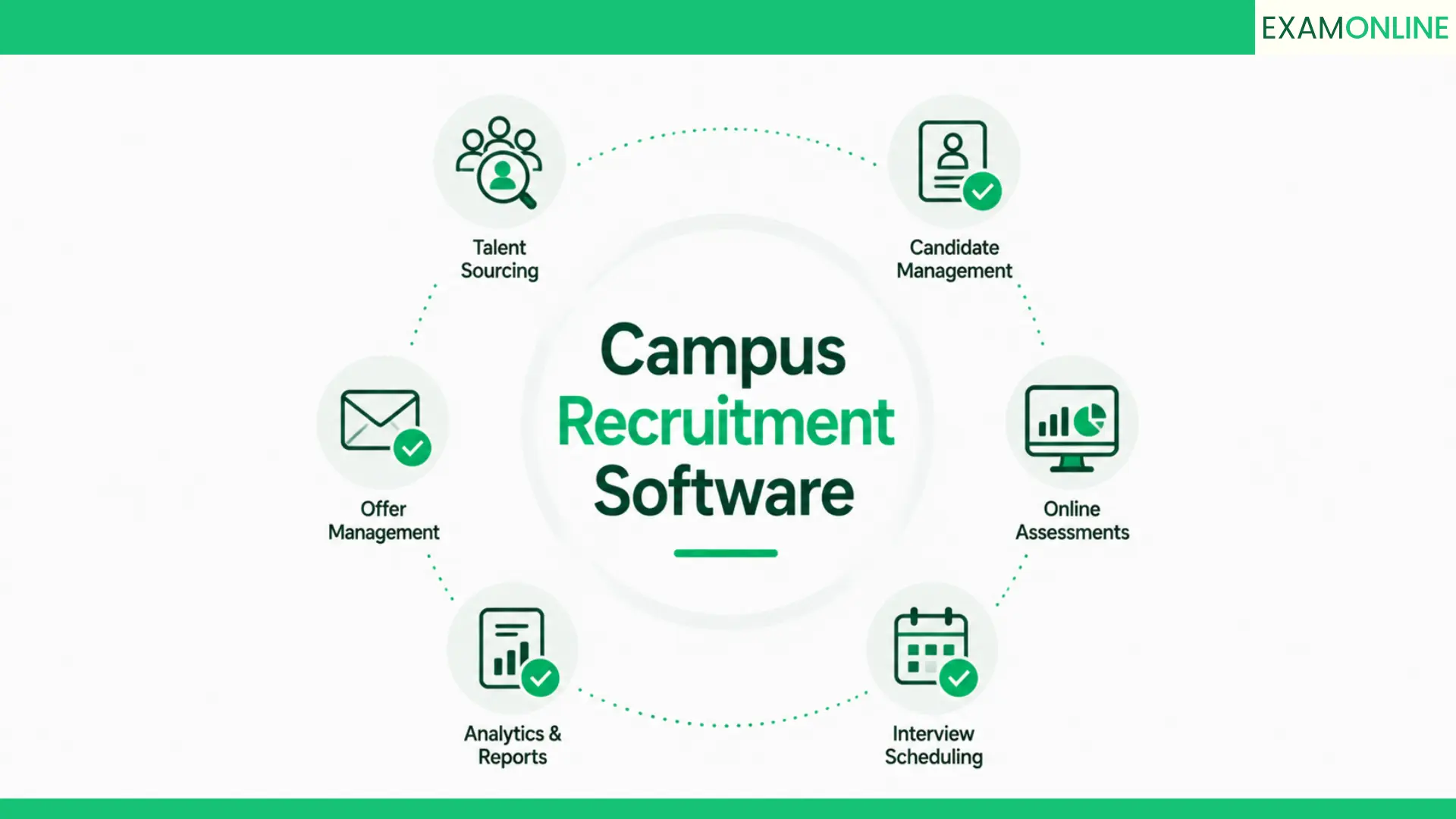
ExamOnline brings together every capability discussed throughout this guide inside a single, purpose built recruitment platform. Businesses running graduate hiring programs across multiple campuses rely on the platform to combine aptitude testing, skill assessment, coding assessment and behavioural assessment within one unified exam software environment.
The platform’s AI powered proctoring maintains exam integrity across remote assessments, while a live recruitment dashboard gives hiring managers instant visibility into candidate rankings and assessment reports. Organisations managing high volume hiring across dozens of institutions particularly value the platform’s ability to scale without sacrificing consistency or security.
Beyond campus hiring specifically, ExamOnline supports the complete certification exam and corporate assessment lifecycle, making it a genuinely versatile choice for organisations that need one trusted vendor across multiple assessment use cases rather than juggling separate tools for each function. Businesses exploring proof of impact can review documented outcomes through ExamOnline’s case studies, and teams comparing plans can check current options on the pricing page.
Companies serving higher education institutions alongside their hiring functions also benefit from ExamOnline’s shared infrastructure across both use cases, reducing the operational complexity of managing separate platforms for academic and recruitment assessments. For organisations ready to see the platform firsthand, booking a personalised walkthrough remains the fastest way to evaluate genuine fit before committing to a full rollout.
Conclusion
Campus recruitment carries genuine weight for every growing business. The graduates hired today become the technical leads, managers and specialists an organisation depends on years down the line, which makes the quality of this hiring process far more important than most companies initially realise.
Campus recruitment software directly addresses the operational strain that modern hiring volumes place on manual hiring processes. From aptitude testing and skill assessment through AI proctoring and recruitment dashboards, a properly chosen recruitment platform brings speed, consistency and genuine evidence into a process that historically ran on manual effort and subjective judgement.
Businesses evaluating their options should treat this decision with the seriousness it deserves. A structured pilot, a clear feature checklist and honest conversations with existing customers reveal far more than any polished sales presentation. The right campus recruitment software pays for itself many times over through faster hiring cycles, stronger candidate quality and a noticeably better experience for every graduate who applies.
Ready to see how a purpose built recruitment platform can transform your next campus hiring season? Book a demo with ExamOnline today and experience campus recruitment software built for genuine scale.
Frequently Asked Questions
What is campus recruitment software used for?
Campus recruitment software helps organisations source, assess and shortlist graduate candidates from universities through online aptitude tests, skill assessments and behavioural evaluations, replacing manual paper based hiring drives. Instead of printing question papers and travelling between institutions, HR teams send digital assessments directly to candidates on their own devices. Every response gets scored automatically the moment a candidate submits the test, giving recruiters ranked results within minutes rather than days. The same platform typically manages scheduling, reminders and communication with candidates too, cutting down on the manual coordination that used to eat up an entire hiring season. Larger organisations use this same recruitment technology to run consistent, standardised drives across dozens of campuses at once, something a purely manual process genuinely struggles to achieve. Over time, the platform also becomes a repository of historical hiring data that HR teams reference when planning future graduate intake.
How does campus recruitment software prevent cheating during remote tests?
Most platforms include AI proctoring features such as facial recognition, browser lockdown and behaviour monitoring that detect suspicious activity during remote assessments and flag it for reviewer attention. The system tracks a candidate’s face throughout the session, raising an alert the moment a second person enters the frame or the candidate looks away from the screen for an unusual length of time. Browser lockdown restricts candidates from switching tabs, opening new windows or accessing outside resources while the assessment runs. Many platforms record audio as well, picking up background conversations that might indicate outside assistance during the test. Video proctoring adds a further layer of assurance, since hiring teams can review a recorded session after the exam if a result ever gets questioned. Together, these layers give recruiters genuine confidence that a candidate’s score reflects their own ability rather than an unsupervised shortcut.
Can campus recruitment software handle high volume hiring across multiple campuses?
Yes. Modern recruitment platforms are built specifically to support volume hiring, allowing organisations to test thousands of candidates across different campuses and cities within the same hiring cycle. The underlying infrastructure runs on cloud servers that scale automatically as more candidates log in simultaneously, so performance stays smooth even during peak exam windows. Recruiters can schedule separate assessment slots for different campuses while still pulling every result into one unified recruitment dashboard for comparison. Question banks can rotate automatically between candidates, reducing the chance that answers get shared between different exam slots on the same day. Large enterprises running graduate intake programs across fifty or more institutions rely on exactly this kind of scalability every placement season. Smaller businesses benefit from the same infrastructure too, simply running it at a scale that matches their own hiring needs.
What assessment types should a good campus recruitment software include?
A strong platform should combine aptitude testing, technical or coding assessment, and behavioural assessment together, giving hiring teams a complete view of candidate capability rather than a single narrow measure. Aptitude testing reveals how quickly a candidate reasons through numerical, verbal and logical problems, which matters most for graduates who carry limited work experience. Technical and coding assessment then confirms whether academic knowledge translates into practical, job ready skill for the specific role being filled. Behavioural assessment rounds out the picture by highlighting communication style, adaptability and team fit, dimensions that sit entirely beyond what pure aptitude scores reveal on their own. Weighting each of these three areas differently depending on the role, for example leaning heavier on coding assessment for engineering positions and heavier on behavioural assessment for client facing roles, produces far more accurate shortlists. Platforms that support this kind of flexible weighting give hiring managers a genuine edge over those relying on a single generic test for every position.
Does campus recruitment software integrate with existing HR systems?
Most established recruitment platforms offer integration with applicant tracking systems and existing HR software, allowing shortlisted candidate data to flow directly into the company’s broader hiring workflow. This means recruiters avoid re entering candidate details manually once an assessment concludes, since scores, resumes and contact information sync automatically between systems. Many platforms also support single sign on and API based connections, which simplifies rollout for IT teams managing multiple HR tools at once. Interview panels benefit as well, since assessment reports appear directly alongside a candidate’s profile inside the applicant tracking system rather than sitting in a separate file. This kind of integration keeps the entire hiring pipeline, from initial test through final offer, visible inside one connected system. Businesses evaluating vendors should always confirm exact integration capability before signing a contract, since this single feature often determines how smoothly the platform fits into daily HR operations.
Is campus recruitment software suitable for small businesses as well as large enterprises?
Yes. Platforms like ExamOnline scale from a single campus drive for smaller businesses to large multi campus programs for enterprises, making campus recruitment software a practical choice regardless of hiring volume. A small business hiring twenty graduates from two nearby colleges can run the exact same aptitude testing and behavioural assessment workflow as an enterprise hiring two thousand candidates across fifty institutions. Pricing typically scales with candidate volume, so smaller organisations pay proportionally less while still getting access to the full recruitment platform rather than a stripped down version. This flexibility means growing businesses can start small, prove the value during one hiring season, and expand usage naturally as their graduate intake grows year over year. Enterprises, meanwhile, benefit from the platform’s ability to handle sudden spikes in volume during peak placement season without any drop in performance or reliability. Regardless of company size, the underlying goal stays the same, replacing manual guesswork with structured, evidence backed hiring decisions.


