
Table of Contents
Introduction
Hiring early-career talent has always been a challenge for organizations. Entry-level roles often attract thousands of applicants, making resume screening slow, inconsistent, and resource intensive. Hiring teams spend significant time filtering candidates before meaningful evaluation even begins.
Campus hiring emerged as a structured solution to this problem. Instead of reviewing unrelated applications from large job portals, companies recruit directly from universities and evaluate candidates who share similar academic backgrounds.
This approach allows organizations to compare candidates more fairly and build long-term talent pipelines. Structured assessments, standardized evaluation criteria, and targeted hiring programs make campus recruitment one of the most reliable ways to hire graduates.
Over the past decade, campus recruitment has also evolved. Traditional on-site placement drives are increasingly complemented by digital infrastructure. Many organizations now conduct remote assessments and evaluate candidates from multiple universities simultaneously.
Remote campus hiring has therefore become a scalable strategy for organizations seeking to identify high-potential graduates efficiently and securely.
What Is Campus Hiring and Why Organizations Use It
What Campus Hiring Means
Campus hiring is a recruitment strategy where organizations hire students and recent graduates directly from universities or educational institutions. Companies partner with specific campuses or departments and evaluate candidates during structured recruitment cycles.
This model allows recruiters to assess candidates who have comparable academic preparation. Instead of evaluating unrelated applications, organizations can compare candidates within a defined group of graduates entering the workforce.
Campus hiring programs typically focus on roles such as:
- Graduate trainee programs
- Entry-level engineering roles
- Analyst and consulting positions
- Early-career technical roles
Because candidates come from aligned academic programs, hiring teams can evaluate aptitude, technical capability, and problem-solving ability more effectively.
Why Companies Depend on Campus Hiring
Campus recruitment helps organizations build predictable pipelines of early-career talent. By targeting universities with relevant academic programs, companies can identify candidates who already possess foundational knowledge required for specific roles.
This approach also simplifies candidate filtering. Instead of reviewing thousands of resumes, hiring teams evaluate candidates through structured testing and standardized evaluation frameworks.
Organizations rely on campus hiring because it allows them to:
- Access emerging talent entering the workforce
- Hire candidates with aligned academic training
- Evaluate large candidate groups efficiently
- Build long-term graduate hiring pipelines
- Standardize recruitment for entry-level roles
Many organizations strengthen this model using pre-employment assessments. These tests measure analytical reasoning, technical knowledge, and problem-solving capability before interview stages begin.
How Campus Hiring Has Evolved

Traditional Campus Recruitment
Historically, campus recruitment was conducted entirely on university premises. Organizations would visit campuses during placement seasons and conduct recruitment drives over several days.
Candidates typically progressed through multiple evaluation stages conducted in person. These stages often included:
- Aptitude tests conducted in exam halls
- Group discussions to evaluate communication ability
- Written ability tests to assess articulation
- Technical interviews with subject experts
- HR interviews for final selection
This approach allowed recruiters to meet candidates directly but required extensive coordination between companies and universities.
Why Traditional Campus Hiring Reached Its Limits
As organizations expanded hiring programs across universities, traditional campus drives began facing operational constraints.
Recruiters had to coordinate travel, schedule recruitment events with multiple institutions, and manage physical exam infrastructure. Conducting hiring campaigns across many campuses became difficult to scale.
Traditional campus hiring started facing challenges such as:
- Travel and coordination across multiple universities
- Limited access to candidates outside target campuses
- Inconsistent evaluation across locations
- Difficulty handling large candidate volumes simultaneously
These limitations encouraged organizations to adopt digital hiring models capable of supporting large-scale recruitment programs.
The Introduction of Assessment-Based Hiring
As campus hiring expanded, organizations began introducing structured assessments to improve evaluation consistency. Written tests gradually evolved into computer-based assessments capable of measuring multiple skill dimensions.
Assessment-driven hiring allowed companies to evaluate:
- Logical and analytical reasoning
- Technical knowledge relevant to the role
- Problem-solving approaches
- Communication and comprehension ability
These assessments produced measurable data that helped recruiters compare candidates objectively rather than relying solely on interview impressions.
To support large recruitment campaigns, many organizations adopted hiring assessment platforms that enable centralized testing, scoring, and candidate analytics.
What Is Remote Campus Hiring
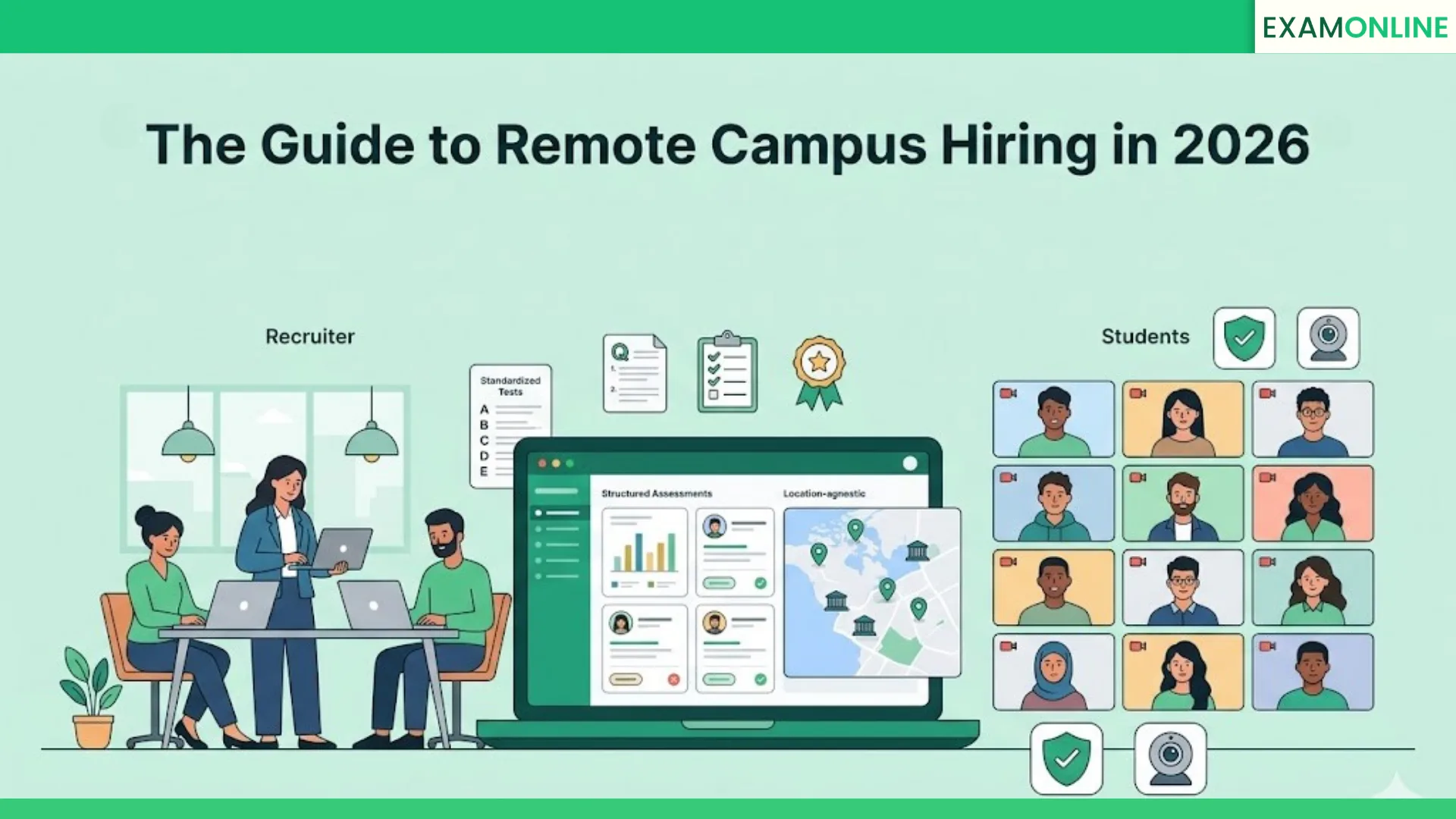
Remote campus hiring is a recruitment model where organizations evaluate university candidates through online assessments rather than conducting all recruitment activities on campus.
Instead of visiting individual institutions, recruiters can invite candidates from multiple universities to participate in the same hiring process. This allows organizations to evaluate a much broader pool of candidates while maintaining consistent evaluation standards.
Candidates typically complete online assessments that measure aptitude, technical knowledge, and analytical ability. Recruiters then shortlist candidates based on structured performance data.
Remote campus hiring allows organizations to:
- Evaluate candidates from multiple universities simultaneously
- Conduct large-scale graduate hiring programs efficiently
- Maintain consistent testing environments across campuses
- Reduce logistical complexity associated with physical recruitment drives
As digital hiring infrastructure improves, remote campus hiring is becoming a standard approach for organizations conducting large graduate recruitment campaigns.
Campus Hiring vs Traditional Hiring
Organizations often compare campus recruitment with traditional hiring when designing entry-level talent acquisition strategies.
Traditional hiring usually begins with resume screening, where recruiters review applications submitted through job portals or career websites. Candidates then progress through interviews and sometimes additional assessments.
Campus hiring follows a more structured evaluation process. Organizations target specific academic programs and assess candidates through standardized tests before interviews begin.
| Factor | Traditional Hiring | Campus Hiring |
| Candidate discovery | Open applications from varied backgrounds | Students from specific academic programs |
| Initial filtering | Resume screening | Structured assessments |
| Evaluation consistency | Often varies across candidates | Standardized evaluation |
| Hiring scale | Limited per cycle | Large candidate groups |
Because campus hiring focuses on defined academic cohorts, recruiters can evaluate candidates using comparable benchmarks. Structured assessments also help identify high-potential graduates earlier in the hiring process.
Benefits of Remote Campus Hiring for Organizations

Remote infrastructure has significantly expanded the reach of campus recruitment programs. Organizations no longer need to conduct recruitment drives campus by campus.
Instead, companies can evaluate candidates from multiple universities through centralized online assessments.
Remote campus hiring provides several advantages:
- Access to candidates from multiple universities in one hiring cycle
- Ability to run large recruitment campaigns simultaneously
- Consistent evaluation standards across all candidates
- Reduced travel and operational costs
- Faster hiring cycles for graduate roles
Remote hiring also enables global graduate recruitment programs. Companies can invite candidates from different universities and regions to participate in the same evaluation process.
How Remote Campus Hiring Works
Remote campus recruitment follows a structured evaluation workflow designed to filter large candidate pools efficiently.
The process usually begins with campus partnerships or candidate invitations. Universities inform eligible students about recruitment programs, and candidates register for the hiring process.
After registration, candidates proceed to the assessment stage. Online assessments evaluate aptitude, technical knowledge, and analytical reasoning.
The typical remote campus hiring workflow includes:
- Candidate registration through campus placement programs
- Online assessments evaluating aptitude and technical skills
- Shortlisting based on performance analytics
- Interviews with selected candidates
- Final hiring decisions and offer releases
Many organizations rely on pre-employment assessments during this stage to measure problem-solving ability and role-specific skills before interview rounds.
Types of Assessments Used in Campus Hiring
Different assessment types measure different dimensions of candidate capability. Effective campus recruitment programs combine multiple evaluation categories to identify high-potential candidates.
Aptitude Assessments
Aptitude tests measure analytical reasoning, numerical ability, and logical thinking. These capabilities strongly correlate with job performance in many entry-level roles.
Aptitude assessments allow organizations to compare candidates across universities and academic backgrounds.
Technical Skill Assessments
Technical assessments evaluate role-specific knowledge required for particular positions. For example, engineering roles may involve coding assessments, while finance roles may require quantitative problem solving.
These assessments help recruiters verify whether candidates can apply academic knowledge in practical scenarios.
Psychometric Evaluations
Psychometric assessments measure behavioural traits such as work style, adaptability, and collaboration tendencies. These insights help recruiters understand how candidates may perform within team environments.
Technology Infrastructure Behind Remote Campus Hiring

Remote campus hiring relies on digital infrastructure capable of supporting large-scale candidate evaluation.
Modern hiring platforms combine several capabilities within a single system:
- Online assessment delivery
- Candidate identity verification
- Secure testing environments
- Monitoring and proctoring tools
- Performance analytics dashboards
This technology allows recruiters to conduct recruitment campaigns across multiple institutions while maintaining consistent evaluation standards.
Using Data and Reports to Improve Campus Hiring Decisions
One major advantage of remote campus hiring is access to structured performance data. Instead of relying only on interview feedback, recruiters can evaluate candidates using assessment analytics.
Assessment platforms generate reports that provide insights into candidate performance across multiple dimensions.
Common insights include:
- Score distribution across candidate groups
- Performance benchmarking between universities
- Skill-level comparisons across applicants
- Identification of top-performing candidates
These insights allow organizations to identify strong candidates earlier in the hiring process while maintaining transparent evaluation standards.
Risks in Remote Campus Hiring
While remote campus hiring improves scalability, it also introduces operational risks that organizations must manage carefully.
Because assessments are conducted outside controlled environments, maintaining evaluation integrity becomes critical.
Common risks include:
- Cheating during online assessments
- Candidate impersonation during testing
- Unauthorized use of external resources
- Inconsistent testing environments across candidates
These challenges require organizations to implement monitoring and verification mechanisms to ensure fair evaluation.
Protecting Remote Campus Hiring with Proctored Exams
Proctored exams help organizations maintain assessment integrity during remote campus hiring.
These systems monitor candidate activity during tests and verify identity before the assessment begins. By recording test sessions and detecting suspicious behavior, proctoring technologies ensure that all candidates are evaluated fairly.
A typical proctored assessment environment may include:
- Identity verification before test access
- Monitoring of candidate activity during assessments
- Detection of unusual or suspicious behavior
- Recorded audit trails for review
Organizations increasingly rely on remote proctored exams to maintain trust in large-scale remote hiring programs.
Future of Remote Campus Hiring
Remote campus hiring continues to evolve as organizations adopt more advanced digital recruitment infrastructure.
Several trends are shaping the future of graduate recruitment:
- Global graduate hiring programs across universities
- Advanced hiring analytics for candidate benchmarking
- AI-assisted candidate evaluation
- Secure remote proctoring technologies
Technologies supporting remote proctoring in hiring at scale allow organizations to conduct large recruitment campaigns while maintaining exam integrity.
As digital infrastructure continues to improve, remote campus hiring is expected to remain a core strategy for organizations hiring early-career professionals.
Best Practices for Effective Remote Campus Hiring

Organizations can improve campus recruitment outcomes by designing structured evaluation strategies.
Successful remote campus hiring programs typically include:
- Clearly defined skill criteria before assessments begin
- Standardized evaluation frameworks across candidates
- Multiple assessment types for balanced evaluation
- Secure testing environments during online exams
- Data-driven candidate shortlisting
These practices help organizations conduct recruitment campaigns that remain scalable, consistent, and defensible.
How ExamOnline Supports Remote Campus Hiring
Remote campus hiring programs require infrastructure capable of delivering secure assessments at scale.
ExamOnline provides an end-to-end platform designed to support large recruitment and certification programs. The platform is used in 25+ countries by 250+ organisations, enabling institutions and enterprises to conduct secure digital assessments across geographies.
The system supports the complete evaluation workflow, including candidate registration, slot booking, multiple attempts, payment gateway integration, identity verification, and automated certificate generation and distribution.
Organizations conducting graduate hiring programs can integrate these capabilities through corporate hiring solutions, enabling secure remote assessments while maintaining consistent evaluation standards across universities.
For organizations hiring early-career talent at scale, reliable assessment infrastructure becomes a critical component of effective recruitment programs.

Frequently Asked Questions (FAQ)
What is remote campus hiring?
Remote campus hiring is a recruitment approach where organizations evaluate university students and graduates using online assessments rather than conducting all recruitment activities on campus.
How do companies conduct remote campus assessments?
Companies invite candidates from partner universities to participate in online assessments that evaluate aptitude, technical knowledge, and problem-solving ability before interview stages.
What types of tests are used in campus hiring?
Campus recruitment programs typically include aptitude assessments, technical skill evaluations, and psychometric tests.
How do organizations prevent cheating in remote campus tests?
Organizations use proctoring systems that verify candidate identity, monitor testing behavior, and detect suspicious activity during online assessments.
What are the advantages of remote campus recruitment?
Remote campus hiring allows organizations to evaluate candidates from multiple universities simultaneously, conduct large recruitment campaigns efficiently, and maintain consistent evaluation standards.


