
Table of Contents
It is 9:03 AM. The exam was scheduled to begin at 9:00. Across fourteen exam centres and three thousand remote candidates, seventy-eight sessions have failed to launch. The login portal is returning an error for a subset of candidates. The support phone line has been active for four minutes and already carries forty candidates in queue. The question paper delivery system is responding correctly on the server side. The candidate-facing interface is returning a blank screen. This is what online exam delivery failure looks like from the inside, and it happens with far more frequency than any platform vendor acknowledges in their sales presentation.
Online exam delivery is the stage of the assessment lifecycle that candidates experience directly and that administrators carry full accountability for. Every technical decision made in the weeks before exam day either strengthens or weakens the delivery experience. Secure browser configuration, concurrent user load capacity, question paper encryption, candidate session continuity, and real-time monitoring all operate invisibly when they work correctly and catastrophically when they fail. The difference between an exam that runs smoothly and one that becomes a recovery operation is almost always an online exam delivery infrastructure decision made before the candidate ever pressed the login button.
This is Post 2 of the ExamOnline five-part series on the online exam lifecycle. It covers every element of online exam delivery from the moment a candidate uses their admit card to log in through to the moment they submit their answers and the session closes securely. The online exam registration stage that produced the admit card is covered in Post 1. The proctoring layer that runs alongside delivery is covered in Post 3. Read the complete series overview in the online exam lifecycle guide before continuing.
➤ Arriving here first? Start with Post 1 for the registration context. Online Exam Registration: From Sign-Up to Admit Card

When the Exam Crashes on the Day That Matters Most
The nightmare scenario for every exam administrator is an exam day technical failure. The pressure of a high-stakes assessment, thousands of candidates prepared and logged in, a question paper ready to deploy, and then a load spike that the delivery server fails to handle, a secure browser that conflicts with an operating system update deployed two days earlier, or a network timeout that disconnects three hundred remote candidates mid-session simultaneously. The exam does not pause because the technology failed. The exam stops, the candidates wait, the phones ring, and the administrator manages a crisis that was entirely preventable.
Online exam delivery failures are rarely caused by a single catastrophic event. They are almost always the result of a chain of smaller decisions: insufficient load testing before the exam window opened, a secure browser version that was communicated to candidates but never verified across their actual device mix, a question paper distribution protocol that added latency under peak load, or a session management system that had never been stress-tested against simultaneous disconnection and reconnection by hundreds of candidates. Each decision deferred in preparation becomes a failure point on exam day. Computer based testing research consistently shows that delivery infrastructure quality is the primary driver of candidate confidence in digital assessment programmes.
The administrators who have lived through an exam day delivery failure describe a consistent experience: the moment when the scale of the problem becomes clear, the rapid realisation that recovery options are limited, and the days of candidate communication, grievance management, and result dispute that follow. An exam that fails to deliver is far more damaging to institutional reputation than an exam that was simply difficult. Candidates who could not access the exam carry a different kind of frustration than candidates who found the questions challenging. That frustration is directed at the platform, the institution, and the administrators responsible for the delivery decision.
The goal of this post is to give exam administrators, IT teams, and assessment platform evaluators the framework to design an online exam delivery stage that handles real-world pressure reliably. Every section maps to a specific delivery decision that determines exam day performance. Explore ExamOnline’s online examination solution to see how the platform is built to handle delivery at scale before working through the detail of what that build requires.

What Online Exam Delivery Actually Involves
Most discussions of online exam delivery focus on the moment the candidate sees the first question. That moment is the result of a delivery architecture that has been operating successfully for the preceding sixty seconds: login authentication, session initialization, secure browser lockdown, question paper decryption, timer synchronization, and interface rendering. Online exam delivery is the complete technical and operational infrastructure that transforms a validated, scheduled candidate into an active test-taker with a secure, functioning exam session on their device.
The scope of online exam delivery is broader than most platform evaluations acknowledge. It begins with the exam portal login experience: how quickly the candidate moves from their admit card credentials to an active session, how gracefully the system handles authentication failures, and how the login queue manages peak demand when thousands of candidates attempt to access the system within a short window at the start of a shift. These first sixty seconds of the online exam delivery experience set the tone for the candidate’s entire assessment, and they are the sixty seconds most likely to generate support calls when the system is under-configured for the actual load.
Beyond login, online exam delivery covers secure question paper distribution, where the paper must be decrypted and rendered on the candidate device in a way that prevents extraction outside the secure browser environment. It covers session continuity, where a network disruption during the exam must be handled gracefully so the candidate resumes without loss of answers or time. It covers time management, where the countdown timer must remain synchronised to the server clock rather than the candidate device clock, across every candidate in every time zone running simultaneously in the same delivery window.

The Complete Scope of Online Exam Delivery
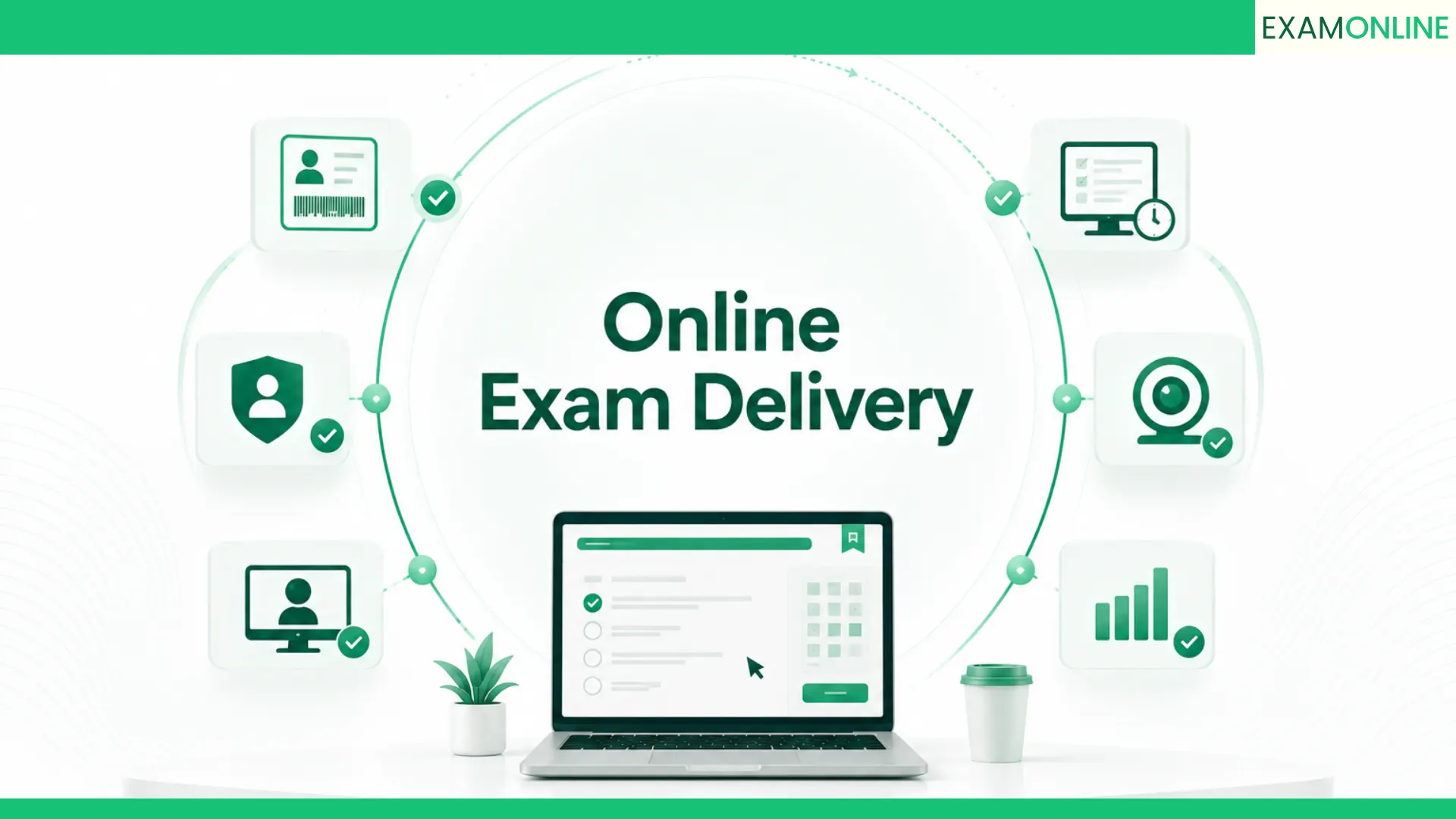
Here is the full sequence of technical events that make up a well-managed online exam delivery session:
- Exam portal login with candidate authentication against the registration database using admit card credentials
- Secure browser launch and environment lockdown across the full candidate device before paper access is granted
- Session initialisation with server-side timer synchronisation and paper variant assignment to the candidate
- Encrypted question paper decryption and rendering within the locked secure browser environment
- Real-time candidate session monitoring with connection status tracking and activity logging throughout
- Anti-copy and anti-screenshot protection enforced across the full exam interface during the active session
- Graceful session recovery for candidates who experience network interruption at any point mid-exam
- Server-synchronised countdown timer running independently of the candidate device clock for accuracy
- Answer auto-save at configurable intervals to the server to prevent any data loss on session disruption
- Secure submission processing with answer encryption, session closure confirmation, and submission reference dispatch
Each of these ten elements requires a technical decision, a configuration choice, and a testing protocol before the exam window opens. The organisations that run online exam delivery reliably treat each element as a distinct operational requirement rather than an assumed platform feature. Explore the online examination solution to see how each element operates within ExamOnline’s connected delivery infrastructure.

Why Exam Day Infrastructure Fails Under Pressure
Infrastructure failure during online exam delivery almost always traces back to a gap between the conditions under which the system was tested and the conditions under which it was deployed. Load testing that simulated five hundred concurrent users does not prepare a system for five thousand. A secure browser configuration that passed quality assurance on the exam team’s devices does not account for the candidate population’s full device diversity. A network bandwidth estimate based on average usage patterns does not account for the spike that occurs when every candidate in a shift attempts to log in simultaneously within the first three minutes of the window opening.
Server capacity is the most visible failure mode but rarely the only one. Question paper delivery latency under peak load is a less obvious failure that manifests as a blank screen after a successful login rather than a failed login event. The candidate sees a loading screen. They wait. They refresh the page. The refresh creates a new session request that adds to the existing load. Other candidates do the same. The problem compounds rapidly. What began as a question paper latency issue becomes a session management crisis within four minutes of the exam shift opening, affecting far more candidates than the original technical trigger.
Device and browser compatibility is the failure mode that affects individual candidates rather than entire cohorts, making it harder to detect in aggregate monitoring but equally damaging to the affected candidates. A candidate whose secure browser conflicts with their operating system version finds the exam environment inaccessible through any user action available to them. They call support. Support teams are unable to resolve a browser conflict in real time during an active exam window. The candidate is disadvantaged through a technical failure that the platform team could have identified through a pre-exam compatibility check dispatched as part of the online exam delivery preparation sequence.
The infrastructure decisions that prevent these failures are well understood and well documented. Horizontal scaling with automatic load balancing handles concurrent user spikes without performance degradation. CDN-distributed question paper delivery eliminates latency caused by geographic distance between the candidate and the origin server. Pre-exam system readiness checks dispatched to every candidate seven days before the exam identify device and browser compatibility issues while resolution is still possible. CERT-In cybersecurity guidelines for digital platforms in India provide the security baseline that exam delivery infrastructure should be tested against, particularly for assessments handling sensitive candidate data and high-stakes credentials.
Common Infrastructure Failure Points in Online Exam Delivery
Here are the failure points that exam delivery infrastructure must be designed and tested against before the exam window opens:
- Server capacity under concurrent login spikes at the start of high-volume exam shifts with large candidate cohorts
- Question paper decryption and rendering latency under peak load across geographically distributed candidate populations
- Secure browser compatibility conflicts with operating system updates deployed close to exam day across diverse candidate devices
- Network bandwidth saturation at centre-based testing locations running multiple simultaneous delivery sessions
- Session timeout handling that terminates active sessions rather than queuing reconnection attempts for disrupted candidates
- Timer desynchronisation between server and device clocks in cross-time-zone online exam delivery scenarios
- Answer auto-save failures that result in candidate data loss when sessions experience unexpected network interruption
- Admin monitoring dashboard performance degradation when tracking thousands of simultaneous active delivery sessions
Each of these failure points has a known technical solution and a known testing protocol. The platform that handles online exam delivery reliably has tested against each one under conditions that replicate the real exam environment. Explore ExamOnline’s approach to secure online exams for the infrastructure decisions the platform has made to address each of these failure modes systematically.

The Secure Browser That Makes or Breaks the Exam
The secure browser is the single most operationally significant component of online exam delivery. It is the layer that transforms a standard web browser on a candidate’s personal device into a locked examination environment: preventing access to other applications, blocking screenshot and screen recording tools, locking the clipboard from copy-paste operations, restricting web searches, and closing communication channels that could be used to share questions or receive answers during an active session. When the secure browser works correctly, the candidate’s device becomes a dedicated examination terminal for the duration of the assessment. When it fails to launch or lock correctly, the entire integrity of the online exam delivery is in question.
Secure browser deployment at scale creates a category of problems that exam administrators consistently underestimate on first encounter. Every candidate device in a large exam population represents a unique combination of operating system version, hardware configuration, security software, and installed applications. A secure browser that locks correctly on Windows 11 with standard configuration may behave differently on Windows 10 with an active enterprise endpoint protection suite. A secure browser that functions correctly on MacOS 14 may produce a blank screen on MacOS 12. These compatibility variations are impossible to prevent across a large candidate population and entirely manageable through pre-exam device testing protocols dispatched well before exam day.
The pre-exam system check is the online exam delivery tool that identifies and resolves secure browser compatibility issues before they become exam day problems. Dispatched to candidates seven to ten days before the exam, the system check guides the candidate through launching the secure browser in test mode, verifying that the lockdown functions activate correctly on their specific device, confirming audio and video device functionality for proctored sessions, and testing connection speed against the platform’s minimum delivery requirements. Issues identified at this stage can almost always be resolved before exam day through a device change, browser version update, or security software configuration adjustment, all of which are feasible before the exam opens.
Secure browser architecture also determines how the online exam delivery system handles a candidate who closes the browser accidentally or whose device restarts unexpectedly mid-session. A well-designed secure browser environment maintains the session server-side, saves answers at configured intervals, and allows the candidate to re-enter their session through the exam portal login using their admit card credentials, resuming from the point of interruption with the remaining time intact on the server-side clock. A poorly designed environment treats the browser closure as a session termination, presenting the candidate with either a locked session or a blank paper on reconnection. This single architectural decision affects every candidate in every exam, and it is made long before the delivery window opens.
Secure Browser Checklist for Exam Delivery Teams
- Verify that the secure browser version deployed is compatible with the full range of operating systems in your candidate population
- Test secure browser lockdown on devices running active enterprise endpoint protection and security software
- Confirm that the secure browser handles dual-monitor configurations correctly for candidates using multiple displays
- Dispatch a pre-exam system check to all candidates at least seven days before the exam delivery window opens
- Test the session recovery workflow under simulated network interruption before the live exam window opens
- Confirm that answer auto-save is active and saving to the server rather than to local browser storage
- Verify that the secure browser blocks screenshot, screen recording, and screen-sharing applications on all tested device configurations
- Test secure browser performance on minimum-specification devices to confirm acceptable rendering speed for all candidate cohorts
Scaling Concurrent Users Without a Single Dropout
The concurrent user challenge in online exam delivery is distinct from the concurrent user challenge in almost any other digital product context. When a streaming service experiences a traffic spike, some users buffer for a few seconds. When an e-commerce platform experiences a spike, some users wait on a checkout page. When an online exam delivery platform experiences a traffic spike at shift opening, some candidates are unable to access their exam. The stakes of performance degradation in exam delivery are categorically different from the stakes in other software contexts, and the infrastructure decisions must reflect that difference completely.
High-volume online exam delivery creates predictable, foreseeable load patterns that are nonetheless routinely under-planned for. A national-level entrance exam with fifty thousand candidates distributed across morning and afternoon shifts creates two distinct peak load events per day, each lasting approximately fifteen minutes at maximum intensity as the shift opens and the full candidate cohort attempts simultaneous login. The platform infrastructure must be sized for the maximum load at the moment of peak concurrent demand, which is always higher than intuition suggests and always shorter than the overall exam window would imply.
Auto-scaling cloud infrastructure is the architectural decision that handles this challenge correctly and cost-effectively. When candidate login rates spike at shift opening, the platform automatically provisions additional compute capacity in response to the load increase, distributing session requests across expanded server resources before performance is affected. When the shift settles into steady-state exam activity, the provisioned capacity scales back. The entire scaling event happens automatically, is invisible to candidates, and costs a fraction of maintaining permanently provisioned infrastructure sized for peak load across the full exam calendar.
India’s NITI Aayog digital infrastructure framework emphasises auto-scaling cloud architecture as the foundational requirement for any government or institutional digital service operating at national scale, a requirement that applies directly to online exam delivery platforms serving large candidate populations across multiple concurrent assessment sessions.
Infrastructure Approaches for High-Volume Exam Delivery
| Infrastructure Approach | Performance Under Peak Load | Cost Profile | Failure Recovery |
|---|---|---|---|
| Fixed server provisioning | Degrades under load spikes above rated capacity | High fixed cost regardless of exam calendar | Manual intervention required during active exam |
| Manual scaling with advance notice | Handles predicted peaks when notice window is sufficient | Medium cost with planning overhead per exam | Partial recovery possible with advance preparation |
| Auto-scaling cloud infrastructure | Handles both predicted and unpredicted spikes automatically | Cost scales with actual concurrent usage | Automatic failover with minimal candidate disruption |
| CDN-distributed question delivery | Handles geographic load distribution for dispersed candidates | Optimised cost for distributed populations | Regional failover with no single geographic point of failure |
The organisations running online exam delivery for the largest candidate populations have all converged on the same infrastructure conclusion: auto-scaling cloud architecture with CDN-distributed content delivery is the approach that handles the load patterns of high-stakes examination reliably. Explore how ExamOnline manages centre-based testing and remote examination delivery within the same auto-scaling infrastructure for organisations running hybrid delivery models across dispersed candidate populations.
How Question Paper Delivery Protects Exam Integrity
Question paper security in online exam delivery is a multi-layer problem that begins before the exam and extends through the candidate’s active session. The paper must be stored in encrypted form until the moment of delivery to the authenticated session. It must be transmitted to the candidate device in a way that prevents interception in transit. It must be rendered within the secure browser in a way that prevents extraction from the display. And it must be structured through item randomisation and question bank variation so that even if a candidate records a question, the paper seen by the next candidate in the same cohort is different enough to limit the value of that sharing.
End-to-end question paper encryption is the foundation of secure online exam delivery. The paper is encrypted at rest in the platform’s content management system, decrypted only at the point of delivery to the candidate’s authenticated and verified session, and rendered within the secure browser environment using methods that bypass the operating system’s screenshot and clipboard APIs. The candidate sees the question on their screen. The copy, screenshot, and transmission functions available on their device are all locked within the secure browser environment. ISO 27001 information security standards provide the framework that enterprise-grade exam delivery platforms use to structure their encryption, access control, and audit logging requirements for question paper security.
Question randomisation in online exam delivery serves two complementary purposes: fairness across candidates and security across the candidate population. When each candidate receives a randomly ordered subset of questions from a larger item bank, the exam is both fair and secure simultaneously. Fair because question ordering effects are eliminated across the candidate population. Secure because the specific paper seen by any one candidate has limited value to any other candidate in the same sitting. Combined with time-limited section navigation, where candidates advance through sections sequentially within fixed time windows, question randomisation makes paper sharing during an active delivery session effectively pointless.
The question paper delivery architecture also determines how the system handles the scenario where a candidate’s session is interrupted mid-exam. A server-side answer storage model, where answers are saved to the server at configurable intervals rather than stored locally in the browser session, means that a candidate who reconnects after a network interruption finds their previously submitted answers intact and their remaining time preserved accurately. This model protects both the candidate from unfair loss of progress and the institution from the grievance, re-examination cost, and result dispute that would follow a session loss event in a high-stakes assessment.
Candidate Session Management: Login to Submission
The candidate’s experience of online exam delivery is the sum of every session management decision the platform makes invisibly on their behalf. From the moment they enter their exam portal login credentials from the admit card they received at the end of the registration stage, to the moment they click submit and receive confirmation that their answers have been securely recorded, every technical event that occurs is either handled gracefully by the platform or becomes a problem the candidate must navigate themselves under exam pressure. Session management is the operational backbone of the online exam delivery experience.
Login is the highest-risk moment in online exam delivery from a candidate experience perspective. It is the moment of maximum concurrent load, maximum candidate anxiety, and minimum tolerance for friction. A login process that adds three minutes to a candidate’s entry time because of authentication queue delays is a login process that compresses the candidate’s available exam time. The candidate arrives at their first question already stressed, already behind their mental plan, and already less favourably disposed toward the platform than they were when they sat down. Login must be fast, forgiving of minor credential inconsistencies, and transparent about queue position when demand is high.
Session continuity management is the delivery capability that most directly determines candidate trust in the platform over the lifecycle of the exam. When a candidate experiences a network disruption mid-exam, the platform’s response defines whether the disruption becomes a minor inconvenience or a significant grievance. A platform that holds the session open server-side, stores answers at thirty-second intervals, and allows the candidate to re-enter seamlessly through the exam portal login creates a candidate who is momentarily stressed and then relieved. A platform that closes the session on disconnection creates a candidate who is genuinely and justifiably frustrated, and who will communicate that frustration to every person they know who is considering the same examination.
Session Management Events in Online Exam Delivery
Here are the key session management events that a well-configured online exam delivery platform handles automatically throughout the candidate’s active assessment window:
- Candidate login authentication against the registration database using admit card credentials with tolerance for minor formatting variations
- Secure browser launch confirmation and environment lockdown verification before the question paper is served to the active session
- Session initialisation with server-side timer start synchronised to the server clock rather than the candidate device time
- Question paper decryption and rendering within the locked secure browser with all extraction methods disabled
- Real-time answer auto-save to the server at administrator-configured intervals throughout the active exam session
- Network disruption detection with session hold and automatic reconnection attempt management for interrupted candidates
- Candidate reconnection handling that restores the complete session state with all answers and remaining time intact
- Tab switch and focus loss detection with configurable alert dispatch and activity logging for proctoring review
- Final submission processing with server-side answer lock, encryption, and session closure confirmation to the candidate
- Post-submission confirmation screen with a unique submission reference number for the candidate’s records
The session management architecture of an online exam delivery platform is what exam administrators experience through the quality of their exam day and what candidates experience through the reliability of their assessment session. Explore how online proctored exams work for the monitoring layer that operates alongside session management throughout the active delivery window, and read Post 3 of this series for a complete breakdown of the proctoring layer.
➤ Ready to explore the proctoring layer that runs alongside delivery? Post 3: Online Exam Proctoring: From Live Test to Verified Score
The Scheduling Engine Behind Smooth Exam Delivery
Online exam delivery at scale requires a scheduling engine that manages the relationship between registered candidates, assigned exam centres or remote sessions, available delivery shifts, question paper variants, and proctoring configurations. This is the layer that transforms the validated registration dataset from Post 1 into an operational exam day plan: which candidate sits in which session, with which paper variant, monitored by which proctoring approach, at which location or through which remote access link. The scheduling engine is the operational bridge between the registration stage and the live online exam delivery stage.
Shift management is the core scheduling challenge in high-volume online exam delivery for security reasons that go beyond simple logistics. A paper that remains active across a six-hour delivery window spanning multiple time zones creates an extended period during which questions from completed sessions can reach candidates in active ones. Shorter shifts with larger candidate cohorts per session, or rolling shifts with question bank variation between delivery windows, are the scheduling strategies that maintain paper security across large populations without sacrificing delivery efficiency.
The scheduling engine must also manage the downstream dependencies of online exam delivery that extend beyond the candidate allocation itself. Invigilator availability at centre-based testing locations, proctoring agent capacity for live-proctored remote sessions, technical support staffing aligned to shift start and close times, and IT team deployment plans across active exam centres all feed into the delivery schedule. An exam management system with an integrated scheduling engine manages all of these dependencies from a single configuration interface rather than requiring the exam team to coordinate them through separate tools and manual communication.
The output of the scheduling engine is what the candidate receives in the form of their exam slot confirmation and online admit card. The accuracy of that output determines whether the candidate arrives at the right location at the right time with the correct paper assignment for their delivery session. Explore how the exam registration and scheduling stage covered in Post 1 connects directly to the delivery scheduling managed at this stage, and read the guide to scaling certification programmes for a practical example of how this scheduling-to-delivery handoff operates in a high-volume credentialing context.
Scheduling Decisions That Directly Affect Online Exam Delivery Quality
- Shift duration and paper security window configured to limit the exposure window of any question bank variant across the full delivery schedule
- Question paper variant assignment managed at the scheduling engine level so each shift receives a distinct randomised variant from the bank
- Centre capacity enforcement verified at scheduling rather than at exam day check-in to prevent overbooking that creates delivery disruption
- Proctoring configuration assignment matched to each candidate’s shift at scheduling time so the proctoring layer activates correctly on delivery
- Remote access link generation triggered by the scheduling engine for remote candidates at the point of slot confirmation rather than on exam day
- Support staffing alignment configured to shift start and close times so technical support coverage matches peak demand during online exam delivery

What Exam Administrators Need on Delivery Day
Exam administrators on delivery day need two things above all others: visibility and control. Visibility means the ability to see what is happening across every active exam session in real time: how many candidates are logged in, how many sessions are active, how many have experienced a disruption event, and how many have submitted successfully. Control means the ability to act on what is seen: extending time for a session affected by a documented platform event, flagging a suspicious session for proctoring escalation, or communicating directly with an exam centre experiencing a local technical issue, all from the same interface showing live online exam delivery status.
The administrator dashboard in an online exam delivery platform is the operational nerve centre of exam day. A well-designed dashboard shows session counts by centre and by shift, real-time connection status across active candidates, exception flags raised by the proctoring layer, support queue volume segmented by issue type, and paper delivery status across all active sessions simultaneously. It gives the exam administrator a live operational picture that allows them to identify emerging problems and respond before they escalate, rather than discovering them through a surge in candidate support calls that arrives after the situation has already compounded.
Incident response capability on exam day is the administrative function that determines how well the organisation recovers from unexpected events during online exam delivery. A candidate whose session is disrupted by a documented platform event needs fast, clear communication about what happened and what their options are. An exam centre experiencing a local network failure needs a rapid decision from the administrator about time extension, cohort rescheduling, or authority escalation. These decisions must be made quickly, with accurate real-time information, through management tools already integrated into the online exam delivery platform rather than assembled from separate communications channels. Web accessibility standards from the W3C also apply to the administrator dashboard itself, ensuring that the tools available on delivery day are usable by all members of the exam administration team under the pressure of a live assessment.
Exam Delivery Day: Do’s and Don’ts for Administrators
| Do This | Avoid This |
|---|---|
| Run a full platform load test at least two weeks before the exam window opens | Rely on the vendor’s stated capacity figures without independent load testing |
| Dispatch a pre-exam system readiness check to all candidates seven days before delivery | Send the readiness check within 48 hours of the exam when resolution time is limited |
| Monitor the administrator dashboard from 30 minutes before the first shift opens | Begin monitoring only after the first candidate support call arrives at the helpdesk |
| Establish an escalation protocol with the platform vendor before exam day | Attempt to reach vendor support for the first time during an active exam incident |
| Configure session auto-save at 30-second intervals before the exam window opens | Use default auto-save settings that may be configured for demonstration rather than production |
| Assign a dedicated technical point of contact at each exam centre before the shift | Rely on centre invigilators to diagnose and report technical issues without prior briefing |
| Test the candidate reconnection workflow under simulated network disruption in advance | Assume that reconnection will work correctly in production because it worked in controlled testing |
The administrators who run the smoothest exam days are the ones who treat online exam delivery preparation as seriously as exam content preparation. Every decision made in the two weeks before the exam determines the range of options available during it. Explore ExamOnline’s online examination solution for the administrative controls available to exam teams running delivery at scale across centre-based, remote, and hybrid assessment environments.

How ExamOnline Delivers Exams at Any Scale
ExamOnline was designed for the delivery challenges that come with running assessments at real institutional and enterprise scale. The platform manages every element of online exam delivery described in this post, from secure browser configuration and concurrent session management through to question paper encryption, auto-save architecture, real-time admin monitoring, and post-submission answer security. Every capability operates on the same infrastructure layer, which means every exam delivered through ExamOnline benefits from the same reliability decisions regardless of whether the candidate count is three hundred or three hundred thousand candidates running simultaneously.
The platform’s delivery architecture is built on auto-scaling cloud infrastructure with CDN-distributed content delivery, eliminating the peak load vulnerability that affects fixed-capacity exam delivery systems. Secure browser deployment is supported across Windows, MacOS, iOS, and Android device environments, with pre-exam compatibility testing built into the candidate communication sequence from the registration stage so compatibility issues are identified and resolved before exam day rather than discovered during it. Question papers are encrypted end-to-end, randomised at the item level, and rendered in a locked environment that prevents extraction through any standard method available on the candidate device.
What ExamOnline Delivers at the Exam Delivery Stage
Here is what the ExamOnline platform delivers across the complete online exam delivery lifecycle:
- Auto-scaling cloud infrastructure that handles concurrent user spikes at shift opening without performance degradation or candidate-facing disruption
- Secure browser deployment across Windows, MacOS, iOS, and Android with pre-exam compatibility verification built into the candidate communication sequence
- End-to-end question paper encryption from storage through delivery and rendering within the secure browser on the candidate device
- Item-level randomisation and question bank variation across candidates in the same delivery shift for paper security throughout the window
- Server-side answer auto-save at configurable intervals with full session recovery on network interruption preserving answers and remaining time
- Real-time administrator dashboard with session counts, connection status, exception flags, incident management tools, and centre-level visibility
- Candidate reconnection workflow that restores the complete session state with all submitted answers and the server-side countdown intact after any disruption
- Server-synchronised countdown timer running independently of the candidate device clock across all time zones and delivery shifts
- Integrated proctoring activation at session start with AI monitoring running alongside online exam delivery throughout the active exam session
- Post-submission answer encryption and secure storage with an immutable audit trail feeding directly into the result processing stage
ExamOnline supports online exam delivery across higher education entrance and semester examinations, corporate hiring assessments, certification exam delivery, learning and development certifications, and competitive examinations at national scale. The platform handles both centre-based testing with local secure browser deployment and remote examination with full AI proctoring running alongside the delivery session. Post 3 covers the proctoring layer in depth, and Post 4 covers the result processing stage that reads directly from the answer data secured during online exam delivery.
ExamOnline gives exam administrators the delivery infrastructure to make the right decisions in preparation and the monitoring tools to manage exam day with genuine confidence. Explore the online examination solution to see the complete delivery platform in detail, and continue to Post 3 of this series for the proctoring layer that runs alongside every online exam delivery session from login to verified score.
➤ Continue the series to the proctoring layer. Post 3: Online Exam Proctoring: From Live Test to Verified Score
Frequently Asked Questions
What is online exam delivery?
Online exam delivery is the technical and operational infrastructure that enables candidates to access, complete, and submit a secure digital assessment. It covers exam portal login, secure browser deployment and lockdown, question paper distribution and rendering, session management and continuity, real-time monitoring, and answer submission with secure storage. Online exam delivery is the stage of the online exam lifecycle that candidates experience directly, and it depends on the accurate candidate data produced during the online exam registration stage to authenticate every session and assign every paper correctly.
What is a secure browser in online exam delivery?
A secure browser in online exam delivery is a dedicated application that creates a locked examination environment on the candidate’s device, preventing access to other applications, websites, and communication tools during the active exam session. It locks the clipboard from copy-paste operations, disables screenshot and screen recording applications, and restricts window focus changes throughout the session. Secure browsers are deployed as part of the pre-exam system readiness check and are launched at the start of the candidate’s exam session. Compatibility with the candidate’s specific device and operating system is verified before exam day through the readiness check dispatched as part of the delivery preparation sequence.
How does online exam delivery handle network disruptions?
A well-configured online exam delivery platform handles network disruptions through a combination of server-side session management and answer auto-save. When a candidate’s connection is interrupted, the platform holds their session open server-side with their answers and remaining time preserved accurately on the server clock. The candidate reconnects through the exam portal login using their admit card credentials and resumes the exam from the point of interruption with the session state fully restored. No administrative intervention is required, and the candidate’s remaining time reflects only the actual time spent in the exam rather than including the duration of the disruption event.
How many candidates can an online exam delivery platform handle simultaneously?
The concurrent user capacity of an online exam delivery platform depends entirely on its infrastructure architecture. Platforms built on auto-scaling cloud infrastructure handle large simultaneous candidate populations by automatically provisioning additional compute resources in response to load increases at shift opening. ExamOnline’s delivery infrastructure is designed for high-volume concurrent assessment, supporting the load patterns created by large-scale entrance examinations, national-level recruitment assessments, and multi-centre professional certifications. Explore the online examination solution to understand how the platform scales with your specific delivery requirements and candidate volume.
How does online exam delivery connect to the proctoring stage?
Online exam delivery and proctoring operate as parallel layers of the same active exam session. At session start, the delivery platform initialises the candidate’s exam environment while the proctoring layer activates identity verification, camera monitoring, and behavioural analytics simultaneously. The delivery session management and proctoring data share the same candidate record from the registration stage, meaning every proctoring flag is linked to a specific session, a specific candidate, and a specific timestamp within the active delivery window. Read Post 3: Online Exam Proctoring: From Live Test to Verified Score for the complete breakdown of the proctoring layer that runs alongside every online exam delivery session.


