
On results day, a university’s exam results portal collapsed under the load of twelve thousand simultaneous logins. The raw scores were ready. The scorecard generation had completed overnight. The result publication system had been tested the previous week at three hundred concurrent users. What the team had never tested was twelve thousand. For the next four hours, candidates received error screens where their scorecards should have been. The scores were accurate. The exam result processing system had done its job completely. The last-mile delivery failed, and in the minds of every candidate who experienced that error screen, the results were late, broken, and suspect.
Exam result processing is the stage of the assessment lifecycle that is most visible to candidates and least visible to the teams running it. The registration stage is the candidate’s first experience of the institution. The delivery stage is their exam experience. The result stage is the moment their effort becomes an outcome, and the quality of that transition defines how they remember the entire assessment. A fast, accurate, clearly communicated result builds institutional credibility. A delayed, disputed, or confusingly formatted result erodes it, regardless of how well every earlier stage was managed.
This is Post 4 of the ExamOnline five-part series on the online exam lifecycle. It covers every element of exam result processing from automated grading through score normalisation, score verification, scorecard generation, result publication, and analytics. The online exam proctoring stage covered in Post 3 produces the verified session data that feeds directly into this stage. The certification stage covered in Post 5 takes the verified scorecard produced here and converts it into a credential. Read the complete series overview in the online exam lifecycle guide before continuing.
➤ Coming from Post 3? You are in the right place. Or go back to the Online Exam Lifecycle: A Complete 5-Part Guide
The Result Stage Where Exam Trust Is Built or Lost
The moment a candidate submits their online exam, two things happen simultaneously. Their performance becomes a dataset. And their trust in the institution enters its most vulnerable period. From submission to scorecard, every hour that passes without a clear communication is an hour in which the candidate’s uncertainty grows and the institution’s credibility is at risk. Exam result processing is the stage that converts submission data into a verified outcome, and the speed, accuracy, and transparency with which that conversion happens determines whether the candidate trusts the result they receive or immediately begins preparing to challenge it.
Result disputes are the most costly outcome in exam administration, and the vast majority trace back to exam result processing decisions rather than actual scoring errors. A result that arrives with limited explanation of how it was calculated invites dispute. A result that arrives significantly later than communicated arrives in a context of already-elevated candidate suspicion. A result whose scorecard format is unfamiliar or confusing creates ambiguity that candidates resolve by assuming the worst. Each of these is a result processing design decision, and each one is entirely avoidable with the right system and workflow in place before the exam closes.
The business case for investing in a robust exam result processing system extends far beyond candidate satisfaction. For organisations using assessments in recruitment, a result delivered quickly and accurately accelerates hiring decisions and reduces the cost of extended vacancy periods. For certification bodies, a result delivered with a tamper-proof digital scorecard and online score verification capability reduces the administrative burden of credential validation requests from employers and regulatory bodies. For universities, a result published through a transparent, well-documented process reduces the volume of re-evaluation applications and the administrative cost of managing them through a formal grievance process.
Exam result processing is therefore the stage where operational investment pays the most visible dividends to the most stakeholders simultaneously: candidates, administrators, hiring organisations, and institutional leadership. Explore ExamOnline’s online examination solution to see how result processing is built as a connected, automated stage of the full assessment lifecycle platform rather than a manual end-of-exam activity, and explore how ExamOnline supports scaling certification programmes for a practical example of how result processing efficiency affects the full credential issuance lifecycle.
Every Step Inside Exam Result Processing Explained
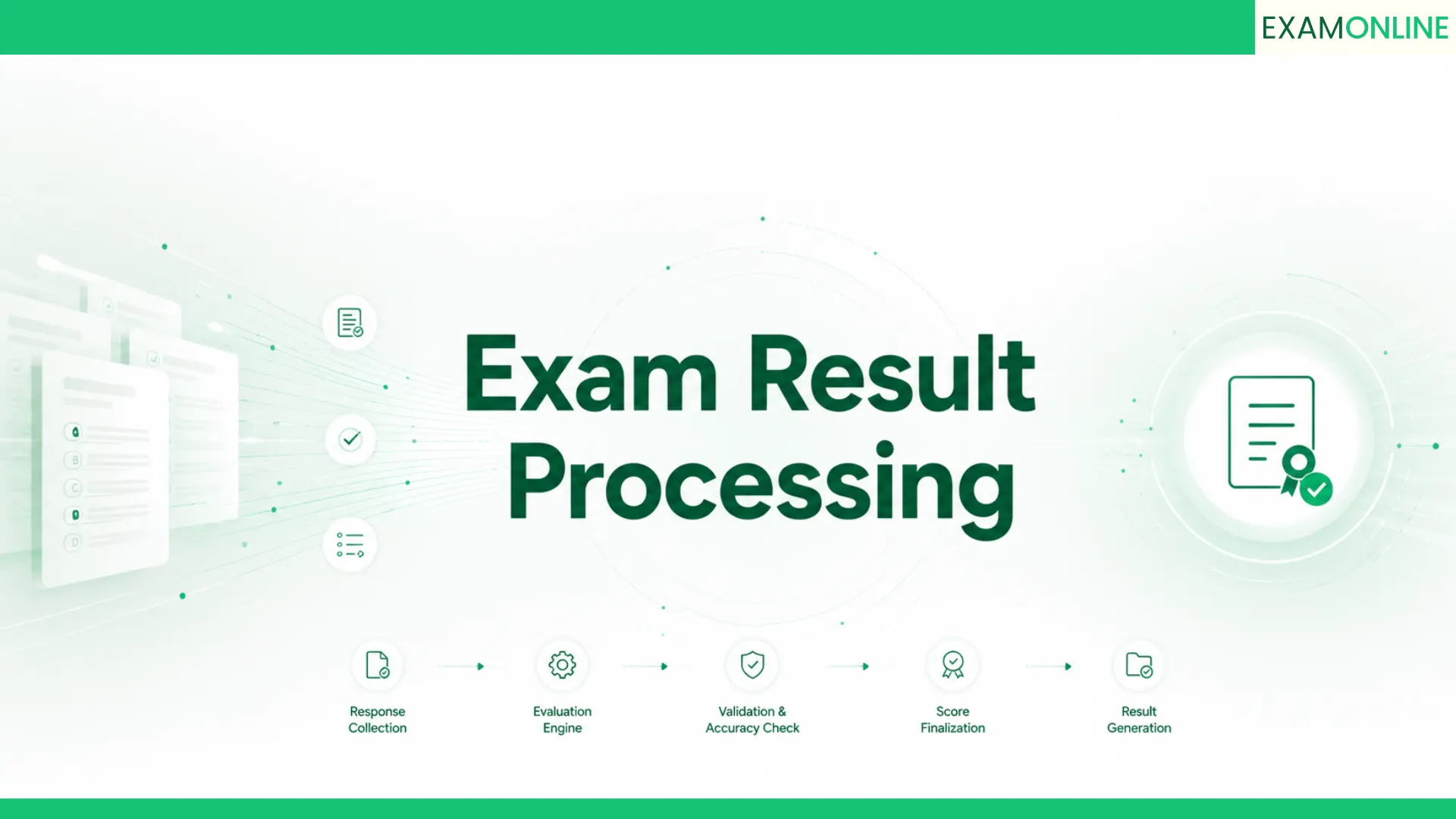
Exam result processing is a sequence, and like every sequence in the assessment lifecycle, the quality of each step determines the quality of every step that follows. Most exam administrators are familiar with the output of exam result processing: the scorecard the candidate receives. What lives between raw answer submission and final scorecard delivery is where the operational complexity exists and where most result management systems create their biggest problems. A clear map of the full exam result processing journey is the starting point for improving any part of it.
The sequence begins the moment the candidate’s answers are locked at submission. The raw answer data, encrypted and stored server-side during the online exam delivery and proctoring stages, is passed to the grading engine. In an objective assessment with multiple choice or structured answer formats, automated grading runs immediately against the answer key for each question variant. In an assessment with subjective components, the automated layer handles objective questions while subjective responses are routed to the human reviewer workflow. The combination of automated and human grading produces a complete raw score record for every candidate in the cohort.
Score normalisation runs after raw grading completes and before any score is verified or released publicly. In assessments where multiple paper variants were used across different exam shifts, normalisation adjusts scores to account for documented difficulty differences between variants. Normalised scores enter the verification stage. After verification, the scorecard generation engine creates each candidate’s digital scorecard, and the result publication system releases the portal with controlled access management. Post-release, the analytics layer processes the full result dataset to produce item-level, cohort-level, and historical performance insights for the exam administration team.
The Complete Exam Result Processing Sequence
Here is the full sequence of steps that make up a well-managed exam result processing workflow from submission to published scorecard:
- Raw answer data retrieval from secure server-side storage following session closure and submission lock
- Automated grading against the configured answer key for every objective question across all paper variants
- Human reviewer routing for subjective response components requiring manual evaluation and scored feedback
- Raw score compilation combining automated and human-graded components into a complete score per candidate
- Score normalisation across paper variants and against historical performance baselines where applicable
- Proctoring flag review reconciliation confirming all integrity decisions are finalised before any score releases
- Mathematical and completeness verification of every score against the answer key and data integrity checks
- Digital scorecard generation populated from the verified score record with all required candidate and exam fields
- Result publication through the exam result portal with controlled release timing and multi-channel delivery
- Post-release analytics generation for administrative review, item analysis, and future exam cycle planning
Each of these ten steps, when automated and connected through a single exam result processing platform, produces a verified scorecard that every stakeholder can trust and rely on for downstream decisions. Explore ExamOnline’s online examination solutions to see how each step operates within a connected result management system that reads directly from the delivery and proctoring data generated in the earlier stages of the exam lifecycle.

Why Automated Grading Is the Only Reliable Option
Manual grading at scale is the most reliable source of result processing errors in high-volume assessment. The mathematics of the problem are straightforward: a single human grader reviewing objective answers for five hundred candidates in an eight-hour window introduces a measurable error rate that compounds with every hour as concentration declines. A grading team of ten working in parallel introduces consistency errors where different graders make different decisions on identical edge cases in the answer key. The larger the exam, the larger the team required, and the larger the team, the more inconsistent the grading outcome across the full cohort.
Automated grading in a connected exam result processing system runs the moment candidate answer data is sealed at submission. The grading engine applies the answer key to every candidate’s response set simultaneously, processes every question in every variant, handles partial credit rules where configured, and produces a raw score for every candidate in the cohort within minutes rather than hours or days. The American Psychological Association’s testing standards identify consistency, auditability, and freedom from systematic error as the three foundational requirements of any valid grading process, all three of which automated grading delivers by design and manual grading achieves only partially even under ideal conditions.
The audit trail that automated grading produces is the dimension that manual grading is structurally unable to replicate. For every candidate, the automated grading log records the specific answer submitted for every question, the correct answer expected per the configured key, the scoring rule applied to that question type, and the score awarded as a result. This record is accessible in seconds when a candidate disputes their result, meaning the re-evaluation team can confirm or correct a score decision in minutes rather than days. That response time is the difference between a grievance that resolves quickly and one that escalates into a formal complaint.
Subjective assessments require human evaluation for the components where expert judgment is genuinely required, and automated grading is designed to complement rather than replace that expertise. The objective components of any mixed-format assessment should always be handled by the automated grading layer, and the human reviewer workflow should be reserved exclusively for the components where judgment adds value. AICTE India’s digital assessment guidelines for higher education institutions increasingly reference automated grading as the minimum standard for objective assessment components at scale, making the transition from manual to automated exam result processing both an operational and compliance-driven decision.
Manual vs Automated Grading in Exam Result Processing
| Dimension | Manual Grading | Automated Grading |
|---|---|---|
| Speed | Days to weeks for large cohorts | Minutes to hours regardless of cohort size |
| Accuracy | Error rate increases with volume and fatigue | Consistent accuracy across all candidates and all questions |
| Consistency | Varies across graders and over time | Identical logic applied to every answer in every paper |
| Audit trail | Manual records difficult to compile retrospectively | Complete timestamped grading log per candidate per question |
| Scale | Requires a proportionally growing review team | Scales automatically to any concurrent candidate volume |
| Cost | High per-candidate cost that grows with cohort size | Consistent low per-candidate cost at any scale |
| Dispute resolution | Difficult to reconstruct the basis for any specific decision | Instant access to the specific grading decision for any answer |

How Score Normalisation Protects Fairness at Scale
Score normalisation is the exam result processing step that most candidates know the least about and that matters most in large-scale, multi-shift assessments. When a national entrance examination runs across hundreds of exam centres and multiple shifts over two or more days, the paper variants used across those shifts are drawn from the same item bank but are necessarily different. Variants are designed to be equivalent in difficulty, but documented differences in perceived difficulty between variants mean that two candidates of equal ability may receive different raw scores based solely on which variant they were assigned. Score normalisation corrects for this systematic inequity. Statistical standard score methodology provides the mathematical foundation that exam result processing systems use to derive fair, comparable normalised scores across variant cohorts.
The normalisation process in automated exam result processing applies statistical adjustments to raw scores based on the measured difficulty characteristics of each paper variant within the sitting. Candidates who sat a statistically harder variant receive an upward adjustment to their normalised score that reflects the documented difficulty differential. Candidates who sat an easier variant receive a corresponding adjustment in the other direction. The result is a set of normalised scores that represent each candidate’s performance relative to a common difficulty baseline rather than relative to the specific variant they happened to be assigned. This is what makes score comparison genuinely fair across a multi-variant, multi-shift examination at national scale.
Score normalisation also serves a quality assurance function within the exam result processing workflow that is distinct from its fairness role. When the normalisation process identifies a paper variant whose raw score distribution is statistically anomalous compared to other variants in the same sitting, this anomaly is a signal worth investigating before results are released. A variant where the average raw score is significantly higher than expected may indicate a paper security event within that specific shift. A variant where average scores are significantly lower may indicate a question design error that prevented candidates from demonstrating their knowledge accurately. Normalisation flags these anomalies before verification, while correction is still possible.
The transparency of the normalisation methodology is as important as the normalisation calculation itself. Candidates who understand how their normalised score was derived are significantly less likely to dispute it than candidates who receive a score with no explanation of the methodology behind it. An exam result processing system that publishes its normalisation approach clearly, makes the normalisation parameters available for review, and provides a score breakdown showing both raw and normalised components gives candidates the information they need to understand their result fully rather than simply accept or reject it on trust.

What Score Verification Does Before Results Go Live
Score verification is the final checkpoint in the exam result processing sequence before any result is released to any candidate. It is the stage where the grading output, the normalisation parameters, and the data integrity of the full result dataset are independently checked against the original assessment configuration. Every score that passes verification carries a confirmation that it was derived from the correct answer key, processed through the correct normalisation methodology, and stored without any data integrity event affecting its value between submission and the release gate opening.
The verification step in exam result processing covers three distinct checks simultaneously. Mathematical verification re-derives every score in the result dataset from the raw answer data and compares it to the graded score to confirm they match exactly. Normalisation verification re-calculates the normalised score for every variant from the configured normalisation parameters and compares it to the stored normalised score to confirm consistency throughout. Completeness verification confirms that every candidate in the registered cohort has a result record and every result record is fully populated with all required fields before the release gate is cleared for publication.
Proctoring flag reconciliation is an additional verification step that applies specifically to candidates who generated integrity flags during the online exam proctoring stage. Before a flagged candidate’s score is released, the exam result processing system confirms that the proctoring review workflow has reached a final decision: cleared for release, withheld pending investigation, or invalidated following a confirmed integrity finding. A score that releases before the proctoring review is finalised is a result processing failure, and it is the integration between proctoring data and result processing on a connected platform that prevents this from occurring in practice.
The verification audit trail is the document that makes every released result defensible to every audience that may scrutinise it. Every score that passes verification carries a timestamp, a record of the verification checks performed, and the outcome of each check. This trail is the first reference point when a candidate challenges their result through the formal grievance process. India’s DIKSHA platform and similar national digital learning infrastructure increasingly require that institutional assessment results carry a verification audit trail compatible with national credential systems, making score verification an infrastructure requirement as much as a quality assurance step.
Score Verification: Do’s and Don’ts for Exam Administrators
| Do This | Avoid This |
|---|---|
| Run mathematical verification on every score before the result portal opens | Spot-check a sample and assume the remaining scores are correct |
| Confirm proctoring flag review is fully completed for all flagged candidates before release | Release scores for the full cohort and withhold only upon a candidate complaint |
| Document the normalisation parameters used and store them as part of the result record | Apply normalisation without recording the parameters used for that specific sitting |
| Configure completeness verification to flag any candidate missing a result record | Open the result portal and handle missing records as support queries after release |
| Store the verification audit trail as part of the permanent exam record for the full retention period | Delete verification logs after result publication to free storage space |
| Test the full verification workflow on a sample cohort before the live exam result processing run | Run verification for the first time on a live result dataset under time pressure |


Building the Digital Scorecard Candidates Deserve
The digital scorecard is the most tangible output of the entire exam result processing workflow, and it is also the output that most result management systems invest the least design attention in. A scorecard that presents a single percentage score with no contextual information is technically a scorecard. It is also nearly useless for every purpose a candidate needs it for: verifying their performance against a cutoff, understanding how they performed relative to their cohort, presenting their result to an employer, or submitting it as supporting documentation with a further application. The scorecard design decision shapes how every candidate experiences the institution, and it is made entirely at the result processing stage.
A well-designed digital scorecard in a modern exam result processing system presents candidate performance across multiple dimensions simultaneously. The total score and the percentage equivalent. The section-wise or subject-wise breakdown showing performance across each evaluated component of the assessment. The candidate’s rank or percentile within their cohort where the exam is competitive. The cutoff or benchmark score where one is defined. The examination date, the variant assigned, and the verified score indicator confirming the result passed the verification stage successfully. All of this is populated automatically from the verified result processing record without any manual scorecard creation.
The digital marksheet format is increasingly required by the downstream processes candidates use their results for. Employers running structured hiring processes want a digital scorecard they can verify against the issuing institution’s record rather than a PDF document that any candidate could fabricate. Universities and professional bodies accepting qualification documentation want a format that includes a verification URL or QR code linking to the official result record in the institution’s system. Skills India’s digital credential framework and India’s national digital infrastructure increasingly require scorecards compatible with DigiLocker delivery and verified digital marksheet standards, making scorecard format a compliance consideration as much as a design one.
Scorecard accessibility across devices and platforms is the final design consideration that result processing teams consistently underestimate until the first results day complaint. A scorecard optimised for desktop display often breaks on the mobile device that most candidates use to first access their result. A scorecard that requires a specific application to open is inaccessible to a candidate at the moment of highest motivation to view their outcome. An accessible digital scorecard is a PDF that renders correctly on any device, an HTML version accessible through the exam result portal, and optionally a mobile notification version delivered through a registered number at the moment of release.
Digital Scorecard Requirements Checklist
- Total score, percentage equivalent, and pass or fail status clearly displayed at the top level of the scorecard
- Section-wise and subject-wise score breakdown showing performance across each evaluated component of the assessment
- Rank or percentile within the candidate cohort where the assessment is competitive and rank data is part of the result record
- Cutoff or benchmark score clearly shown alongside the candidate’s score for direct comparison
- Unique verification URL or QR code linking to the official result record for employer and institutional verification
- Examination date, paper variant code, and verified score indicator confirming the result passed the verification stage
- Candidate name and registration number exactly as recorded during online exam registration for identity consistency
- Mobile-responsive format tested on representative devices before result publication goes live
Exam Analytics: Turning Scores Into Strategic Data
The exam result processing stage produces far more than individual scorecards. It produces a dataset that, when analysed correctly, reveals the performance characteristics of the entire examination: which questions performed as designed and which did not, which cohort segments outperformed or underperformed historical baselines, where the score distribution signals a paper security event or a question design problem, and which assessment elements are producing the differentiation between high and low performers that a well-designed exam is supposed to create. This dataset is the strategic resource that most organisations leave almost entirely underutilised after each exam cycle.
Item-level analytics in the exam result processing output are the most operationally valuable insights for future exam design decisions. A question where ninety-two percent of candidates selected the correct answer provided minimal discrimination value: it was too easy to separate strong from weak performers meaningfully. A question where thirty-eight percent of candidates selected the same wrong answer suggests that the distractor is plausible in a way that reflects a genuine knowledge misconception within the candidate population, and the question may be measuring something different from what the exam designer intended. These insights, available through the exam analytics software layer, are the inputs that make the next exam better designed than the current one.
Cohort-level performance analytics give assessment results their strategic value in organisational and institutional decision-making beyond the individual result. A corporate learning and development team tracking skill assessment results across departments, roles, and time periods can identify which training interventions are producing measurable score improvements and which are producing no detectable change. A university tracking entrance examination performance across feeder institution types can identify where its outreach efforts are producing qualified applicants and where the application-to-qualification gap is widest. These are the insights that justify the investment in a structured online result processing and analytics infrastructure.
Predictive analytics in the exam result processing layer are the emerging capability that enterprise assessment platforms are building toward. Correlating assessment scores with post-hire performance data, course completion rates, or certification renewal rates creates predictive models that improve the design and weighting of future assessments. An assessment score that strongly predicts six-month role performance becomes a more valuable hiring decision input than one showing weak predictive validity. Building that correlation requires structured result processing data combined with the downstream performance data that the hiring or learning organisation holds. Recruitment assessment and learning and development contexts are the two areas where this predictive analytics investment delivers the fastest and most measurable return.
Analytics Available Through Exam Result Processing
Here are the key analytics dimensions generated by a well-configured exam result processing platform across the full post-exam review cycle:
- Item-level difficulty analysis showing the percentage of candidates selecting each response option for every question in every variant
- Item discrimination analysis identifying which questions successfully separate high and low performers as the assessment was designed to do
- Score distribution analysis showing the shape and spread of performance across the full candidate cohort for this sitting
- Section-wise and subject-wise performance breakdown for assessments with multiple evaluated components contributing to the total score
- Cohort comparison analysis tracking performance across exam centres, shifts, paper variants, or defined candidate segments
- Historical baseline comparison identifying significant deviations from expected performance patterns based on previous exam sittings
- Proctoring flag correlation analysis linking flag rates to specific questions, shifts, or candidate segments for integrity review
- Cutoff analysis showing the score distribution around defined cutoff points for selection decisions and pass rate reporting
Result Publication at Scale Without Chaos or Errors
Result publication is the exam result processing step that most candidates experience directly and that most result management systems handle the most poorly. The technical challenges of result publication at scale are well understood and consistently under-prepared for: a simultaneous login spike from thousands of candidates the moment the result portal opens, a combination of static scorecard display and dynamic verification features that must perform under peak load, and a communication sequence that must reach every candidate through multiple channels simultaneously. Each of these challenges has a known solution, and each solution requires a decision made before results day rather than on it.
Controlled result release is the approach that resolves the peak load challenge in result publication at scale. Rather than opening the result portal to the full candidate cohort simultaneously, a controlled release sequences access by candidate group, registration sequence, or exam centre in staggered waves spaced five to ten minutes apart. Each wave creates a manageable load event rather than a single catastrophic spike. From the candidate’s perspective, they receive a specific result access time rather than a generic notification, and they access their scorecard at the time they were given rather than competing with thousands of others for server capacity at the same moment.
Multi-channel result delivery is the communication architecture that ensures every candidate receives their result regardless of which channel is most reliable for them at the point of release. The result portal is the primary access point, but every candidate simultaneously receives their scorecard through their registered email address and a result notification through their registered mobile number. Candidates in regions with variable internet access can receive essential score information through SMS-based delivery that functions without requiring a full portal session. This multi-channel approach eliminates the category of candidate complaint where a legitimate result was generated correctly but never reached the candidate through the primary channel.
Grievance management is the exam result processing function that begins the moment results are published and continues until every result dispute is formally resolved. A well-designed exam result processing system includes a structured re-evaluation application workflow accessible directly through the exam result portal, a defined SLA for re-evaluation completion, and an automated communication sequence that keeps applicants informed of their re-evaluation status throughout the process. Organisations that treat grievance management as a separate post-results activity consistently take longer to resolve disputes and accumulate more candidate complaints than those where the grievance workflow is built into the result processing platform from the start.
Result Publication Checklist for Exam Administrators
- Load test the result portal at ten times the expected peak concurrent access volume at least one week before the release date
- Configure controlled release sequencing to spread candidate access across a timed window rather than a single simultaneous opening
- Prepare multi-channel delivery including portal access, email scorecard dispatch, and SMS notification for all registered candidates
- Test scorecard generation at full cohort scale before the release date to identify any rendering or formatting failures
- Configure the grievance application workflow and confirm it is accessible immediately upon result publication
- Communicate the result release time to all candidates with at least 48 hours advance notice for access planning
- Prepare the support team with a result-specific FAQ and a clear escalation protocol before the portal opens
- Confirm that the result data backup and recovery process is tested and operational before results go live

How Exam Results Connect to the Certification Stage
Exam result processing is the penultimate stage of the online exam lifecycle, and the quality of its output determines everything that follows in the certification stage. The verified scorecard produced by result processing is the source document for every downstream credential event: digital certificate generation, digital badge issuance, official marksheet dispatch, and the credential verification record that employers and institutions query when they need to confirm that a qualification is genuine. A result processing stage that produces a verified, accurate, well-structured scorecard makes the certification stage fast, reliable, and trustworthy. A result processing stage that produces errors or ambiguities makes every downstream credential event more complex and less defensible.
The data handoff between exam result processing and the certification stage is a specific technical and operational event that many exam management systems handle poorly because they treat result processing and certificate generation as separate systems requiring manual data transfer. In a disconnected architecture, the scorecard data must be exported from the result system and imported into the certification system manually. Every manual transfer introduces a data integrity risk. Every data integrity risk produces a category of credential that may be questioned by the employer or institution that receives it. An integrated exam lifecycle platform eliminates this handoff entirely by passing the verified score record directly to the certificate generation engine as part of the same automated workflow.
Selective result release is the result processing feature that certification bodies and recruitment organisations use to manage the relationship between the verified score and the downstream credential event automatically. In a certification context, a candidate whose score falls below the pass threshold receives their result but the system triggers no certificate generation event. The certificate is generated and dispatched only for candidates whose verified score meets or exceeds the qualifying threshold, without any administrator intervention between the verification and issuance steps. In a recruitment context, candidates above the defined shortlist threshold trigger an automatic status update in the hiring system. Explore ExamOnline’s certification exam solution and corporate hiring assessment platform to see how these selective release integrations work in practice.
The echo-chain that connects exam result processing to the certification stage in this series is the word at the centre of both: the scorecard. The scorecard that result processing produces is the document that the certification stage transforms into a verifiable credential. Every section score, every normalised total, and every verified indicator on that scorecard travels forward into the certificate that the candidate carries beyond the exam. Read Post 5: Exam Certification: From Scorecard to Credential for the complete breakdown of how the verified scorecard produced in this stage becomes a tamper-proof, verifiable digital credential that candidates and institutions can rely on.
➤ Continue to the certification stage. Post 5: Exam Certification: From Scorecard to Credential

How Exam-online Turns Every Score Into a Scorecard
ExamOnline manages the complete exam result processing lifecycle on the same connected platform that handles registration, delivery, and proctoring, which means the verified score is derived from the same candidate data layer that every other stage reads from. There is no export between stages. There is no import. The answer data sealed at submission flows directly to the grading engine, the normalised score flows directly to the verification layer, and the verified score flows directly to the scorecard generation engine without any manual transfer at any stage in the sequence. The entire exam result processing workflow from raw answer to published scorecard runs automatically.
The platform’s automated grading engine handles every objective answer type: single-select multiple choice, multi-select, true or false, numeric input, and sequence-based questions. Answer keys are configured per variant at the exam setup stage, meaning grading runs correctly across every paper variant in a multi-shift assessment without any manual variant-to-key matching required on result day. Score normalisation parameters are configured before the exam opens, meaning normalisation runs automatically against every variant’s result set as soon as grading completes. The exam administrator does not need to intervene at any point in the automated result processing chain from submission to verified score.
What ExamOnline Delivers at the Result Processing Stage
Here is what the ExamOnline platform delivers across the complete exam result processing lifecycle from submission to published scorecard:
- Automated grading engine handling all objective question types across all paper variants simultaneously at any cohort volume
- Score normalisation with configurable parameters applied automatically across multi-variant, multi-shift assessments without manual intervention
- Proctoring flag reconciliation confirming all integrity decisions are finalised before any flagged candidate score releases
- Mathematical and completeness verification of every score in the full cohort before the result portal opens for candidate access
- Dynamic digital scorecard generation populated from the verified score record with section-wise breakdown, rank, and verified indicator
- Configurable online marksheet formats compatible with DigiLocker, employer verification portals, and institutional record systems
- Controlled result release sequencing with multi-channel delivery through portal, email, and SMS dispatched simultaneously
- Grievance management workflow accessible through the result portal with defined SLA and automated status communication to applicants
- Exam analytics dashboard with item-level, cohort-level, and historical performance analysis available immediately after release
- Direct integration with the certificate generation engine for automatic credential issuance on confirmed qualifying scores
ExamOnline supports exam result processing across higher education entrance and internal examinations, corporate hiring and recruitment assessments, certification exam delivery, learning and development programme certifications, and competitive examinations at national scale. The platform’s approach to centre-based testing and remote examination both feed into the same result processing infrastructure, giving administrators a single consistent workflow regardless of how the exam was delivered.
ExamOnline gives exam administrators the result processing infrastructure to produce verified, accurate, well-structured scorecards at any scale, with the analytics to improve every future exam and the integration to make every scorecard the foundation of a trusted credential. Explore the online examination solution to see the complete result processing platform in detail, and continue to Post 5 for the certification stage that transforms the verified scorecard produced here into a tamper-proof digital credential.
➤ One more post in the series. Post 5: Exam Certification: From Scorecard to Credential
Frequently Asked Questions
What is exam result processing?
Exam result processing is the sequence of steps that converts a candidate’s submitted exam answers into a verified, published scorecard. It covers automated grading, score normalisation, proctoring flag reconciliation, score verification, digital scorecard generation, result publication, and post-release analytics. Exam result processing is the fourth stage of the online exam lifecycle and the stage that connects the online exam proctoring stage that precedes it to the certification stage that follows. A well-managed exam result processing workflow produces accurate, timely, transparent results that candidates trust and downstream organisations can verify.
What is score normalisation in exam result processing?
Score normalisation in exam result processing is the statistical adjustment applied to raw scores across different paper variants in a multi-shift assessment to ensure fair comparison between all candidates. When multiple variants from the same item bank are used across shifts, documented differences in variant difficulty are corrected through normalisation so all candidates are compared on a common scale rather than a variant-specific one. Normalisation is applied after raw grading completes and before score verification runs, and its parameters are configured before the exam opens as part of the assessment setup.
What is a digital scorecard in exam result processing?
A digital scorecard in exam result processing is the verified, structured document that presents a candidate’s exam result across all relevant dimensions: total score, percentage, section-wise breakdown, rank or percentile where applicable, and a verified score indicator confirming the result passed the verification stage. Digital scorecards in a modern result management system are generated automatically from the verified score record, formatted for compatibility with downstream verification systems, and delivered through the exam result portal, email, and optionally through DigiLocker or equivalent digital credential infrastructure.
How does exam result processing connect to the certification stage?
The verified scorecard produced by exam result processing is the source document for the certification stage that follows. In an integrated online exam lifecycle platform, the verified score record passes directly to the certificate generation engine without manual export or import. Candidates whose scores meet the qualifying threshold trigger automatic certificate generation. Candidates below the threshold receive their scorecard without triggering a credential event. Post 5: Exam Certification: From Scorecard to Credential covers the certification stage in full detail, including digital certificate generation, badge issuance, and credential verification.
How does ExamOnline handle large-scale exam result processing?
ExamOnline handles large-scale exam result processing through automated grading, normalisation, verification, and scorecard generation running on the same connected platform as registration, delivery, and proctoring. The grading engine processes all answer variants simultaneously, normalisation runs against configured parameters automatically, and scorecard generation completes for the full cohort before the result portal opens. Controlled release sequencing manages peak load at publication, and the grievance workflow is accessible from the result portal immediately upon release. Explore online examination solutions for the full result processing specification.


