

Table of Contents
Introduction
In recent years, remote proctored exams have evolved from a convenient option into a core pillar for professional certification and licensing. From IT credentials to medical boards, legal associations, and regulatory authorities, the ability to assess candidates remotely is reshaping how competence is measured and recognized. This change is not only technological—it is about trust, access, regulation, and long-term professional standards.
The Changing Landscape of Certification & Licensing
- Accessibility Beyond Borders: Remote proctoring allows licensing bodies to reach candidates in areas where test centers are unavailable. Professionals no longer need to travel long distances or face travel hurdles.
- Scalability & Speed: Unlike traditional exam centers that require scheduling, venues, and invigilators, remote proctoring enables quicker setup, more exam windows, and faster results.
- Cost Efficiency: Both organizations and candidates benefit from lower costs—no venue rentals, logistics, or travel expenses. Over time, these savings strengthen certification programs.
Impact of Remote Proctored Exams on the Evolving Landscape
- Increased Accessibility:
Eliminates geographical and logistical barriers, enabling candidates from diverse regions to participate without travel constraints. - Faster Certification Process:
Streamlines scheduling and assessment, allowing organizations to scale exams efficiently while maintaining high standards. - Enhanced Security & Integrity:
AI-powered monitoring combined with real-time human oversight ensures credibility and exam integrity. - Trust & Recognition:
Builds confidence among regulators, employers, and candidates by maintaining transparent and reliable assessment standards. - Flexible & Equitable Credentialing: Adapts to modern professionals’ needs, creating a more inclusive, resilient, and fair certification ecosystem.
Security & Integrity: The Cornerstone
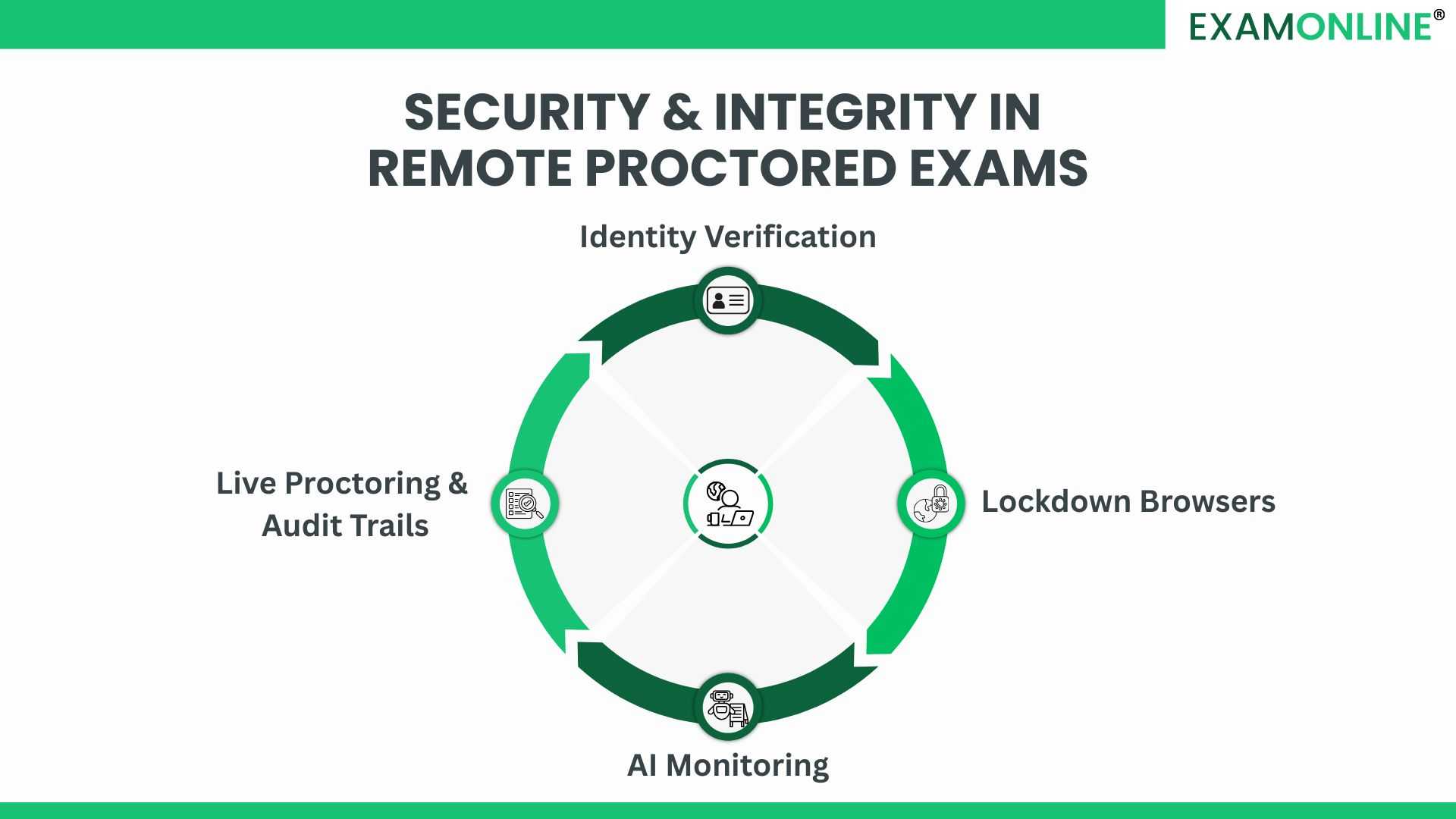
Professional exams demand uncompromised integrity. Remote proctoring leverages a multi-layered security framework that often surpasses traditional in-person monitoring:
- Identity Verification: Facial recognition, and ID scans ensure the right candidate takes the exam.
- Lockdown Browsers: Restrict access to external applications, preventing screen-sharing, copy-paste, or switching.
- AI-Powered Monitoring: Algorithms track gaze, sound, and screen activity, flagging anomalies with high precision.
- Live Proctoring: Human proctors oversee sessions in real time, ready to intervene if suspicious activity occurs.
- Audit Trails & Recordings: Sessions are securely recorded for dispute resolution and compliance.
Regulatory Acceptance & Recognition
- Policy Evolution: Once resistant, many boards and associations now recognize remote proctoring as permanent or hybrid.
- Global Jurisdiction: Compliance with regional data protection laws (like GDPR) is critical when candidates sit exams cross-border.
- Trust & Credibility: Transparency, accreditation, and clear proctoring policies are essential to ensure employers and institutions value remote credentials equally.
Broader Impacts: Equity & Inclusion
- For Underrepresented Groups: Candidates with disabilities, mobility challenges, or limited resources benefit when accessibility tools are integrated.
- Flexible Scheduling: Working professionals can choose exam slots that fit their lives.
- Environmental Benefits: Reducing travel cuts costs and lowers carbon footprints.
The ExamOnline Advantage

While many providers offer remote proctoring, ExamOnline has emerged as a trusted leader for certification and licensing authorities worldwide. Its AI-powered, data-driven platform combines the scalability of automation with the judgment of human oversight.
- Enhanced Security: Multi-layer identity checks, AI fraud detection, and live audits safeguard exam integrity.
- Unmatched Accessibility: Support for candidates with diverse needs, including assistive technologies.
- Scalable & Cost-Efficient: Ability to conduct thousands of high-stakes exams globally with reduced operational overhead.
- Actionable Insights: Rich analytics and reporting enable boards to refine exam design and improve candidate experience.
For licensing bodies looking to future-proof their credentialing programs, ExamOnline offers a proven solution that balances security, fairness, and global reach.
Conclusion
Remote proctored exams are no longer temporary measures—they are the future of certification and licensing. They deliver broader access, stronger integrity, and greater efficiency, while empowering candidates with flexibility and inclusivity. With leaders like ExamOnline setting benchmarks in security, scalability, and accessibility, remote proctoring is becoming a trusted foundation for professional credentialing worldwide.

Frequently Asked Questions (FAQs):
What is a remote proctored exam, and how is it different from traditional in-person testing?
Remote proctored exams are taken online under AI and/or human supervision, ensuring the same security standards as physical test centers but with added convenience.
Are remote proctored exams secure enough for professional certification/licensing?
Yes. With biometric verification, AI monitoring, lockdown browsers, and human oversight, remote exams now offer integrity levels equal to or greater than test centers.
What equipment and environment are required to take a remote proctored exam?
A computer with a camera, microphone, stable internet, and a distraction-free space is essential. System checks are usually required before the exam.
What happens if there’s a technical failure during a remote proctored exam?
Most providers allow rescheduling, pausing, or reinstating exams after disruptions. Policies vary, but candidates are protected from unfair disadvantage.
Are remote proctored certifications as credible as those earned in-person?
Yes—when delivered by accredited bodies with transparent security protocols, remote certifications carry equal recognition by employers and regulators.


