Table of Contents
Introduction
The operational model for higher education has fundamentally changed. As institutions expand their digital footprint, the challenge of upholding academic integrity in digital assessments is no longer a simple logistical problem—it’s a critical strategic imperative. For decades, the human invigilator was the accepted standard for exam security. Today, that model is failing to meet the demands of scale, efficiency, and fiscal responsibility.
The question for academic leaders is no longer about choosing between tradition and technology. It’s about making a data-driven decision that will define the credibility and future of your institution. This is a direct comparison of the legacy model of human invigilation against the superior efficiency of AI proctored software.
The AI-Driven Solution: Benefits & Limitations
AI-powered assessments aren’t just an alternative; they are a strategic upgrade to the entire assessment framework. These Remote Proctoring Tool solutions leverage sophisticated technology to build a secure, consistent, and scalable environment that human capital alone cannot replicate.
Benefits of AI-Powered Proctoring
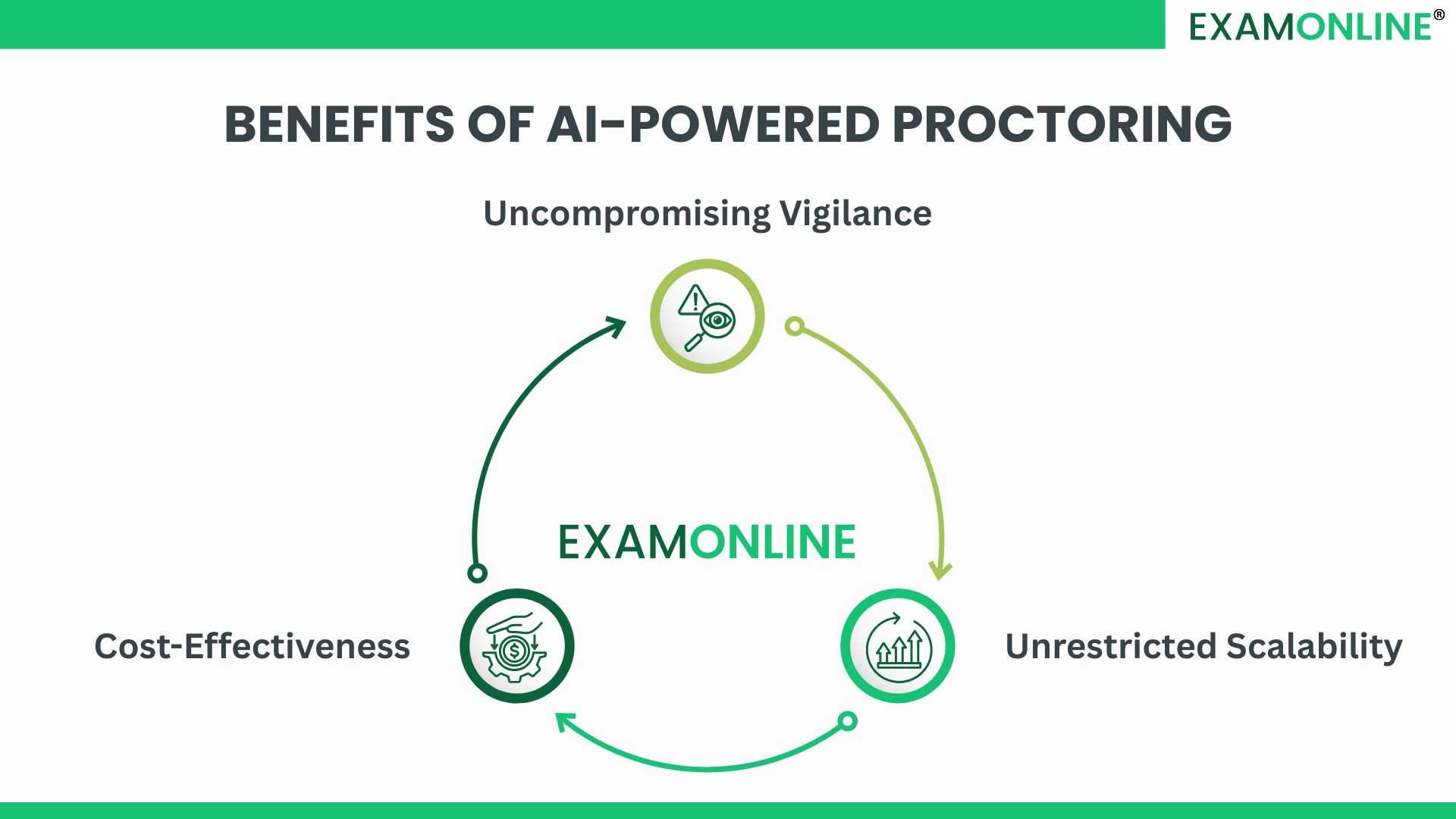
Uncompromising Vigilance: An AI system is perpetually vigilant. It doesn’t tire and it holds no biases. Our advanced AI models are calibrated to detect and flag over 99% of behaviors indicative of academic dishonesty, from subtle eye movements to the presence of unauthorized devices.
Unrestricted Scalability: This is the most significant operational advantage. An AI platform can securely monitor tens of thousands of students concurrently, across any time zone, without degradation in quality. This empowers you to administer exams 24/7, providing ultimate flexibility and removing the administrative burden of coordinating schedules.
Cost-Effectiveness: AI proctored software converts a perpetual operational expense into a predictable, scalable investment. Institutions can reduce their invigilation costs by more than 60%. The cost per examination decreases as volume increases, delivering an economy of scale impossible with the human model.
Challenges of AI-Powered Proctoring
Despite its advantages, an AI-only approach has clear limitations that require human oversight.
- False Positives: AI systems can sometimes produce false flags, misinterpreting a student looking away in thought or a pet entering the room as a potential breach. This can cause unnecessary stress for students and creates additional workload for administrators reviewing the flagged incidents.
- Lack of Nuanced Judgment: An AI cannot understand the context or intent behind an action. It can flag a student’s technical issue as a potential integrity breach, leading to unnecessary frustration and without the ability to de-escalate the situation in real-time.
The Human-Centric Model: A Solution for AI’s Gaps
The human-centric model of invigilation is deeply ingrained in academic tradition. It’s built on a foundation of human judgment and direct oversight that precisely addresses the limitations of an AI-only approach.
Benefits of Human Invigilation

Nuanced Judgment & Context: A human proctor can interpret context and intent. They can distinguish between a student looking away in thought and one trying to cheat, or understand a technical issue versus a malicious attempt to disrupt the exam. This is the perfect tool to verify or dismiss the false positives flagged by AI.
Real-Time Intervention: Human proctors can provide immediate assistance to a student experiencing a technical issue or can address a non-malicious breach in real time, often de-escalating the situation before it becomes a formal incident.
Personal Touch: The presence of a human can offer a sense of reassurance and fairness to test-takers, particularly during high-stakes exams. This personal interaction can reduce test anxiety and improve the overall candidate experience.
A Holistic Approach: The Power of Human and AI Together
The definitive solution is not a single technology, but a strategic, tiered approach. For any institution focused on operational excellence and future growth, the numbers demonstrate that the right tool for the job depends on the assessment’s unique requirements. Our platform provides a complete ecosystem of customizable proctoring models, encompassing pure AI solutions, dedicated human invigilation, and a powerful combination of both.
- Comprehensive Scalability: An AI platform can securely monitor tens of thousands of students concurrently. For high-stakes assessments, human invigilators can be seamlessly integrated to ensure every student receives dedicated, real-time supervision, providing a truly flexible and scalable solution for any exam.
- Uncompromising Security: Our AI system is perpetually vigilant, detecting and flagging over 99% of academic dishonesty behaviors. For situations demanding the highest level of scrutiny, our human invigilators provide the nuanced judgment and intervention that no algorithm can replicate. This hybrid approach ensures every student is assessed against a uniform, objective standard while maintaining the integrity of every credential.
Conclusion: The Choice is Clear
The choice between automated and human proctoring is no longer a debate; it is a strategic business decision. The most effective approach is a tiered integrity framework that combines the unwavering vigilance of AI with the nuanced judgment of human invigilators. ExamOnline provides the comprehensive technical architecture to implement this customizable proctoring model, allowing institutions to align security protocols with the specific needs of every assessment and optimize resource allocation.
Secure your assessments. Protect your reputation. Schedule a Strategic Consultation to design your ideal integrity framework.

Frequently Asked Questions (FAQ)
What are the main differences between AI proctored software and human invigilators?
AI proctoring offers continuous, unbiased monitoring at a massive scale, while human invigilators provide real-time intervention and contextual judgment but are limited by their capacity, time, and potential for human error.
Which method is more effective in preventing cheating, AI proctoring or human invigilation?
AI proctoring provides superior, consistent detection of suspicious behaviors due to its tireless nature and sophisticated algorithms. The most effective approach is a hybrid model where AI flags incidents for human review, combining technological vigilance with human judgment.
Can AI proctoring replace human invigilators entirely?
While AI can handle the vast majority of monitoring tasks, it cannot entirely replace human invigilators. A hybrid approach is often preferred as human proctors can provide real-time assistance, exercise nuanced judgment, and handle complex scenarios that AI may misinterpret.
What are the advantages of using AI proctoring over human proctors?
AI proctoring is significantly more scalable and cost-effective, allowing institutions to manage thousands of concurrent exams without the logistical burden of hiring and scheduling a large workforce. It also ensures consistent, unbiased application of rules, eliminating human fatigue and bias.
What are the limitations or challenges of AI proctoring compared to human invigilation?
AI proctoring can sometimes produce false positives, flagging innocent behavior as suspicious, and it lacks the human ability to understand context and intent. Additionally, some users may have privacy concerns about automated surveillance.