
Table of Contents
Introduction
Corporate learning has shifted from a support function to a performance driver. Organizations are investing heavily in training programs and digital learning ecosystems, but a fundamental question remains – is learning actually translating into performance?
This is where L&D assessments in corporations become critical.
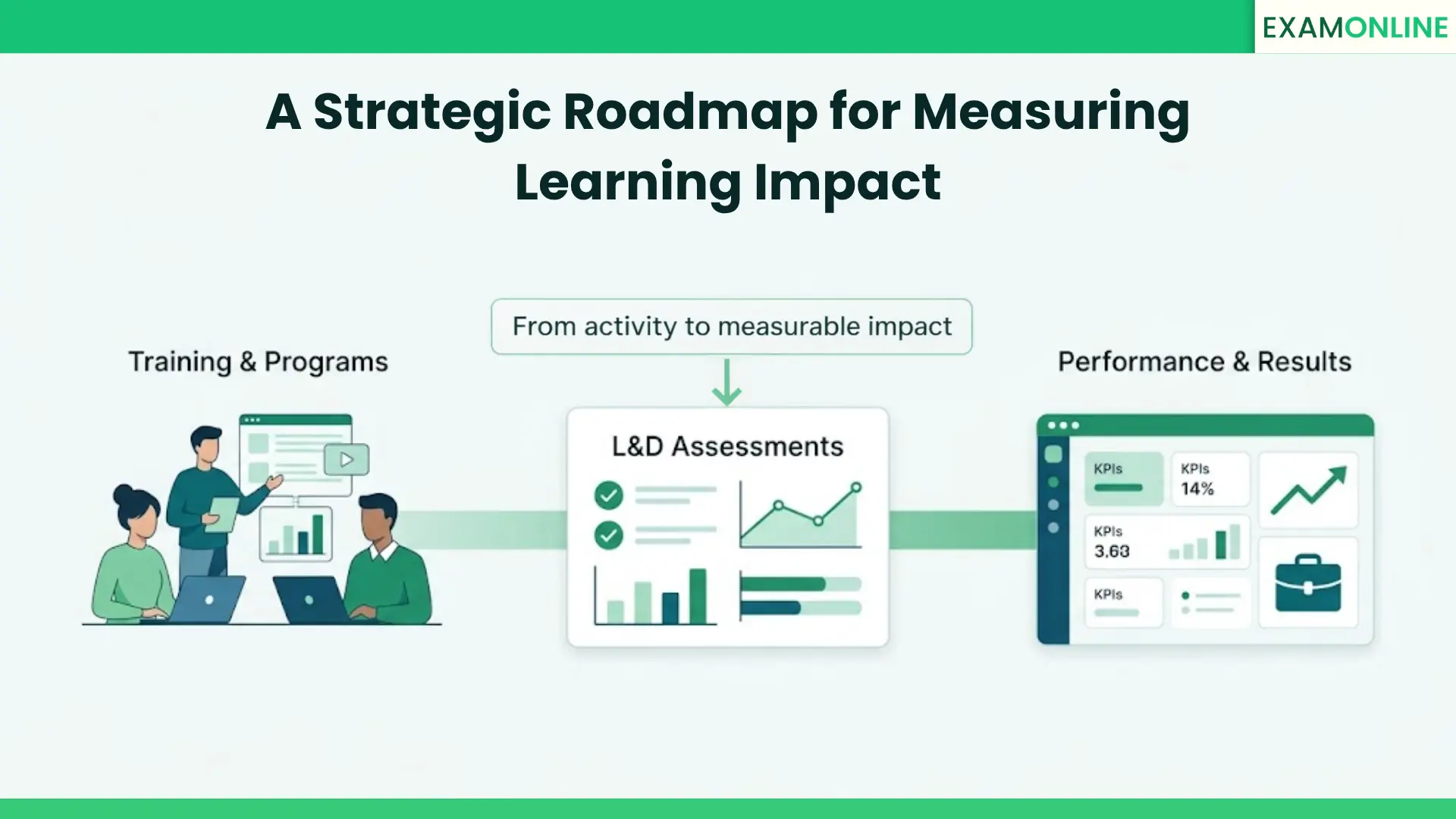
Without structured assessment, learning remains an activity. With assessment, it becomes measurable, comparable, and defensible. For HR and L&D leaders, the focus is no longer on delivering training – it is on proving business impact.
Why L&D Assessments in Corporates Are No Longer Optional
The shift from training delivery to measurable outcomes
L&D functions are no longer evaluated based on how many programs they deliver. They are evaluated based on whether those programs improve performance.
This shift has moved the focus from activity to outcomes. Organizations now expect learning to translate into observable capability on the job.
L&D assessments in corporates enable:
- Measurement of actual skill development
- Alignment between training and performance
- Visibility into workforce readiness
This makes assessments a structural layer, not an add-on.
Why completion rates fail as a success metric
Completion rates are easy to track, but they do not reflect actual learning impact.
They indicate participation, not understanding. An employee can complete a program without being able to apply the knowledge in real scenarios.
Completion-based metrics fail because they do not measure:
- Real-world application of skills
- Retention of knowledge over time
- Improvement in job performance
L&D assessments address this gap by validating capability instead of participation.
Employer expectation – proving capability, not attendance
From an employer’s perspective, training is only valuable if it improves workforce performance.
Organizations expect:
- Demonstrated skill improvement
- Reduction in performance gaps
- Measurable business impact
L&D assessments in corporations provide a structured mechanism to validate these outcomes, making learning investments accountable.
What L&D Assessments in Corporates Actually Measure

Knowledge vs application vs behavior
Most organizations assess knowledge, but stop there. This creates a limited view of learning effectiveness.
Effective L&D assessments operate across multiple layers.
A structured model evaluates:
- Knowledge – conceptual understanding
- Application – ability to use knowledge in real scenarios
- Behavior – consistency of skill usage over time
Without this layered approach, assessments fail to reflect real job readiness.
Role-based competency validation
Assessments must reflect the realities of specific roles. A generic approach leads to irrelevant outcomes.
Different roles require different competencies, which means evaluation must be contextual.
Role-based assessments typically include:
- Mapping skills to job responsibilities
- Designing scenario-driven evaluations
- Adjusting difficulty based on role complexity
This ensures outcomes are actionable and not just indicative.
Continuous vs one-time assessment models
One-time assessments provide a snapshot, but do not capture long-term capability. Organizations are shifting toward continuous models that create a learning-performance loop.
A continuous assessment approach includes:
- Pre-training diagnostics
- Post-training validation
- Periodic reassessments
This enables ongoing improvement rather than one-time evaluation.
Where Most Corporate L&D Assessment Strategies Fail
Over-reliance on post-training quizzes
Many organizations treat assessments as a final step after training, typically using recall-based quizzes.
While easy to deploy, they fail to reflect real-world capability.
Common limitations include:
- Focus on memorization instead of application
- Lack of contextual evaluation
- No insight into long-term retention
A deeper perspective on this shift is explained in why assessment must move beyond surface validation.
Lack of alignment with business outcomes
A major failure point is the disconnect between L&D assessments and business goals.
When assessments are not tied to performance metrics, they fail to demonstrate value.
This results in:
- Difficulty in justifying L&D investments
- Lack of leadership visibility
- Limited strategic impact
L&D assessments in corporations must be directly linked to business outcomes to remain relevant.
No auditability or defensibility
As assessments influence decisions, their credibility becomes critical.
However, many organizations lack structured evaluation systems.
Key risks include:
- Inconsistent scoring across teams
- Lack of audit trails
- Inability to justify decisions
Without defensibility, assessment data cannot support enterprise decision-making.
Framework for Designing Effective L&D Assessments
Defining assessment objectives linked to business KPIs
Assessment design must begin with clarity on outcomes.
Organizations need to define measurable success criteria aligned with business goals.
Effective objective setting involves:
- Identifying role-specific skill gaps
- Linking learning outcomes to KPIs
- Defining evaluation benchmarks
This ensures assessments are strategic, not operational.
Choosing the right assessment formats
Different skills require different evaluation approaches.
The format must reflect how the skill is used in real-world scenarios.
Common formats include:
- Scenario-based assessments for decision-making
- Case-based evaluations for problem-solving
- Simulations for task-based roles
The closer the format is to actual job conditions, the more reliable the results.
Mapping assessments to job roles and learning paths
L&D assessments in corporations must be embedded within the learning journey.
They should align with training modules, role expectations, and progression frameworks.
This typically involves:
- Integrating assessments within learning modules
- Customizing based on role and level
- Creating progressive evaluation layers
This becomes scalable when supported by centralized systems, as discussed in how centralized assessment improves consistency.
Governance, Risk, and Compliance in L&D Assessments

Why assessment integrity matters in corporates
As L&D assessments influence promotions and role transitions, integrity becomes non-negotiable.
If the assessment process is flawed, the resulting decisions lose credibility.
Organizations must ensure:
- Secure assessment environments
- Standardized processes
- Resistance to manipulation
This is critical in maintaining trust in assessment outcomes.
Bias, standardization, and fairness
Unstructured assessments introduce bias and inconsistency.
Different evaluators may interpret responses differently, leading to uneven outcomes.
To ensure fairness, organizations must implement:
- Standardized evaluation criteria
- Role-based benchmarking
- Consistent difficulty levels
Standardization is essential for both operational consistency and governance.
Audit trails and defensibility in learning evaluation
Organizations must be able to justify decisions based on assessment data.
This requires structured auditability.
Defensible systems typically include:
- Defined scoring logic
- Recorded assessment history
- Transparent reporting
This integration of governance is further explored in how learning and assessment systems operate together.
Technology Enablement – Scaling L&D Assessments in Corporates
Role of assessment platforms in scalability
Dedicated assessment platforms are designed to handle complexity, volume, and standardization simultaneously.
They allow organizations to move from isolated assessments to structured, repeatable systems that can operate across functions and regions. This becomes critical as L&D programs expand beyond small cohorts.
Assessment platforms enable:
- Standardized delivery across large employee bases
- Configurable workflows aligned with L&D processes
- Consistent evaluation frameworks across teams
This ensures that scale does not compromise consistency.
Integration with HRMS and LMS ecosystems
For L&D assessments in corporations to be effective, they must be integrated into the broader enterprise ecosystem.
Standalone systems create silos, while integrated systems create continuity between learning, assessment, and performance.
Integration enables:
- Seamless transition from training to evaluation
- Centralized data for analysis and reporting
- Alignment with performance management systems
This ecosystem-level view is critical for long-term scalability, as explained in how structured systems enable enterprise-wide evaluation.
Implementation Roadmap for L&D Assessments in Corporates
Step 1 – Define capability frameworks
Implementation begins with identifying what needs to be measured.
Organizations must define the skills, competencies, and behaviors required for each role. Without this clarity, assessments lack direction and relevance.
Step 2 – Align assessments with learning journeys
Assessments should not be treated as standalone checkpoints.
They must be embedded within the learning journey, ensuring that training and evaluation reinforce each other. This alignment creates a structured flow from learning to validation.
Step 3 – Standardize evaluation criteria
Consistency is critical when assessments influence decisions.
Organizations must establish clear scoring frameworks, benchmarks, and evaluation logic that apply across teams and geographies. This reduces subjectivity and improves reliability.
Step 4 – Deploy securely at scale
Once designed, assessments must be delivered in controlled environments that ensure integrity.
Secure deployment typically involves:
- Controlled access to assessment environments
- Mechanisms to prevent unfair practices
- Monitoring systems to ensure compliance
This ensures that results reflect actual capability.
Step 5 – Measure, iterate, and optimize
Assessment systems must evolve continuously.
Organizations should analyze performance data, identify trends, and refine both learning programs and assessment frameworks. This creates a feedback loop that strengthens long-term outcomes.
The ExamOnline Approach to L&D Assessments at Scale
L&D assessments in corporations require more than delivery capability. They require a system that ensures consistency, security, and scalability across diverse teams.
ExamOnline enables organizations to manage the complete lifecycle of assessments, including registration, scheduling, evaluation, multiple attempts, and certificate generation. This creates a unified workflow where learning outcomes can be measured without fragmentation.
Having delivered over 20 million assessments globally, the platform has been used in environments where reliability, auditability, and scale are critical. This reflects not just operational capacity, but the ability to maintain consistency across varied assessment contexts.
Organizations using structured assessment systems can:
- Standardize evaluation across roles and geographies
- Ensure secure and controlled assessment delivery
- Generate reliable data for decision-making
To understand how this can be implemented within enterprise learning environments, explore a unified assessment workflow for L&D programs.
By aligning assessment delivery with governance and scalability requirements, organizations move from tracking learning activity to validating workforce capability.

Frequently Asked Questions (FAQ)
What are L&D assessments in corporates?
L&D assessments in corporates are structured evaluations used to measure whether employees have acquired and can apply skills gained through training programs.
How are L&D assessments different from training evaluations?
Training evaluations measure engagement or satisfaction, while L&D assessments measure actual capability, application, and performance readiness.
What metrics should HR track in L&D assessments?
HR teams should track skill improvement, assessment consistency over time, and alignment with performance outcomes to understand effectiveness.
How often should L&D assessments be conducted?
Assessments should be continuous, including diagnostics before training, validation after training, and periodic reassessments to track retention and growth.
Can L&D assessments be standardized across global teams?
Yes, with structured frameworks and integrated platforms, organizations can standardize assessments across geographies while maintaining role-specific relevance.


