
Table of Contents
Introduction: Why LMS-Based Assessments Need Integrated Security
A Learning Management System (LMS) enables organisations to deliver, manage, and track learning at scale. It supports enrollment, content delivery, assessments, and result management across enterprises, universities, certification bodies, and government programs.
However, an LMS is not designed to monitor exam sessions, verify identity throughout an assessment, or produce a defensible record of candidate behaviour.
LMS proctoring integration bridges this gap. It connects a proctoring layer to the learning infrastructure, enabling identity verification, real-time monitoring, and audit-ready records within the same environment.
Organisations that rely only on LMS-level controls can deliver assessments efficiently, but may lack the visibility required to validate how those assessments were conducted when needed.
What an LMS Does vs Where Proctoring Integration Becomes Critical
An LMS is built for structured learning delivery and administration. It handles:
- Candidate enrolment
- Content distribution
- Assessment delivery
- Progress tracking
- Result storage
These capabilities enable scale and consistency. They do not extend into session-level monitoring.
Once a candidate logs in:
- Credentials are verified
- Identity is not continuously validated
- Behaviour is not monitored
- Environment is not tracked
This is not a system limitation – it is a defined scope boundary.
- The LMS manages access and delivery
- Proctoring integration secures the assessment session
For a system-level understanding of this separation, see proctoring and assessment architecture.
Why LMS Alone Cannot Fully Ensure Assessment Integrity
When assessments run without integrated monitoring, certain limitations become visible:
Identity verification is limited to login
There is no mechanism to confirm that the same candidate remains present throughout the session.
Behavioural activity is not captured
External assistance, environmental changes, or unexpected activity are not recorded.
Session-level evidence is not available
LMS logs confirm access and completion, but not how the exam was conducted. Organisations cannot reconstruct events they did not observe.
Compliance expectations require verifiable records
In regulated environments, organisations are expected to demonstrate that assessment conditions were controlled and consistent.
The key requirement is not only conducting exams, but being able to demonstrate how they were conducted when required.
What Is LMS Proctoring Integration and How It Works
LMS and proctoring software integration connects a learning management system with a proctoring tool so both systems share identity context, session activity, and incident data in real time.
The LMS continues to deliver the assessment. The proctoring layer adds monitoring and verification.
Common integration methods:
LTI (Learning Tools Interoperability)
- Enables in-platform launch of proctoring sessions
- Removes need for separate login
- LTI 1.3 offers stronger security
API Integration
- Supports real-time data exchange
- Enables customised workflows and automation
- Provides higher flexibility
SSO (Single Sign-On)
- Allows unified authentication
- Reduces identity gaps
- Improves user experience
From the user’s perspective, the experience remains within the LMS interface, while monitoring operates in the background.
Integration ensures that session-level data is automatically linked to the assessment record, eliminating the need for manual reconciliation.
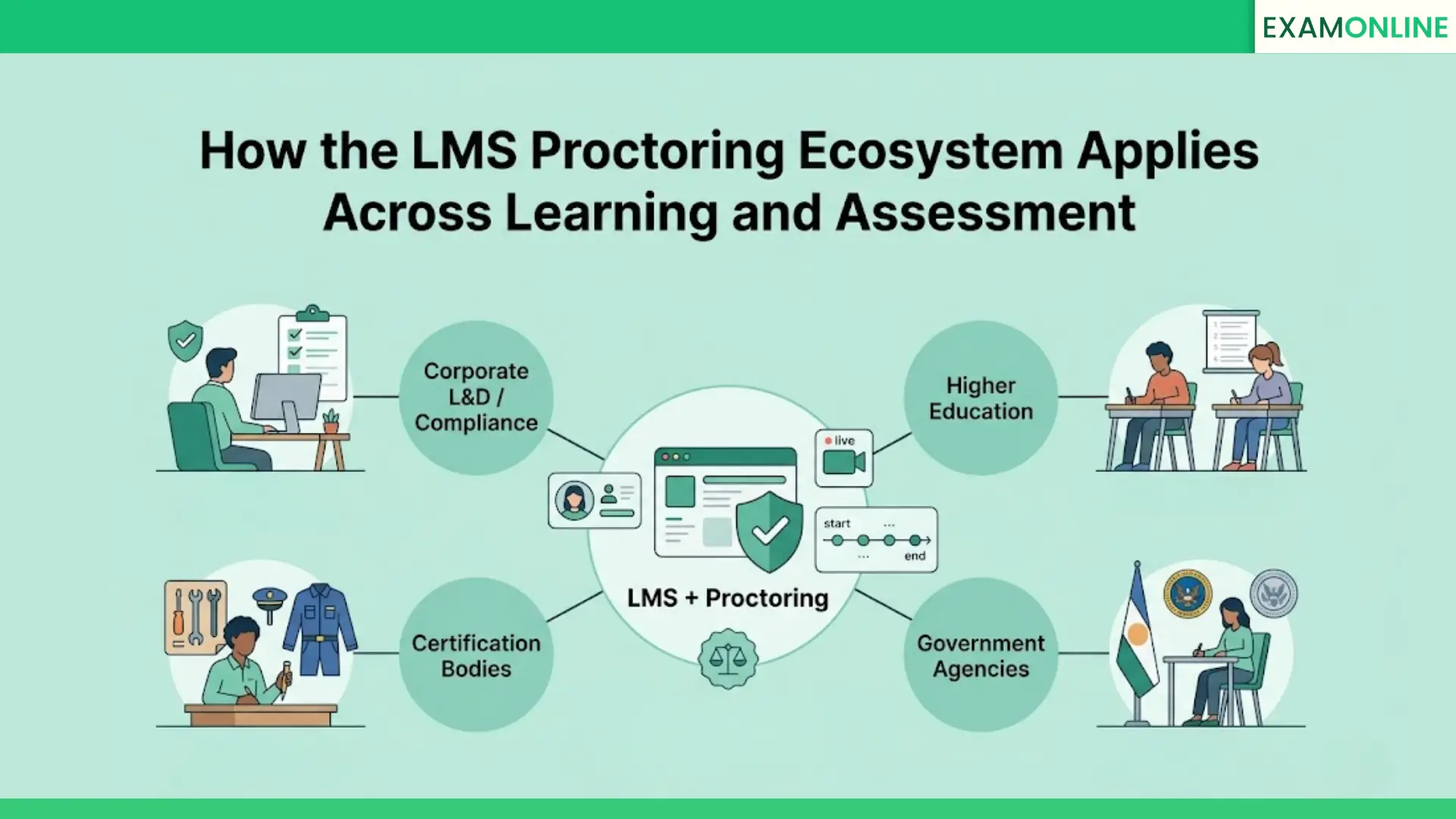
Where LMS Proctoring Integration Is Applied Across Use Cases
LMS proctoring integration is relevant wherever assessment outcomes need to be reliable and verifiable.
- Enterprises – compliance certifications and workforce assessments
- Universities – remote and high-stakes examinations
- Certification bodies – scalable global testing programs
- Government agencies – workforce credentialing and licensing
The underlying technology remains consistent. What differs is the level of governance required around the result.
As accountability increases, the need for integrated monitoring and recording becomes more important.
What Changes with LMS Proctoring Integration: From Access Control to Verified Sessions
Integrating proctoring shifts assessments from access-based validation to session-level verification.
Continuous identity verification
Identity can be validated at multiple points during the session, not only at login.
Real-time monitoring
- Behavioural signals
- Screen activity
- Environmental changes
are detected and recorded as they occur.
Unified audit trail
Session recordings, flags, and assessment data are stored together in a single system.
Improved review and decision support
Session-level data enables structured review when required.
For a governance perspective on how session data supports decisions, see exam insights and governance.
LMS vs LMS Proctoring Integration: Key Differences in Exam Security
| Criterion | Standalone LMS | LMS Proctoring Integration |
| Identity verification | Login only | Continuous validation |
| Behaviour monitoring | None | Real-time tracking |
| Audit trail | Basic logs | Complete session records |
| Dispute handling | Limited visibility | Evidence-supported review |
| Compliance readiness | Limited | Structured documentation |
The most meaningful difference is the audit trail.
With integrated proctoring, organisations can review and validate assessment conditions when required, rather than relying only on system logs.
Risks of Disconnected Proctoring and LMS Systems
When proctoring operates separately from the LMS, inefficiencies and gaps can emerge:
- Session data and results exist in separate systems
- Manual reconciliation is required for audits or disputes
- Incident data may not align directly with candidate records
- Administrative overhead increases with scale
From a governance perspective, managing data across multiple systems can introduce complexity around storage, access, and retention.
Integration addresses this by ensuring that assessment data and session data remain connected by design.
How to Evaluate and Configure LMS Proctoring Integration

Successful integration depends on both technical compatibility and configuration decisions.
Key evaluation criteria:
- LTI compatibility – LTI 1.3 preferred
- SSO protocols – SAML 2.0, OAuth, OpenID Connect
- API capability – clear and maintainable documentation
- Identity verification setup – method and timing defined
- Monitoring configuration – anomaly thresholds and review rules
- Data mapping – automatic linking of session data to candidate records
- Scalability validation – tested under real usage conditions
For a deeper selection framework, refer to proctoring platform evaluation.
Integration decisions should be finalised before deployment, as they directly influence how effectively assessment integrity can be maintained.
A Practical Perspective: Extending LMS Capabilities with Proctoring
Proctoring integration does not replace an LMS.
It extends it.
- The LMS continues to manage learning and assessment delivery
- The proctoring layer ensures session integrity and verification
This separation allows organisations to maintain their existing infrastructure while adding a structured layer of monitoring and validation.
The result is a connected system where access, activity, and outcomes are aligned.
ExamOnline: Integrated Proctoring for End-to-End Assessment Workflows

ExamOnline delivers proctoring as a native component within a complete assessment ecosystem, deployed across 25+ countries and used by 250+ organisations including certification bodies, universities, enterprises, and government agencies.
The platform manages the full certification workflow within a single environment – including candidate registration, slot booking, multiple attempts, payment gateway processing, identity verification, proctored session delivery, and certificate generation with automatic distribution.
Integrated Proctoring software ecosystem operates within the same identity and session context as the assessment, ensuring that all activity is recorded and linked without system fragmentation.
Integration with existing LMS or assessment platforms is supported via LTI, API, and SSO, allowing organisations to retain their infrastructure while implementing a structured and auditable security layer.
For organisations where assessment outcomes need to be validated, reviewed, or audited, integrated proctoring provides the foundation for a system that supports those requirements consistently.
LMS proctoring integration does not replace learning systems – it ensures that assessment outcomes within them can be trusted and verified.

Frequently Asked Questions (FAQs):
What is LMS proctoring integration?
It connects a learning management system with a proctoring tool to enable identity verification, monitoring, and recording during online exams.
Why isn’t an LMS enough for exam security?
Because it verifies login credentials but does not monitor identity or behaviour during the session.
How does proctoring work within an LMS?
It operates as an integrated layer that tracks session activity and links it to the assessment record in real time.
Is LMS proctoring integration required for compliance?
In many regulated environments, it is used to demonstrate that assessment conditions were controlled and verifiable.
What happens without integration?
Assessment and session data remain separate, making audits, reviews, and validation more complex.
