

Table of Contents
Introduction: Why Remote Proctoring Still Faces Resistance
Online examinations have moved from being an alternative to becoming a primary assessment method across education, hiring, and certifications. The pandemic accelerated this transition, proving that exams could be delivered remotely at scale.
Despite adoption, concerns around integrity, fairness, and control continue to surface. Much of this resistance is not based on present-day systems but on:
- Early-generation proctoring tools
- Incomplete understanding of how modern proctoring works
- Comparisons with physical exams rather than digital-first standards
Remote proctoring today goes beyond webcam monitoring or manual supervision. It combines identity verification, behaviour analysis, multi-modal monitoring, and privacy-first controls to deliver secure and scalable online exams.
This blog debunks five common myths and explains how remote proctoring actually works in practice.
What Remote Proctoring Actually Is
What Remote Proctoring Means
Remote proctoring is a technology-enabled method of supervising online examinations to ensure:
- Candidate authenticity
- Exam integrity
- Fair and consistent enforcement of rules
Monitoring is conducted remotely using human proctors, AI-driven systems, or a combination of both, depending on exam requirements.
How Modern Remote Proctoring Works
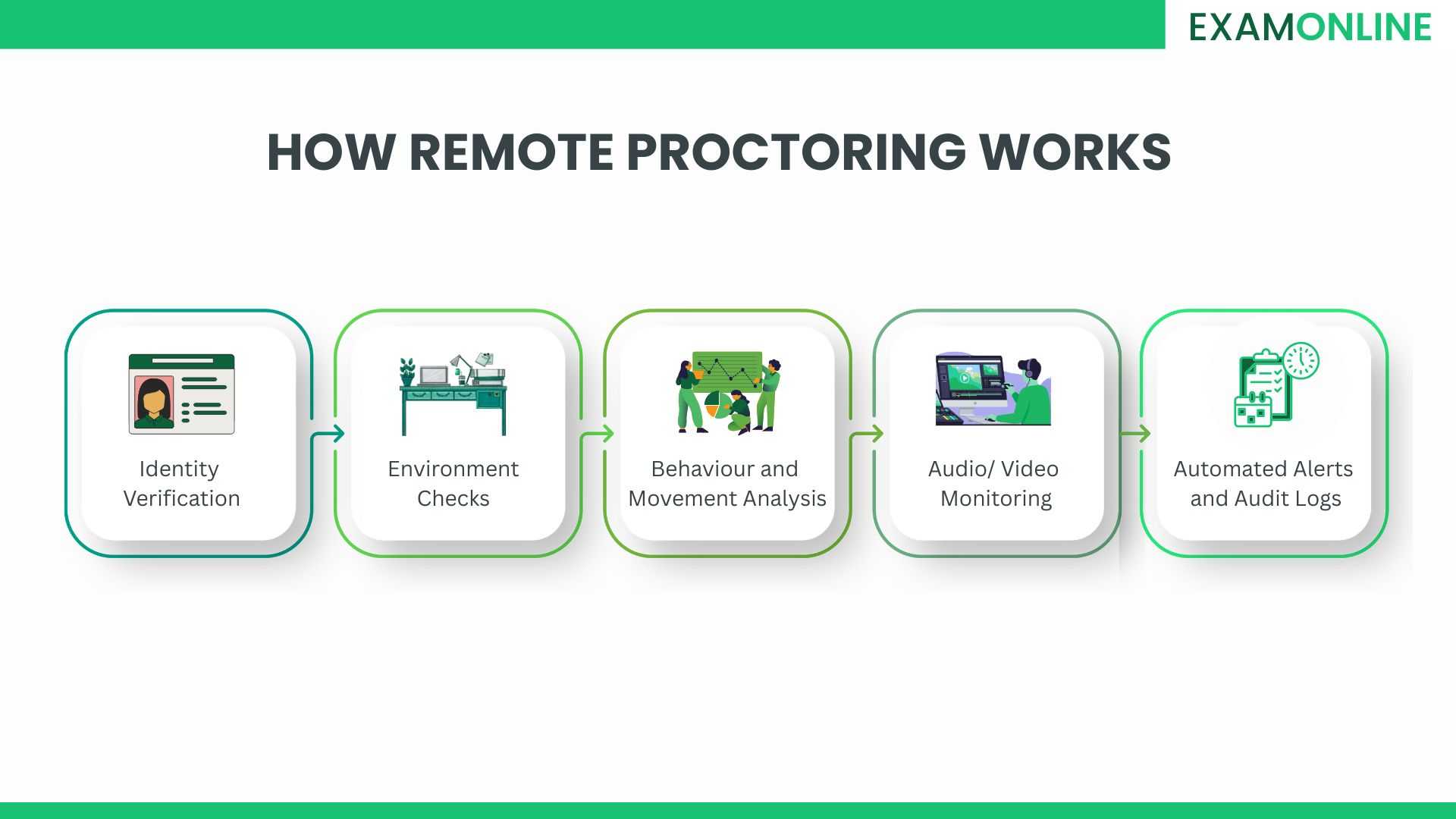
Instead of relying on a single control, modern systems use multiple layers such as:
- Identity verification
- Environment checks
- Behaviour and movement analysis
- Audio monitoring
- Automated alerts and audit logs
These controls operate only during the exam session and within clearly defined boundaries.
What Remote Proctoring Is Not
Remote proctoring:
- Does not provide unrestricted access to a candidate’s device
- Does not monitor candidates outside the exam window
- Does not involve continuous human observation by default
Many myths originate from misunderstanding this distinction. With this baseline established, we can now address the most common misconceptions. For a deeper understanding of how remote proctoring models, technologies, and use cases fit together, refer to this comprehensive guide to remote proctoring.
Myth 1: Remote-Proctored Exams Are Not Secure or Reliable
What the Myth Claims
Remote-proctored exams/ Remote Proctoring Tools are often perceived as:
- Easy to manipulate
- Less controlled than physical exam halls
- Dependent on weak or inconsistent monitoring
This belief assumes that physical presence equals stronger security.
Why This Myth Exists
Earlier online exam systems relied heavily on basic webcam feeds and manual supervision. In comparison to traditional invigilation, these early approaches lacked depth and consistency, reinforcing doubts around reliability.
Why This Is No Longer True
Modern remote proctoring improves exam security by using multi-layered controls that operate consistently across all candidates, unlike single-point physical invigilation.
Key mechanisms include:
- Automated identity verification
- Behavioural anomaly detection
- Audio and screen monitoring
- Machine-generated alerts for review or action
This is explained in detail in how online proctoring ensures exam integrity across different exam formats and candidate volumes.
Remote-proctored exams are not inherently less secure. When implemented correctly, they often provide higher reliability than traditional methods.
Myth 2: Remote Proctoring Increases Candidate Stress and Anxiety
What the Myth Claims
This myth suggests that:
- Being monitored online is intrusive
- Candidates feel pressured knowing they are watched
- Performance suffers due to constant surveillance
Why This Myth Exists
The assumption comes from equating remote proctoring with continuous human observation, similar to strict physical invigilation environments.
Why This Is Not Accurate
Most remote proctoring platforms today are automation-led rather than surveillance-led. Monitoring occurs quietly in the background and escalates only when predefined rules are violated.
In practice, remote exams reduce several stress factors:
- No travel or venue-related anxiety
- Familiar test environment
- Clear, predictable exam flow
- Minimal interruption during the assessment
As long as candidates follow exam guidelines, they experience little to no interaction with the proctoring system.
Candidate Experience in Reality
Stress in examinations is typically driven by unclear instructions or unfamiliar processes, not by proctoring itself. When expectations are communicated clearly, remote proctoring functions as a silent safeguard rather than a source of pressure.
Remote proctoring does not inherently increase anxiety. In many cases, it creates a calmer and more controlled exam experience by not being intrusive. The end-to-end candidate journey and monitoring flow are covered in depth in this guide to candidate experience in remote proctored exams.
Myth 3: Remote Proctoring Is a Threat to Candidate Privacy and Data Security
What the Myth Claims
This myth assumes that remote proctoring:
- Invades personal privacy
- Allows unrestricted access to a candidate’s device
- Stores or misuses sensitive personal data
As a result, stakeholders often view remote proctoring as inherently risky from a data protection standpoint.
Why This Myth Exists
The concern largely stems from a lack of transparency and awareness about how proctoring systems operate. Many people assume that because monitoring occurs remotely, proctors can:
- View personal files or applications
- Access devices beyond the exam session
- Retain recordings indefinitely
These assumptions are often based on misconceptions rather than actual system behaviour.
Why This Is No Longer True
Modern remote proctoring follows privacy-by-design principles aligned with regulations such as GDPR.
Monitoring is:
- Consent-driven – candidates are informed before the exam begins
- Time-bound – access is restricted strictly to the exam duration
- Purpose-limited – only exam-relevant signals are captured
Proctors cannot access personal content outside the scope of the assessment, and recordings automatically stop once the exam ends. Data handling follows defined retention policies aligned with applicable privacy regulations.
Broader adoption trends and governance considerations are discussed further in governance and trust in remote proctoring. (Remote Proctoring: The Future of Online Examinations)
How Privacy Is Enforced in Practice
Key safeguards typically include:
- Explicit candidate consent flows
- Role-based access for exam administrators
- Encrypted storage and controlled review workflows
- Compliance with data laws
Remote proctoring does not compromise privacy by default. When implemented responsibly, it balances exam integrity with strong data protection controls.
Myth 4: Remote Proctoring Is Expensive, Complex, and Difficult to Manage
What the Myth Claims
Many institutions believe that:
- Remote proctoring significantly increases exam costs
- Implementation requires heavy technical effort
- Ongoing management is operationally burdensome
This perception often delays adoption.
Why This Myth Exists
Traditional exam models involve visible costs like venues and invigilators, which feel familiar and predictable. In contrast, technology-led solutions are often assumed to be expensive simply because they are digital and advanced.
Additionally, early online systems sometimes required third-party installations or manual configurations, reinforcing the idea of complexity.
Why This Is Not Accurate
Remote proctoring often reduces total exam costs by eliminating or minimising:
- Physical exam venues
- Printed materials
- On-site invigilation
- Logistics and scheduling overheads
Modern proctoring-enabled exam platforms are typically cloud-based and designed for rapid deployment, requiring minimal setup and no complex installations for candidates.
Operational Reality
From an administrative perspective:
- Exams can be configured centrally
- Monitoring rules are reusable across assessments
- Reports and audit trails are generated automatically
This significantly lowers long-term operational effort compared to repeated physical exam setups.
This shift toward efficiency and scale is explored further in scaling online exams without compromising security.
Remote proctoring is not an expensive or complex add-on. It is a scalable, cost-efficient and robust replacement to traditional examination infrastructure.
Myth 5: Remote Proctoring Is Limited to Webcam Video Monitoring
What the Myth Claims
This myth reduces remote proctoring to:
- A live webcam feed
- Manual observation by a human proctor
- One-dimensional monitoring
Such an assumption underestimates the depth of modern proctoring systems.
Why This Myth Exists
Video-based monitoring was one of the earliest and most visible forms of online proctoring. As a result, many stakeholders still equate proctoring exclusively with live video surveillance.
Why This Is No Longer True
Remote proctoring is now multi-modal, combining video snippets, image captures, and audio analysis instead of relying solely on live webcam feeds.
More advanced implementations record screen, audio, and video activity together and automatically flag potential violations, making monitoring more reliable and review more defensible than early video-only approaches.
Beyond video monitoring, proctoring systems may use:
- Image-based capture when violations are performed or random intervals
- Audio analysis to detect external assistance
- Behaviour tracking for movement or focus changes
- AI-generated alerts for rule violations
These mechanisms work together to identify suspicious patterns rather than isolated events.
A deeper breakdown of monitoring approaches is available in different remote proctoring models comparison, and the essential features of remote proctoring software.
Why Multi-Modal Proctoring Matters
Relying on multiple signals:
- Improves detection accuracy
- Reduces false positives
- Minimises unnecessary human intervention
It also allows institutions to choose monitoring methods based on exam sensitivity and scale. Remote proctoring is not limited to webcam monitoring. It is a comprehensive integrity framework designed to adapt to different assessment needs.
The ExamOnline Advantage: How These Myths Are Addressed in Practice

Debunking myths about remote proctoring requires more than theoretical explanations. The real test lies in how these concerns are addressed during actual exam execution.
ExamOnline approaches remote proctoring as an end-to-end exam integrity framework, built directly into the online examination process.
How ExamOnline Counters the Common Myths
- Security and reliability: Identity verification, behaviour analysis, audio monitoring, and automated alerts ensure consistent enforcement across candidates. These controls align with established information security practices, including frameworks such as ISO/IEC 27001, to ensure secure handling of assessment data.
- Candidate stress: Monitoring operates quietly in the background and escalates only on rule violations, allowing candidates to focus on the exam without disruption.
- Privacy and data protection: Proctoring is consent-driven and time-bound, with access limited strictly to the exam session and governed by defined data controls.
- Cost and operational complexity: Centralised exam configuration and automated reporting reduce dependence on physical infrastructure and manual invigilation.
- Limited proctoring capabilities: Multi-modal monitoring combines video, image-based checks, audio analysis, and AI-driven alerts to improve accuracy and reduce false positives, along with recordings for evidences
See Remote Proctoring in Action

Understanding remote proctoring is one thing. Seeing how it works within a real exam environment provides clarity.
Schedule a live demo to see how ExamOnline supports secure, scalable online examinations without compromising integrity or candidate experience.
Frequently Asked Questions (FAQ)
Is remote proctoring suitable for high-stakes examinations?
Yes. When implemented with layered security controls and clear enforcement rules, remote proctoring is widely used for high-stakes academic, recruitment, and certification exams.
How is candidate consent handled in remote-proctored exams?
Candidates are informed about monitoring requirements before the exam begins. Proctoring activates only during the assessment window and ends automatically once the exam is submitted.
What happens when suspicious behaviour is detected?
The system generates alerts based on predefined rules. Depending on configuration, exams may be flagged for review, paused, or terminated, with full audit trails available for administrators.
Can remote proctoring scale to large candidate volumes?
Yes. Remote proctoring platforms are designed to handle high concurrency without compromising enforcement consistency, making them suitable for large-scale exams.
Does remote proctoring replace human judgment entirely?
No. While automation improves consistency and scale, human review remains critical for contextual evaluation and final decision-making.
Closing Perspective – Separating Perception From Reality in Remote Proctoring
Remote proctoring has evolved significantly from its early implementations. Many of the concerns that continue to surround it are rooted in outdated assumptions rather than present-day capabilities.
As online assessments become central to education, hiring, and certification, exam integrity can no longer rely solely on physical presence. Modern remote proctoring provides institutions with a scalable, consistent, and auditable alternative.
The key is not whether remote proctoring should replace traditional exams, but whether organisations are evaluating it based on current realities instead of past perceptions and future requirements. When understood and implemented correctly, remote proctoring becomes less about surveillance and more about trust, fairness, and credibility in digital assessments.


