Table of Contents
Introduction
Remote Proctoring reshapes online exams into protected, scalable evaluation systems by combining AI-driven monitoring, structured human oversight, and thorough review records. This allows candidates worldwide to take high-stakes exams from any location while preserving integrity, fairness, and credibility.
This blog provides a complete, step-by-step breakdown of remote proctoring – from basic workings and proctoring models to integration strategies, ethical considerations, benefits, cost efficiencies, and practical uses across education, certification, and corporate environments. It is designed to help institutions, certification bodies, and enterprises implement remote assessments with assurance and governance-level stability.
What Is Remote Proctoring?
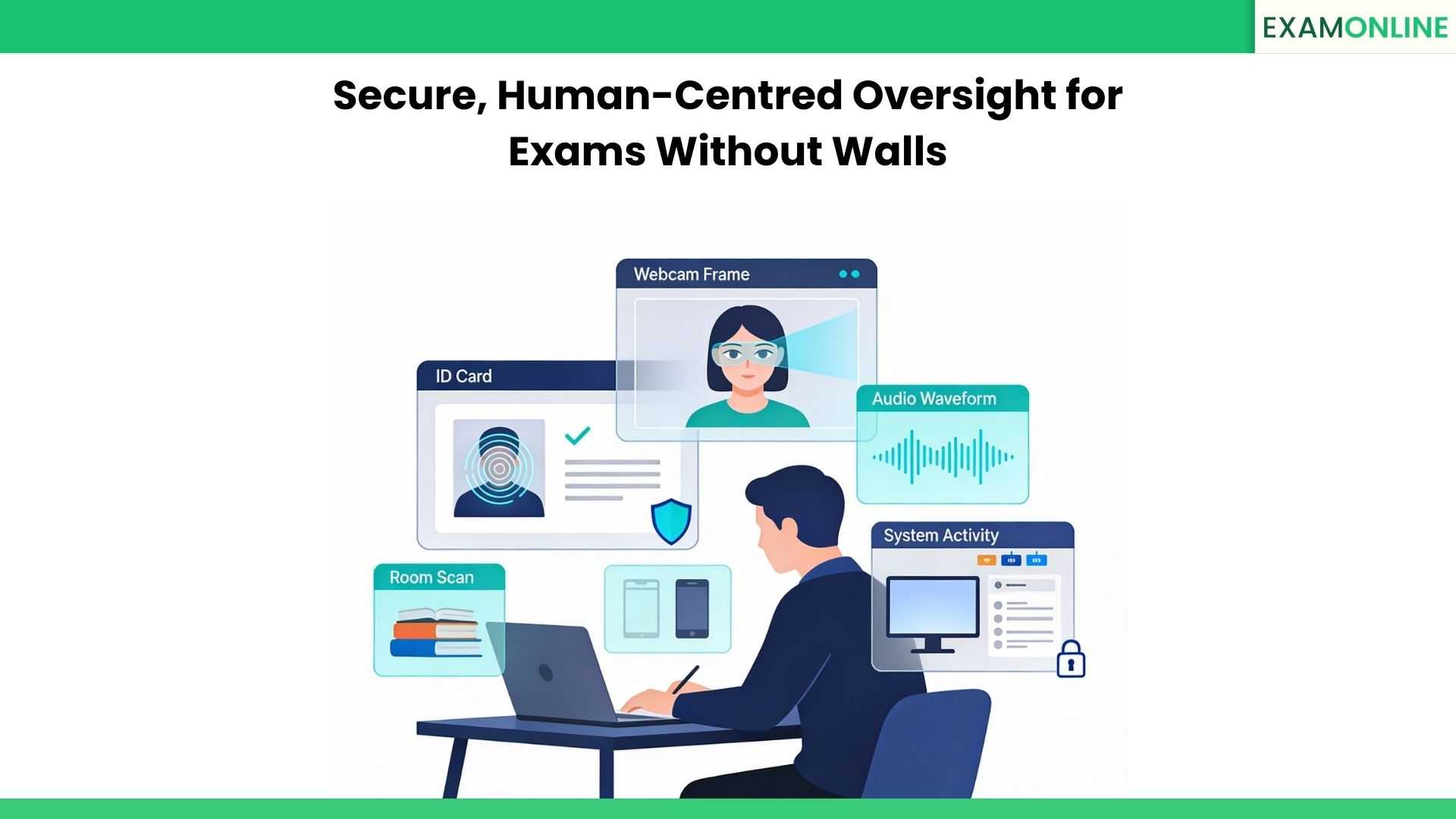
Remote proctoring is a digital oversight system that allows examinations to be conducted remotely while preserving the security, accountability, and impartiality traditionally associated with physical test centres. It replaces location-based control with technology-aided oversight, ensuring that exam conditions remain verifiable even when candidates are geographically distributed.
Fundamentally, remote proctoring relies on multiple coordinated monitoring layers. These include identity verification through details matching and ID validation, continuous behavioural analysis by tracking eye gaze, posture, and head movement, environmental scanning to detect unauthorised materials like phone/book, audio monitoring for noises, and logging of screen activity, browser navigation, and restricted app usage.
Unlike basic online exam platforms that merely deliver questions and capture responses, remote proctoring actively manages the entire testing environment. Its primary purpose is trust – producing outcomes that are credible, defensible, and auditable even in the absence of physical invigilators. This distinction becomes especially clear when examining how online proctored exams are executed in practice and how the role of invigilation has evolved in digital exams.
Why Remote Proctoring Became a Necessity
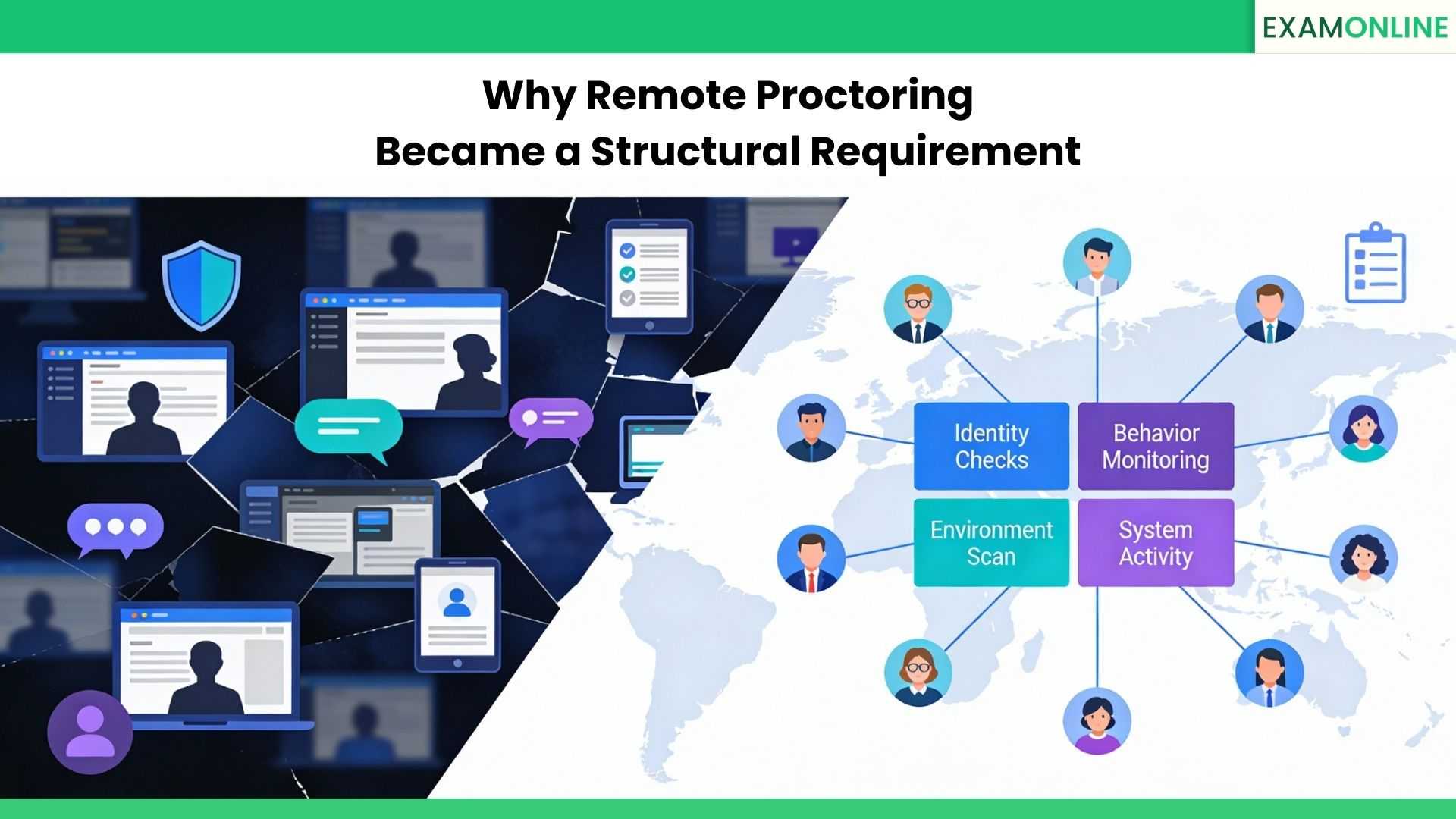
The growth of online education, global certification programs, remote hiring, and employee training with geographical dispersion has changed how assessments are delivered. Exams today span across countries, time zones, and device types, often involving thousands of candidates attempting high-stakes tests simultaneously.
This transition disturbed the physical safeguards of traditional exams – controlled venues, visible supervision, and uniform enforcement. In their absence, institutions faced rising risks of impersonation, unauthorised collaboration, device manipulation, and inconsistent rule enforcement. Early attempts at manual online invigilation struggled under scale, fatigue, and cost, often failing to provide consistent oversight.
Remote proctoring emerged not as an enhancement, but as a replacement and improvement. By combining identity, behaviour, environment, and digital activity into a single supervisory system, it restored exam security in remote settings. As online examinations became permanent solutions rather than temporary alternatives, structured proctoring shifted from optional to mandatory, particularly across assessment ecosystems.
What Remote Proctoring Is and Is Not

Remote proctoring functions as a non-disturbing integrity layer that operates alongside the examinations. It does not replace exam delivery systems, content engines, or automated grading tools, nor does it independently determine pass or fail outcomes.
Instead, it observes and documents candidate behaviour, flags abnormalities, and generates structured evidence to support human decision-making. This separation ensures exam governance remains transparent and defensible, especially during appeals or regulatory reviews.
Remote proctoring is also not passive recording. Modern systems actively manage liveness detection, behavioural pattern analysis, audio intelligence, and fool proof logging. These mechanisms extend beyond secure browsers by addressing physical, behavioural, and systemic risks together, ensuring integrity across the entire assessment lifecycle.
Types of Remote Proctoring

Remote proctoring operates through structured supervision modes. Each mode differs in how monitoring is executed, how evidence is generated, and how violations are escalated, while remaining part of the same integrity framework.
Live Remote Proctoring
Live remote proctoring functions through real-time human supervision supported by technology. Once a candidate begins the exam, their video, audio, and screen feed are streamed securely to trained proctors. Each proctor monitors multiple candidates simultaneously through a central dashboard. Monitoring is continuous and synchronous, meaning suspicious activity is observed as it occurs.
Technology assists by highlighting abnormal behaviour, but decision authority remains human-led, preserving contextual judgement and proportional intervention. This live presence also creates a strong deterrent effect, mirroring physical invigilation.
AI-Based (Automated) Remote Proctoring
AI-based remote proctoring replaces continuous human observation. Integration with automated behavioural, environmental, and system-level analysis, while preserving mandatory human review at decision points.
During the exam, AI models analyse facial presence, gaze patterns, eye and head movement, environmental stability, audio signals, and screen activity. Rather than reacting to isolated events, the system builds behavioural timelines and flags anomalies supported by evidence such as screenshots and activity logs.
Human reviewers then assess only flagged segments, ensuring consistency, reduced fatigue, and evidence-driven outcomes. The ethical foundations of this model are explored in responsible AI-based exam supervision and its growing necessity in education ecosystems.
Key Benefits of Remote Proctoring

Remote proctoring does not merely add security controls. It systematically resolves foundational weaknesses that emerge when assessments move online without supervision.
Exam integrity in unsupervised digital environments
In unsupervised online exams, candidates can seek external assistance, switch devices, consult unauthorised materials, or rely on AI-powered tools without detection. Comparable integrity gaps have historically existed in pen-and-paper exams as well, particularly where invigilation is inconsistent or scale is large. This contrast becomes clearer when evaluating online proctored exams against traditional exam models.
Remote proctoring mitigates these risks through layered oversight: identity verification establishes authenticity, presence tracking prevents substitution, behavioural analysis identifies external reliance patterns, and system monitoring exposes digital manipulation. These layers function together to close cheating pathways holistically, particularly in the AI era.
Standardisation and fairness across candidates
Without structured supervision, exam enforcement varies widely based on geography, institutional capability, and proctor consistency. This results in uneven conditions and unfair candidate advantages, often driven more by exam context than competence.
Remote proctoring introduces uniform monitoring logic and predefined thresholds applied consistently across all candidates. AI-driven analysis ensures standard evaluation, while structured human review preserves contextual fairness, enabling equitable comparison at scale.
Audit readiness and defensible outcomes
In traditional and lightly supervised exams, institutions often struggle to defend outcomes during appeals, accreditation reviews, or legal scrutiny. Decisions based on suspicion rather than evidence rarely withstand formal review.
Remote proctoring generates time-stamped logs, visual and audio evidence, system activity trails, and structured incident reports for every session. This creates a forensic-grade audit trail that ensures decisions are transparent, proportional, and defensible.Despite its growing adoption, remote proctoring is often surrounded by misconceptions around privacy, fairness, and effectiveness. Many of these concerns stem from outdated implementations or incomplete understanding of how modern systems operate. When examined closely, most of these assumptions do not hold true for mature, well-governed solutions .
Cost Efficiency and Operational Impact
Remote proctoring reshapes exam economics by eliminating cost structures tied to physical infrastructure and manual oversight, particularly in pen-and-paper exam models. This transformation becomes more effective when combined with modern online assessment platforms.
Elimination of physical exam infrastructure costs
Traditional exams incur recurring expenses related to test centre rentals, security, travel, accommodation, and printed materials. These costs grow linearly with candidate volume.Remote proctoring removes dependency on physical venues by enabling candidates to test from verified remote locations, significantly reducing infrastructure costs while expanding global reach.
Reduction in invigilation and administrative overhead
Manual invigilation requires large teams, attendance verification, incident documentation, and extensive post-exam reconciliation, increasing cost and error rates.
Remote proctoring automates monitoring, alerting, and evidence capture, shifting human effort to targeted review. This reduces staffing requirements while improving review consistency.
Predictable scaling without linear cost growth
Offline exams scale linearly, requiring more venues, staff, and logistics for every increase in volume.
Remote proctoring enables thousands of candidates to be supervised concurrently using AI-driven workflows, allowing exam volumes to grow without proportional cost escalation.
Integrating Remote Proctoring with Assessment Ecosystems
Remote proctoring is designed to embed seamlessly within digital assessment environments through standardised integration mechanisms rather than tool-specific dependencies.
API and LTI-based integrations
API and LTI integrations allow remote proctoring to operate alongside online exam systems and learning environments. Exam lifecycle triggers, candidate metadata, and assessment context are synchronised automatically, enabling supervision to activate without disrupting the exam interface.
SSO-based identity integration
Single Sign-On integration aligns candidate identity across assessment and proctoring layers, reducing authentication friction while maintaining centralised identity governance. This supports scalable access control and compliance readiness across organisations.
Webhooks and event synchronisation
Webhook integrations enable real-time communication of exam events, alerts, and completion statuses to reporting and governance systems. This event-driven model strengthens operational visibility and security oversight without manual intervention.
Industry-Specific Applications of Remote Proctoring
Higher Education and Academic Institutions
Universities shifted exams online to support growing enrolments, distance learning, and faster evaluation cycles. Semester exams, entrance tests, and internal assessments moved to remote formats, exposing integrity risks in the absence of supervision. Remote proctoring became essential to restore academic credibility and auditability.
Certification and Professional Credentialing Bodies
Certification bodies adopted online exams to expand global reach and support continuous credentialing. Without proctoring, certifications faced dilution and compliance risks. Remote proctoring preserves credential value through identity assurance, content protection, and audit trails.
Corporate Hiring and Workforce Assessments
Organisations adopted online assessments to accelerate hiring and scale evaluation. In the absence of proctoring, impersonation and inflated scores undermined hiring outcomes. Remote proctoring ensures authentic candidate evaluation and defensible hiring decisions.
How ExamOnline Delivers Trusted Remote Proctoring at Scale
ExamOnline is a leading online assessment and remote proctoring platform trusted by 250+ organisations across 25+ countries. It combines AI-driven monitoring with structured human review to supervise candidate identity, behaviour, environment, audio, and system activity throughout the exam lifecycle.
ExamOnline generates evidence-backed alerts rather than automated penalties, ensuring transparent, review-driven decision-making. Beyond proctoring, ExamOnline delivers a complete end-to-end assessment platform supporting objective, subjective, and technical exams, with seamless LMS and enterprise integrations. This unified approach enables organisations to scale online exams without compromising trust or exam credibility.
Drawing from ExamOnline’s experience across large-scale proctored assessments, organisations typically see up to 50% reduction in operational costs when transitioning from manual, centre-based exams to remote proctoring. These efficiencies increase further as exam volumes scale, driven by reduced infrastructure dependency, lower invigilation overhead, and automated monitoring workflows.
Frequently Asked Questions (FAQ)
What is remote proctoring?
Remote proctoring supervises online exams by verifying identity, monitoring behaviour, and ensuring exam integrity.
Why is remote proctoring needed for online exams?
Unsupervised exams are vulnerable to impersonation and external assistance, compromising result credibility.
Is remote proctoring suitable for high-stakes exams?
Yes. Its auditability and consistency make it suitable for high-stakes digital assessments.
Does remote proctoring replace human decision-making?
No. Technology flags anomalies, but final decisions remain human-led.
Can remote proctoring work with existing exam systems?
Yes. It integrates through APIs, LTI, SSO, and webhooks.
Is remote proctoring fair to candidates?
When implemented correctly, it applies uniform rules and evidence-based review.
Can remote proctoring scale for large candidate volumes?
Yes. AI-driven monitoring enables large-scale supervision without proportional cost growth.