

Table of Contents
Introduction
Online exams have become a common exam method across education, certification, recruitment, and professional evaluation. As institutions evolve and move beyond physical campuses and candidate volumes grow across the globe from different locations, the capability to conduct exams online, consistently, and credibly has become a necessity rather than an option.
Modern online exams are not question papers delivered and distributed online. They are controlled assessment systems designed to deliver standard evaluation, traceable results and actions, and operational scalability while reducing dependency on physical infrastructure involved in overall operations while conducting an exam.
What Is an Online Exam?
An online exam is an exam that is conducted digitally using internet enabled devices like laptop, desktop, mobile instead of sitting in an exam center and giving the exam with pen and printed question papers. The entire exam lifecycle – from candidate registration, exam creation and settings, question delivery, response submission, evaluation, and result processing – is managed through an online platform with most of the processes automated.
For a focused explanation of the concept, scope, and use cases, refer to our dedicated blog on What Is Online Exam.
Unlike offline exams that rely on physical invigilators and supervision at the center, online exams operate through predefined digital rules which act in starting and ending exams at the scheduled time, login validation, exam actions like answering a question, navigating among questions and other activities.
These rules ensure that all candidates follow the same structure, timing, navigation, and evaluation logic regardless of where and when they take the exam. This enables institutions to conduct assessments at scale while maintaining consistency and control.
As a result, online exams function as standard evaluation systems capable of supporting large, distributed candidates without allowing any bias in exam delivery and action tracking, with evidence impossible to tamper.
Why Online Exams Became Necessary
The adoption of online exams is driven by changes in how education and work across industries are structured.
Universities and education industries expanded into distance learning, E-Learning and blended academic programs. Organisations moved toward remote and multi-location hiring models, which needed a remote exam system to test and validate the knowledge and skills of candidates. Certification bodies experienced global demand for credentials without a matching expansion of physical test centres. Government and public-sector tests have to be more open and consistent across areas.
Traditional offline tests had a hard time keeping up with these developments because they relied on physical locations, were expensive to set up, could only be held in certain places, and took a long time to grade manually. It grew harder and more expensive to coordinate invigilators, run exam centers, and make sure that conditions were the same at all sites.
The role of remote assessments in enabling global exam access and scale is explored further in Scalable and Secure Remote Assessment for Global Accessibility.
Online exams become a scalable option that lets institutions give tests from anywhere while still keeping control, uniformity, and reach.
Evolution of Online Exams: From Digitisation to Structured Examination Systems
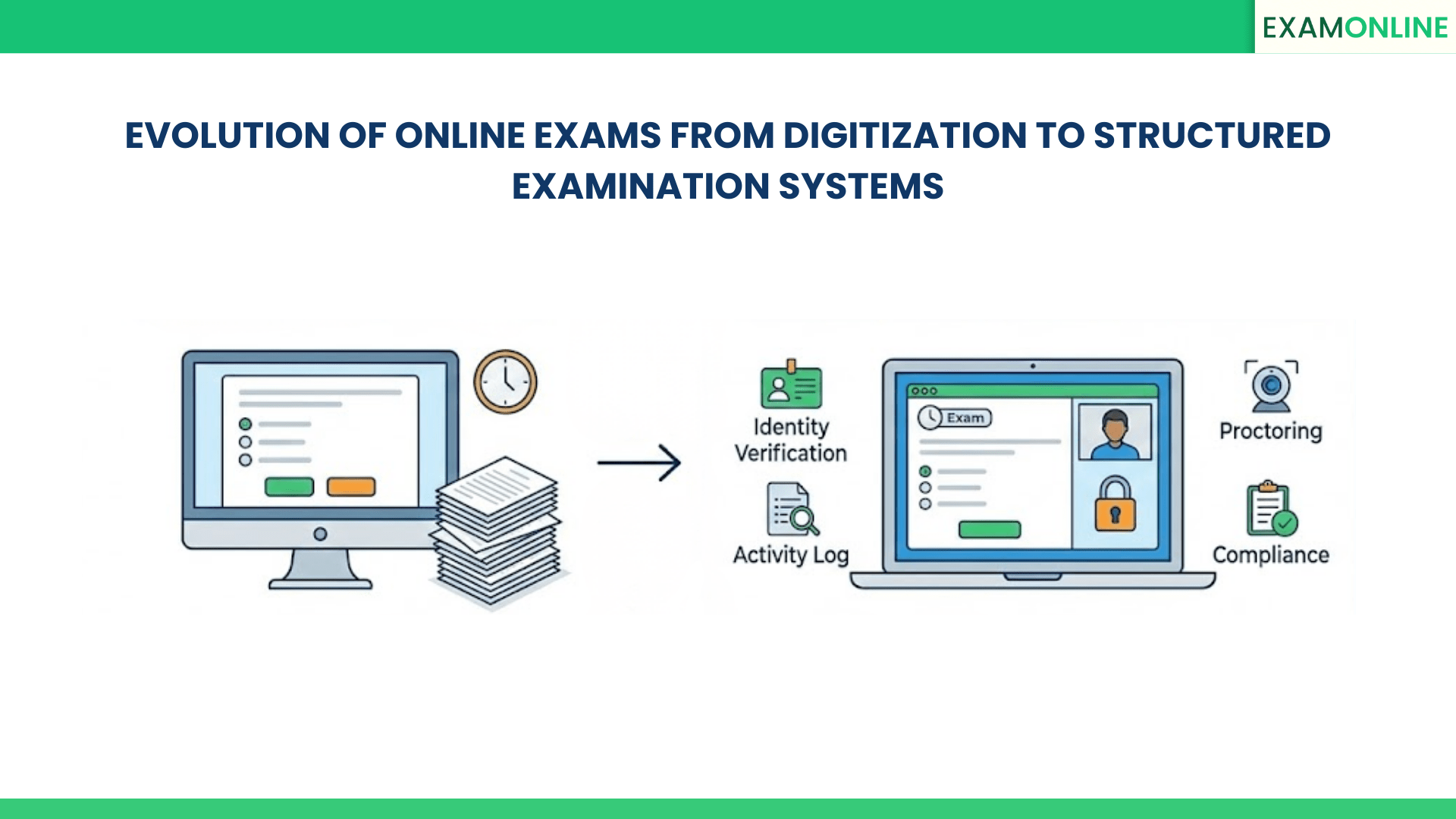
The main goals of early online tests were to digitize question papers and automate scoring. This made things easier and faster, but it didn’t give much control over checking identities, exam settings, or accountability after the exam.
Institutions transitioned from basic online tests to structured examination systems as exams grew more consequential and the number of candidates surged. These systems brought in regulated exam setups, rule-based navigation, timed procedures, and extensive recordings of activities.
The transition from simple online tests to full-fledged digital examination systems is explained in detail in our guide on the Online Examination System.
Today, online tests are more like controlled systems than random digital assessments. They are made to provide outputs that are traceable, defensible, and in line with academic standards, company regulations, and government rules.
How an Online Exam Works: End-to-End Core Process
Candidate Registration and Eligibility Management
An online system collects personal, academic, or organizational information from candidates who want to register. Eligibility regulations decide who can take the test, making sure that only approved people can take part.
Exam Design and Configuration
Administrators set up the test framework by deciding how many questions there will be, how long it will take, how to navigate, how to score, and how to submit answers. At this stage, admin decides how to grade knowledge or abilities and how consistently the test will be given to all candidates.
Exam Delivery and Candidate Attempt
Candidates can take the test using a web browser. The system uniformly enforces time limitations, navigation constraints, and response capture, guaranteeing that all candidates experience identical exam conditions, with no bias.
Submission, Evaluation, and Result Processing
Once the exam concludes, responses are submitted digitally. Objective responses are evaluated automatically, while descriptive, coding, or skill-based responses follow structured review workflows. Results are generated based on predefined evaluation criteria.
For a practical, step-by-step walkthrough of planning and running exams, see our blog on how to conduct an online exam. Together, these steps form a complete digital alternative to physical exam delivery while preserving structure and repeatability.
Candidate Journey in an Online Exam

The candidate experience in an online examination is developed to be systematic, consistent, and uniform, guaranteeing that all participants undertake the assessment under identical conditions. From the point of candidate registration, the system directs them through well-defined phases that reduce ambiguity and decrease exam-day difficulties.
Candidates initiate the process by completing registration and onboarding, during which personal information, eligibility requirements, and examination instructions are provided in advance. Prior to the examination, candidates are provided with information regarding the exam format, duration, navigation procedures, and technical specifications, enabling them to prepare with confidence.
On the day of the examination, candidates access a secure interface to access the assessment, adhere to on-screen instructions, and complete the evaluation within specified parameters. Timers, navigation controls, and submission procedures guarantee uniformity across the entire examination. Following submission, candidates are provided with conformation and, where appropriate, notifications and communication about evaluation schedules or outcomes.
This structured journey diminishes candidate uncertainty, enhances adherence to examination regulations, and guarantees that performance is assessed objectively, without any bias or advantage.
Administrative Controls in Online Exams
Online exams offer institutions complete administrative oversight throughout each phase of the examination process. Unlike traditional examinations, where oversight and enforcement differ across various locations and processes, online exams consolidate control within a unified system.
Administrators have the ability to configure examinations by establishing eligibility criteria, setting examination timeframes, determining duration, managing navigation permissions, defining scoring algorithms, and specifying submission requirements. Candidate management processes of the solution provider enable institutions to oversee registrations, track attendance, exam and attempt details and address exceptions efficiently without manual intervention.
During and post the examination, administrators are provided with comprehensive dashboards, activity logs, reports and evaluation procedures. These controls facilitate the uniform application of exam policies, enable more efficient resolution of issues, and ensure systematic validation of results.
By coordinating examination governance, online exams allow institutions to uphold consistent standards across substantial candidate populations while minimising operational complexity and reliance on human resources.
Online Exams vs Pen-and-Paper Exams
The transition from conventional pen-and-paper examinations to online assessments is motivated by structural efficiency, scalability, and governance needs. Although both formats work to assess candidate competence, their implementation methodologies vary considerably.
| Aspect | Online Exams | Pen-and-Paper Exams |
| Scalability | Easily scalable across global locations and large candidate volumes | Limited by physical infrastructure and operational capabilities |
| Logistics | No physical logistics required | Requires exam centres, printing, distribution, and storage |
| Standardisation | Uniform exam delivery and rules for all candidates | Varies across centres and invigilators, involving human inefficiencies and bias |
| Evaluation Speed | Automated and structured evaluation workflows | Manual evaluation, time-intensive |
| Auditability | Digital logs, activity records, and reports, log evidences | Limited physical records, difficult to audit, no recorded evidence in most cases |
| Candidate Reach | Accessible across geographies | Restricted to exam centre locations |
| Operational Cost | Lower long-term operational cost | High recurring logistical costs |
Although pen-and-paper examinations remain relevant for certain physical or practical assessments, online examinations provide distinct advantages for extensive, repeatable, and governance-oriented evaluations.
Types of Online Exams Based on Assessment Design

Online exams can be classified by how capability is assessed, independent of industry or institution.
Knowledge-Based Exams
These exams assess conceptual understanding, theoretical knowledge, and subject mastery. They are commonly used in academic assessments, certifications, and compliance testing where standardised evaluation is required.
Skill-Based Assessments
Skill-based exams evaluate how candidates apply knowledge in practical contexts. They focus on execution, decision-making, and task completion rather than recall, making them suitable for professional and vocational evaluation.
Coding and Technical Exams
Coding exams assess programming ability, algorithmic thinking, and technical problem-solving. Candidates work within controlled coding environments that support multiple languages, predefined constraints, and test cases.
Simulation-Based Exams
Simulation exams replicate real-world environments such as laboratories, operational systems, or decision-driven scenarios. They are used where outcomes depend on applied judgment rather than written responses, including healthcare, aviation, and operations.
Gamified Assessments
Gamified exams use interactive mechanics to evaluate cognitive ability, behavioural traits, and problem-solving patterns. These assessments are often applied in aptitude testing and early-stage talent evaluation.
By aligning exam design with the capability being measured, institutions improve assessment accuracy and relevance.
Online Exam Formats and Question Structures
Online exams support a wide range of question formats to capture different dimensions of competence. Objective formats enable efficient large-scale evaluation. Descriptive questions assess analytical thinking and structured expression. Coding tasks measure technical execution. Scenario-based questions evaluate contextual reasoning. Multimedia inputs allow assessment beyond text-based knowledge.
Combining multiple formats within a single exam reduces bias and produces a more comprehensive view of candidate capability.
Industries and Institutions Using Online Exams

Higher Education and Universities
Universities use online exams to manage large student populations, support distance learning, and standardise assessments across campuses. Online exams reduce administrative overhead while enabling consistent academic evaluation.
Certification and Professional Bodies
Certification organisations rely on online exams to deliver credentials at scale across regions. Standardised delivery, controlled evaluation, and audit-ready records are essential to maintain credential credibility.
Corporates and Enterprises
Organisations use online exams for campus hiring, lateral recruitment, and internal skill benchmarking. Online exams enable faster screening, uniform comparison, and data-driven talent decisions.
Government and Public-Sector Institutions
Public-sector bodies use online exams to ensure transparency, consistency, and defensible outcomes across jurisdictions. Centralised execution reduces operational variance and manual intervention.
Across sectors, online exams function as instruments of scale, standardisation, and institutional trust, and Online exams are being used for hiring, simplifying recruitment.
Ensuring Integrity in Online Exams Through Proctoring
Proctoring is a structured method of supervising online exams to ensure that candidates follow defined exam rules while attempting assessments from remote locations. It replaces physical invigilation with technology-enabled monitoring and verification mechanisms.
What Proctoring Does
Proctoring enforces exam rules consistently across all candidates. It ensures that the registered candidate takes the exam independently, without unauthorised assistance or environmental manipulation. By embedding supervision into the exam workflow, proctoring enables online exams to be used confidently for high-stakes assessments.
How Proctoring Works
Proctoring operates as an integrated control layer throughout the exam session. It verifies candidate identity, monitors exam activity, observes behavioural patterns, tracks device usage, and records environment-related signals relevant to exam conduct. Deviations from predefined rules are flagged and logged for review.
For a deeper breakdown of online proctoring workflows, controls, and exam scenarios, read Online Proctoring Exam Insights.
Benefits of Proctoring
Proctoring strengthens exam credibility by reducing impersonation and unfair practices. It ensures uniform rule enforcement, improves fairness across candidates, and generates structured records that support audits, reviews, and grievance resolution.
Integration With LMS and Third-Party Assessment Tools
Modern proctoring systems integrate seamlessly with learning management systems and external assessment platforms. This allows institutions to add integrity controls to existing academic or hiring workflows without disrupting established systems, while maintaining centralised reporting and data consistency.
Through these mechanisms, proctoring transforms online exams into governance-ready examination systems.
A detailed explanation of remote proctoring models, monitoring layers, and governance considerations is covered in our comprehensive Remote Proctoring guide.
Benefits of Online Exams for Institutions and Organisations
Online exams reduce dependence on physical infrastructure, lower administrative effort, and simplify coordination across locations. They accelerate evaluation cycles, improve accessibility for candidates, and generate structured data for continuous assessment improvement.
When implemented with appropriate governance and oversight, online exams enhance institutional credibility while enabling long-term scalability.
How AI Has Transformed Online Exams
Artificial Intelligence has fundamentally changed how online exams are designed, conducted, monitored, and evaluated. What were once rule-based digital exams have evolved into adaptive, intelligence-driven assessment systems capable of operating at scale while preserving credibility.
AI has shifted online exams away from static delivery models toward dynamic, data-driven examination environments that respond to candidate behaviour, assessment patterns, and integrity risks in real time.
The impact of generative AI on assessment authenticity and exam design is examined in Online Assessment Authenticity in the ChatGPT Era.
AI in Online Exam Proctoring
AI-powered proctoring has transformed remote supervision by enabling continuous, automated monitoring without reliance on physical invigilators. Computer vision and behavioural analysis models observe candidate actions, identify anomalies, and flag irregular patterns that may indicate rule violations.
These systems analyse multiple signals simultaneously, allowing institutions to monitor large candidate volumes consistently while reducing subjectivity and operational overhead. AI-driven proctoring enables scalable exam oversight while maintaining fairness across candidates.
AI in Exam Authoring and Question Design
AI has significantly improved how exams are created and maintained. Intelligent authoring tools assist in generating question variants, balancing difficulty levels, and reducing predictability through structured randomisation.
AI-driven analysis of historical exam data helps identify poorly performing questions, bias patterns, and content gaps. This enables institutions to continuously improve assessment quality rather than relying on static question banks.
AI in Evaluation and Scoring
AI has enhanced evaluation processes, particularly for descriptive, technical, and skill-based assessments. Natural language processing and pattern recognition models assist in scoring written responses, analysing code submissions, and identifying deviations from expected solution paths.
These capabilities reduce evaluation time, improve consistency, and support large-scale assessments without compromising review quality. Human oversight remains essential, but AI significantly improves efficiency and standardisation.
AI in Exam Operations and Governance
Beyond assessment and monitoring, AI plays a critical role in exam operations and governance. Intelligent systems analyse exam logs, candidate behaviour patterns, and outcome distributions to identify systemic risks and compliance issues.
AI-driven analytics support audit readiness, anomaly detection, and continuous improvement of exam policies. This enables institutions to maintain defensible examination frameworks in increasingly complex digital environments.
AI has transformed online exams from digital test delivery mechanisms into intelligent assessment systems. By integrating AI across proctoring, authoring, evaluation, and governance, institutions can conduct secure, scalable, and credible online exams even as assessment environments become more complex.
Future of Online Exams

The future of online exams is shaped by deeper integration of technology with assessment science. Simulation-based exams are expanding across healthcare, aviation, and operations. Coding and technical assessments continue to evolve for engineering and digital roles. Advanced analytics are improving exam design, question performance, and evaluation accuracy.
As regulatory frameworks mature and institutions refine governance practices, online exams are increasingly becoming long-term assessment infrastructure rather than situational alternatives.
The ExamOnline Advantage
ExamOnline delivers a unified online examination platform designed for institutions that need scale, security, and operational control without complexity. The platform brings assessment creation, online exam delivery, proctoring, evaluation, analytics, and reporting into a single system, eliminating fragmented tools and manual coordination.
ExamOnline supports academic exams, certifications, hiring assessments, and skill-based evaluations while maintaining consistent exam standards across locations. With seamless LMS and third-party assessment integrations, institutions can extend exam integrity without disrupting existing workflows.
Trusted by 250+ organisations across 25+ countries, ExamOnline enables high-volume, high-stakes online exams with confidence, governance readiness, and long-term scalability.
Frequently Asked Questions (FAQ)
What is an online exam?
An online exam is a digitally conducted assessment where candidates attempt tests using internet-enabled devices, with all exam activities managed through an online system.
Are online exams suitable for high-stakes assessments?
Yes, when supported by structured exam design, proctoring, and post-exam review mechanisms.
What types of skills can online exams assess?
Online exams can assess knowledge, practical skills, technical ability, decision-making, and behavioural traits.
How does proctoring help maintain exam integrity?
Proctoring supervises identity, behaviour, and exam activity to ensure compliance with exam rules.
What does a proctoring system typically monitor?
Proctoring systems monitor identity verification, exam activity patterns, device usage, and environment-related signals.
Can proctoring integrate with LMS platforms?
Yes, modern proctoring systems integrate with LMS platforms and third-party assessment tools.
How scalable are online exams?
Online exams are designed to support large candidate volumes across multiple locations with consistent delivery.
Are online exam results auditable?
Yes, online exams generate structured logs and reports that support audits, reviews, and grievance handling.


