Table of Contents
Introduction
Online exams are structured digital assessments that allow institutions to evaluate candidates remotely while maintaining standardized evaluation processes. Universities, certification bodies, employers, and training providers increasingly rely on online exams to manage large candidate groups without the logistical constraints of offline exams.
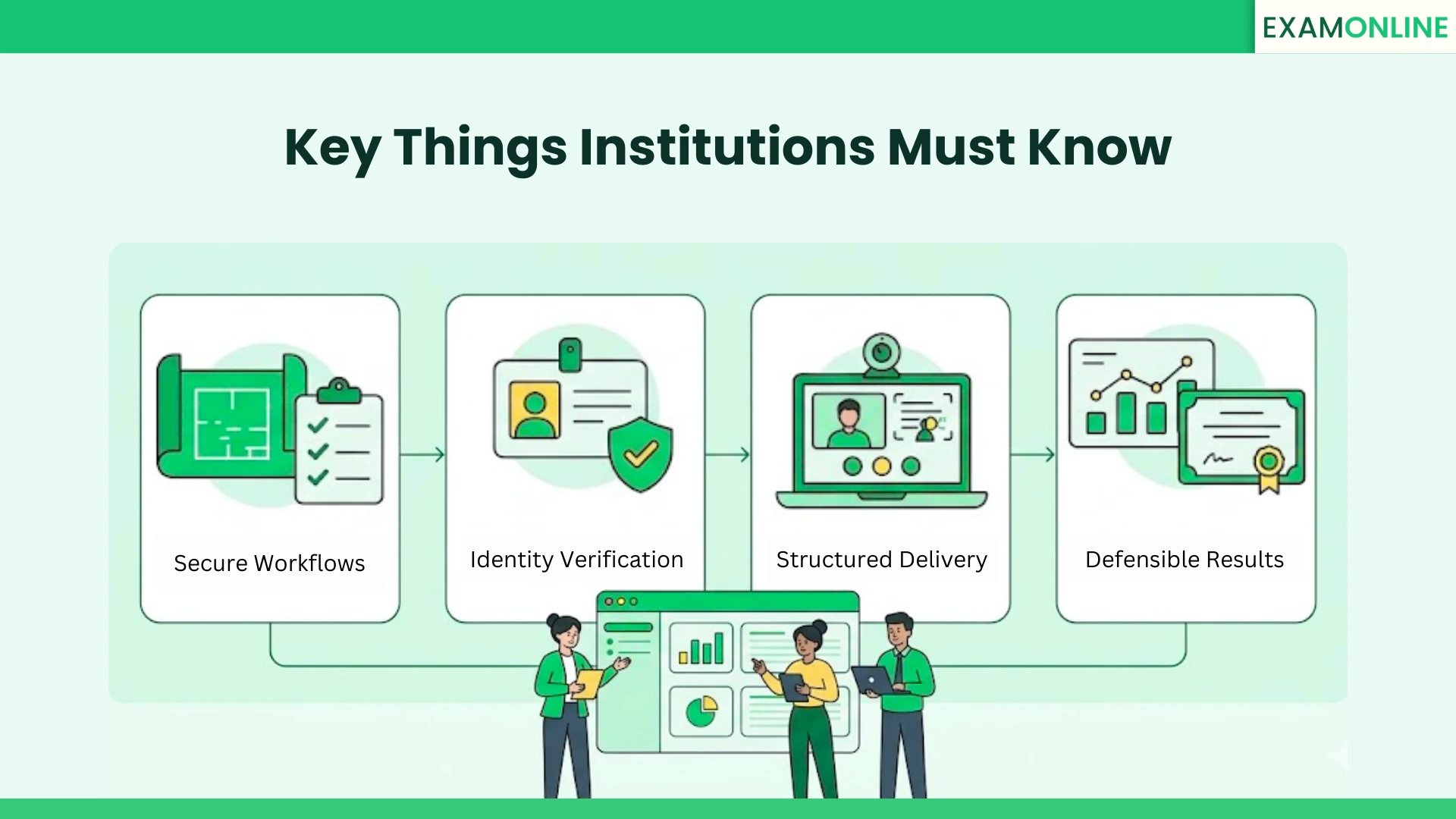
The shift toward digital evaluation has accelerated as organizations look for scalable ways to deliver assessments across locations. However, conducting online exams involves more than uploading questions to a platform. Institutions must design secure workflows, verify candidate identity, manage exam delivery, and ensure that results remain credible and defensible.
Organizations planning digital assessments therefore approach online exams as complete evaluation systems rather than standalone digital tests.
Why Institutions Are Transitioning to Online Exams
Traditional examination models depend on physical infrastructure such as printed papers, exam centres, and manual invigilation. Managing these processes becomes increasingly complex when institutions need to evaluate candidates across multiple locations.
Online exams remove many logistical barriers by allowing institutions to deliver assessments digitally. This enables organizations to conduct exams simultaneously for large candidate groups without the limitations of physical venues.
Where Online Exams Are Commonly Used
Online exams are now used across several assessment environments:
- university and higher education evaluations
- professional certification programs
- recruitment and hiring assessments
- employee training and skill verification
- government and public sector examinations
Many organizations now treat digital assessments as a core component of their evaluation strategy rather than a temporary alternative. Institutions often begin by understanding how an online exam system operates before implementing their own digital exam workflows.
What Conducting Online Exams Actually Involves
A common misconception is that conducting online exams simply means uploading questions to a digital platform. In practice, online exams require managing a complete assessment lifecycle that begins before the exam and continues even after candidates submit their responses.
Institutions must coordinate several operational components to ensure that online exams remain reliable, secure, and verifiable.
Core Workflow of an Online Exam
The typical workflow for conducting online exams includes several interconnected stages:
- candidate registration and information collection
- scheduling exam sessions or time windows
- verifying candidate identity before the exam begins
- delivering the exam through a digital interface
- monitoring candidate activity during the exam session
- evaluating responses through automated or manual grading
- publishing results and communicating outcomes
Each stage contributes to the credibility of the exam process. Weak workflows in any stage can undermine assessment reliability and create disputes around results.
Institutions therefore study how online examination systems function in practice before designing their own digital assessment infrastructure.
Define the Purpose of the Online Exam
Before designing an online exam, institutions must determine the objective of the assessment. The purpose of the exam influences the format, difficulty level, and evaluation model used during the test.
Online exams may be designed for several purposes, including academic evaluation, certification validation, recruitment assessments, or internal training programs. Each objective requires different question formats and scoring approaches.
For example, certification exams often prioritize accuracy and strict identity verification, while recruitment assessments may focus more on evaluating cognitive ability or technical skills. Without a clearly defined objective, online exams risk measuring the wrong competencies and producing unreliable outcomes.
Designing the Format of Online Exams

The structure of the exam plays a critical role in determining how effectively an assessment evaluates candidates. Online exams must be designed to ensure that the questions align with the objective of the evaluation.
Common Online Exam Formats
Institutions typically use several formats when designing online exams:
- multiple-choice questions for knowledge-based assessments
- descriptive answers for analytical evaluation
- case-based scenarios for applied decision making
- coding or simulation tasks for technical roles
Selecting the appropriate format helps institutions measure the competencies they intend to evaluate. Organizations that conduct large-scale digital assessments often review the structure of computer-based assessments when designing exam frameworks.
Security and Identity Verification in Online Exams

Maintaining exam integrity is one of the most critical challenges when conducting online exams – especially for exams designed for certifications, hiring, and other high-stake exams. Without proper security mechanisms, institutions risk impersonation, unauthorized assistance, or the misuse of exam content.
Candidate Identity Verification
Identity verification ensures that the individual taking the exam is the registered candidate. Institutions commonly use mechanisms such as:
- government ID validation
- facial authentication
- candidate photo capture before the exam begins
- verification throughout the exam session with proctoring
Exam Security Controls
In addition to identity checks, institutions implement several security measures to protect online exams:
- browser lockdown to restrict navigation
- monitoring of candidate behavior during the exam
- session recording and activity logs
- audit trails for reviewing exam sessions
Organizations concerned with exam integrity often implement frameworks similar to those discussed in online exam security practices.
Infrastructure and Operational Readiness for Online Exams
Conducting online exams requires reliable infrastructure and operational planning. Institutions must ensure that their exam systems can support candidate participation across different devices and internet environments.
Candidate Accessibility
Candidates may attempt online exams from different locations and technical environments. Institutions therefore consider factors such as device compatibility, internet stability, and clear instructions for accessing the exam platform.
Providing system checks and preparation guidelines helps reduce technical disruptions during the exam.
Exam Operations at Scale
When institutions conduct exams for large candidate groups, operational coordination becomes critical. Key operational considerations include:
- managing large volumes of candidate registrations
- allocating exam slots or time windows
- supporting candidates during technical interruptions
- managing retake attempts when required
Organizations planning large-scale assessments often centralize these processes using systems similar to those described in online assessment platforms.
Evaluation, Results, and Certification Workflow
The evaluation process begins once candidates complete the exam. Institutions must establish transparent workflows for grading, result publishing, and candidate communication.
Online exam systems often combine automated evaluation with manual review where necessary. Multiple-choice questions may be graded automatically, while descriptive answers or case responses may require human evaluation.
Once grading is completed, results are published and candidates are notified. In certification programs, this stage also includes generating digital certificates and maintaining records of exam outcomes.
A structured evaluation workflow ensures that exam results remain transparent and defensible if candidates question the outcome of the assessment.
Step-by-Step Process to Conduct Online Exams
Institutions that successfully conduct online exams typically follow a structured process. This ensures that each stage of the exam lifecycle is properly managed.
A typical process includes:
- defining the objective of the exam
- designing the exam format and question structure
- registering candidates and collecting required information
- scheduling exam sessions or time windows
- verifying candidate identity before the exam begins
- delivering the exam through a secure digital interface
- monitoring exam sessions to maintain integrity
- evaluating candidate responses through automated or manual grading
- publishing results and issuing certificates where applicable
Following a structured process helps institutions maintain consistency across exam sessions and ensures that the assessment remains reliable.
Technology Platforms Used to Conduct Online Exams
Modern exam platforms simplify the process of conducting online exams by centralizing multiple workflows within a single system. These platforms allow institutions to manage exam creation, candidate registration, scheduling, monitoring, and evaluation through a unified interface.
Technology platforms also help institutions maintain exam integrity by providing monitoring tools, activity logs, and reporting systems that track candidate behavior during the exam.
By automating several operational processes, digital exam platforms reduce administrative workload and help institutions conduct assessments at scale.
How ExamOnline Supports Institutions Conducting Online Exams
Institutions conducting digital assessments often require platforms capable of managing the complete exam lifecycle. ExamOnline supports organizations across 25+ countries and 250+ organisations, enabling institutions to manage secure and scalable digital exams.
The platform supports an end-to-end certification workflow that includes candidate registration, slot booking, payment gateway integration, identity verification, exam delivery, and evaluation processes. Institutions can also configure multiple exam attempts and automate certificate generation once candidates complete the assessment.
ExamOnline further enables organizations to distribute certificates automatically while maintaining secure records of exam sessions and results. Institutions that require secure monitoring can integrate advanced capabilities through the remote proctoring tool to maintain exam integrity across distributed candidate environments.
Digital assessment platforms become essential when institutions need to scale exams while maintaining defensible evaluation processes.
Conducting online exams is not simply about digitizing tests – it requires structured systems that ensure evaluation remains scalable, secure, and credible.

Frequently Asked Questions (FAQ)
What are online exams?
Online exams are digital assessments conducted through internet-based platforms that allow institutions to evaluate candidates remotely while maintaining standardized evaluation procedures.
How do institutions prevent cheating in online exams?
Institutions use several mechanisms such as identity verification, browser restrictions, behavior monitoring, and session recording to maintain exam integrity during online assessments.
What technology is required to conduct online exams?
Institutions typically require an online examination platform that supports exam creation, candidate registration, scheduling, monitoring, and evaluation workflows.
Can online exams support large candidate volumes?
Yes. Digital exam platforms are designed to handle large candidate groups simultaneously by automating exam delivery, monitoring, and evaluation processes.
Are online exams suitable for certification programs?
Online exams are widely used in certification programs because they allow organizations to verify candidate competencies while maintaining secure and standardized evaluation procedures.