

Table of Contents
Introduction
Computer based exams have become a standard assessment format across education, certification, hiring, and institutional evaluation. As assessment volumes increase and expectations around consistency, fairness, and scalability rise, organisations are increasingly evaluating computer based exams as a foundation for reliable and repeatable assessment outcomes.
Choosing computer based exams is not simply a technology upgrade. It is a structural decision that influences exam standardisation, assessment quality, candidate experience, and the ability to scale assessments without operational strain.
What Is a Computer Based Exam?

A computer based exam is an assessment conducted using a digital interface where questions are presented on a computer and candidate responses are captured electronically under predefined rules. The exam structure, timing, navigation, and submission behaviour are controlled by software rather than manual supervision.
Computer based exams define the format of assessment, not the delivery location. They can be conducted at physical exam centres using dedicated systems or delivered remotely to candidates through internet-enabled platforms, while maintaining the same exam structure and evaluation logic. This separation of format from delivery allows institutions to standardise assessments while remaining flexible in execution.
A detailed, execution-focused view of how institutions plan and run computer based exams is explained in how to conduct computer based exams.
Core Components of a Computer Based Exam System
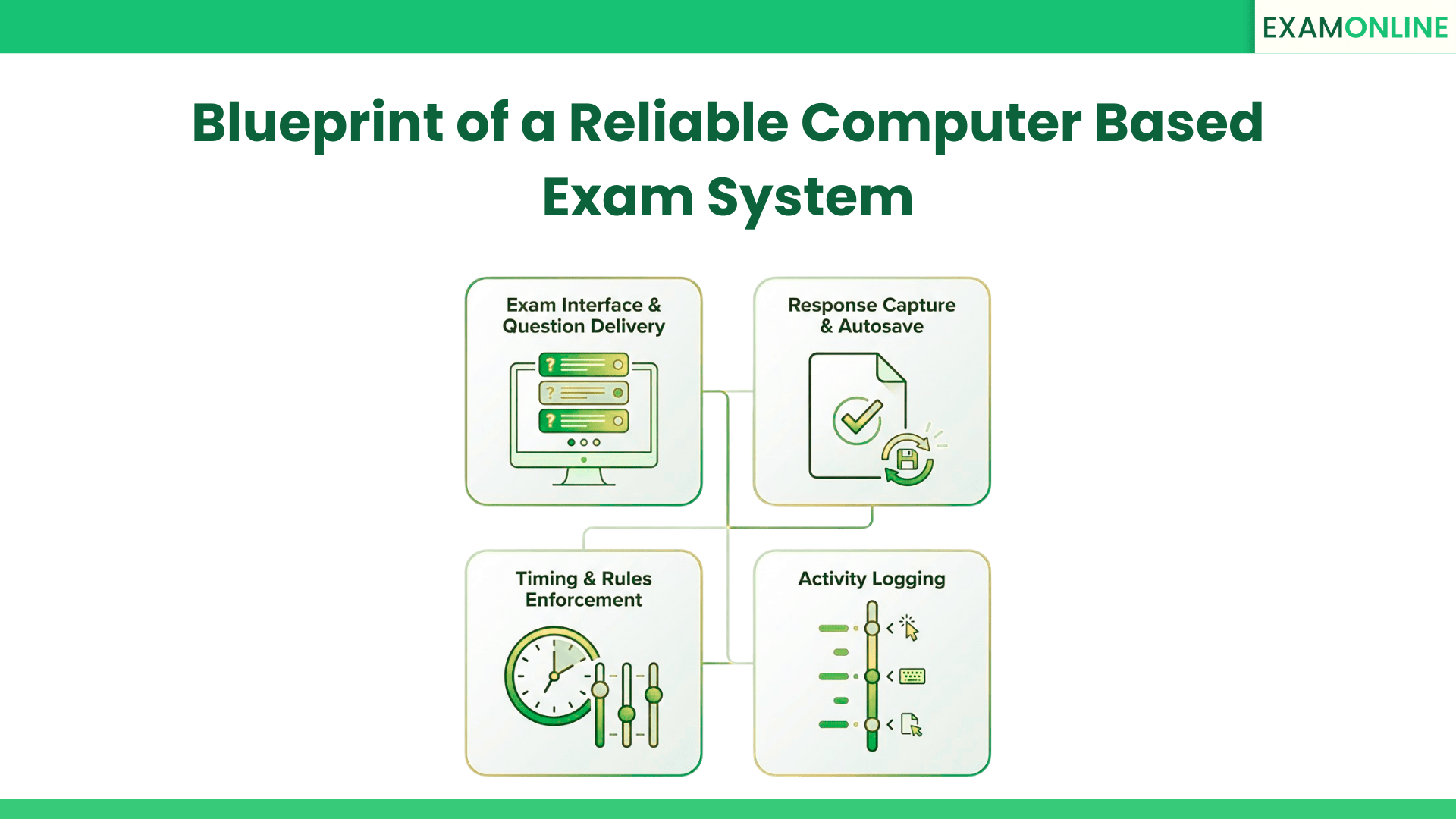
A computer based exam system is built around a set of core components that work together to ensure consistent delivery, reliable response capture, and structured evaluation. These components define how the exam behaves for every candidate.
Exam Interface and Question Delivery
The exam interface presents questions, instructions, and navigation controls in a uniform manner. It governs how candidates move between sections, mark responses, and submit answers, ensuring a consistent experience across sessions.
Response Capture and Autosave Mechanisms
Responses in computer based exams are captured digitally and saved continuously. Autosave mechanisms protect candidate inputs against disruptions, reducing the risk of data loss and ensuring response integrity throughout the exam session.
Timing, Rules, and Activity Logging
Computer based systems enforce exam timing, submission rules, and section constraints automatically. At the same time, they generate time-stamped activity logs that record candidate interactions, supporting transparency and post-exam review.
These components together form the technical foundation upon which delivery, security, and governance layers are added.
Types of Computer Based Exams

| Type of Computer Based Exam | Description | Typical Use Cases |
| Centre-based computer exams | Exams conducted on computers at physical locations | Entrance exams, government tests |
| Remote computer based exams | Exams delivered to candidates in remote locations | Online education, global certifications |
Computer based exams can be implemented in multiple forms depending on delivery context, infrastructure availability, and assessment objectives. While the core exam format remains digital, the way it is deployed can vary without compromising standardisation or evaluation integrity.
Centre-Based Computer Exams
Centre-based computer exams are conducted in controlled physical locations where candidates attempt assessments on designated computer systems. These environments are commonly used for:
- Entrance and eligibility exams
- Government and public-sector tests
- Large-scale academic assessments
Remote Computer Based Exams
Remote computer based exams allow candidates to attempt assessments from their own locations while using the same computer-based exam interface and rules. This format expands reach without changing assessment structure and is widely adopted in distance education, global certifications, and distributed hiring programs.
How Computer Based Exams Differ from Paper-Based Exams

| Aspect | Computer Based Exams | Paper-Based Exams |
| Exam delivery | Digital interface on computers | Printed question papers |
| Rule enforcement | Software-enforced, uniform | Invigilator-dependent |
| Response capture | Automatic digital capture | Manual writing |
| Evaluation speed | Faster, automated workflows | Slower, manual checking |
| Standardisation | High and consistent | Varies by centre |
| Auditability | Digital logs and records | Limited physical records |
Computer based exams differ fundamentally from paper-based exams in how assessments are controlled, executed, and evaluated. The shift is not limited to replacing paper with screens, but to embedding exam rules and processes directly into software.
Unlike paper-based exams, where invigilation and compliance rely heavily on human supervision, computer based exams enforce discipline programmatically.
Key differences include:
- Automatic enforcement of time limits and navigation rules
- Elimination of manual paper handling and distribution
- Digital response capture with reduced risk of loss or damage
- Faster and more consistent evaluation workflows
These differences make computer based exams more predictable, auditable, and scalable, especially when assessments must be repeated across large candidate volumes.
When Assessments Need to Measure Applied Capability
Computer based exams are especially effective when assessments must evaluate more than factual recall. Digital exam environments allow institutions to design assessments that reflect real-world tasks, decision-making, and problem-solving rather than static answers.
Assessment Designs Enabled by Computer Based Exams
Computer based formats support a wider range of assessment types, including:
- Descriptive and analytical responses
- Coding and technical problem-solving tasks
- Scenario-based and simulation-driven questions
- Multimedia inputs such as images, audio, and video
By aligning assessment design with the actual capability being measured, institutions improve both relevance and evaluation accuracy. This approach is particularly valuable in professional education, technical hiring, and competency-based certifications.
Design principles and best practices are explained in computer-based assessment design insights.
Role of Security and Monitoring in Computer Based Exams

Computer based exams introduce a fundamental shift in how exam security is implemented. Instead of relying solely on physical supervision, computers enable rule-based controls, activity logging, and system-level restrictions that operate consistently across candidates.
At the computer-based format level, security focuses on:
- Enforcing exam rules through software logic
- Restricting unauthorised actions such as navigation misuse
- Capturing exam activity data for post-exam review
- Ensuring response integrity through continuous autosave and logging
These controls establish a baseline level of exam discipline that is not possible in paper-based environments.
Security Layers in Computer Based Exam Environments
Computer based exams implement multiple security layers at the system level to enforce exam discipline and protect response integrity. These controls operate through software-defined rules rather than manual supervision, ensuring consistent enforcement across all candidates regardless of where the exam is conducted.
Baseline security layers common to all computer based exams include:
- Controlled exam interfaces with restricted navigation
- Device-level checks to limit unauthorised applications or actions
- Session tracking with time-stamped activity logs
- Secure transmission and encrypted storage of exam responses
In centre-based computer exams, these system-level controls are enforced within a physically supervised environment. Invigilators, controlled infrastructure, and standardised hardware complement the software controls, creating a layered security model where physical supervision reinforces digital enforcement.
For remote or distributed computer based exams, additional supervision mechanisms are introduced to replace physical invigilation and maintain equivalent levels of integrity. These integrity-focused controls and supervision models are explained in remote exam supervision frameworks.
Remote supervision approaches, monitoring depth, and integrity workflows for off-site exams are explained in remote proctoring models for online exams.
Where Computer Based Exams Are Used Today
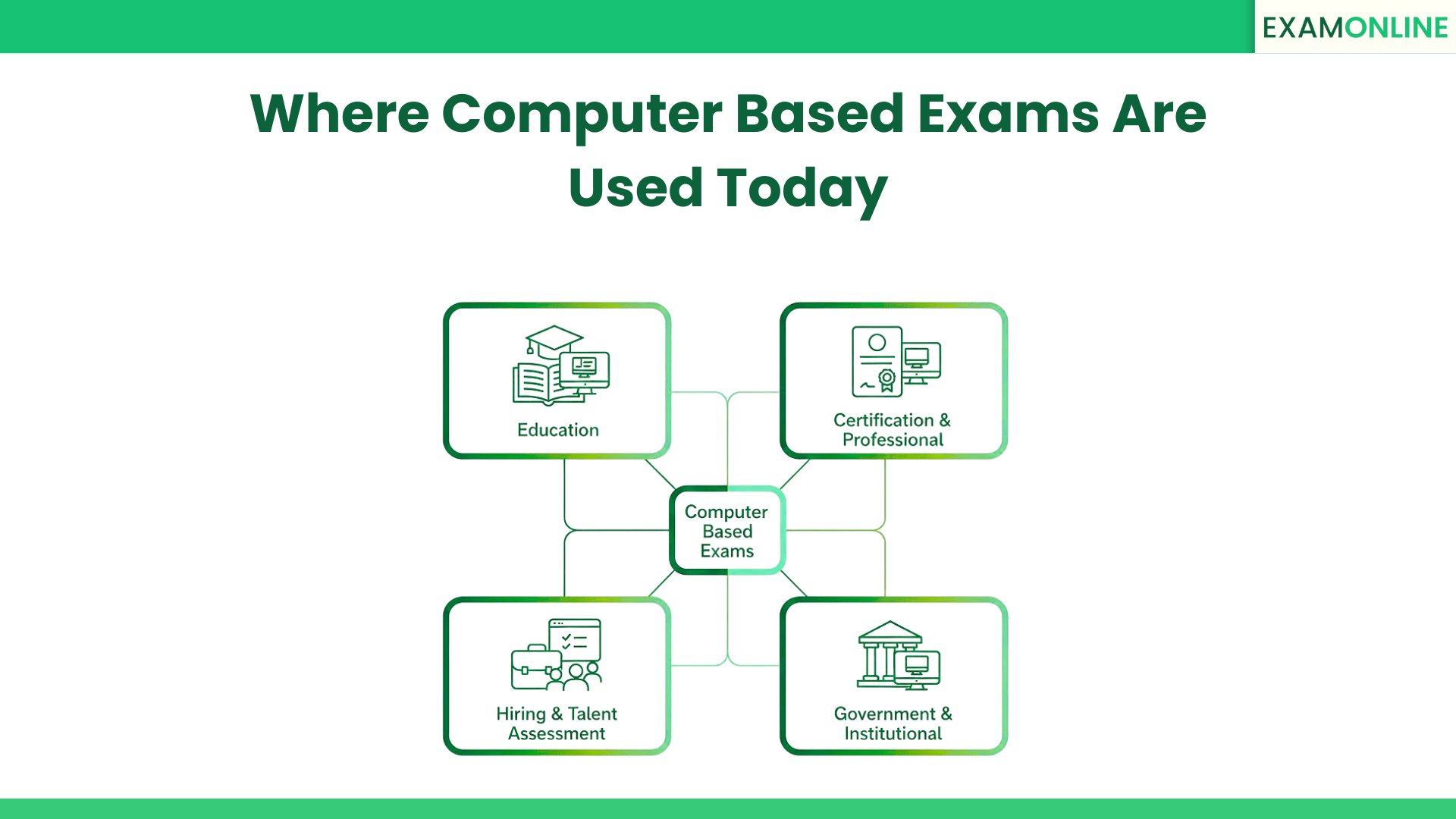
Computer based exams are widely adopted across sectors that require standardised, repeatable, and scalable assessments. Their flexibility allows the same core exam format to be deployed across different contexts without compromising consistency.
Education, Certification, and Professional Evaluation
Educational institutions use computer based exams for:
- Semester and internal assessments
- Entrance and eligibility tests
- Online and blended academic programs
Certification bodies rely on computer based formats to deliver credentials at scale while maintaining uniform evaluation standards across regions.
Hiring, Talent Assessment, and Workforce Evaluation
In recruitment and talent assessment, computer based exams support:
- Aptitude and technical screening
- Role-specific skill evaluation
- Structured comparison across large candidate pools
These assessments benefit from consistent scoring logic and reduced manual bias.
Government and Institutional Testing
Government bodies and public institutions use computer based exams to manage:
- High-volume examinations
- Regionally distributed candidates
- Transparent and auditable assessment processes
Across all these use cases, computer based exams act as the foundational assessment format, with delivery, integrity, and governance layers added as required. Broader delivery considerations are explored in internet-enabled exam delivery systems.
How Computer Based Exams Fit Into Modern Digital Assessment Systems
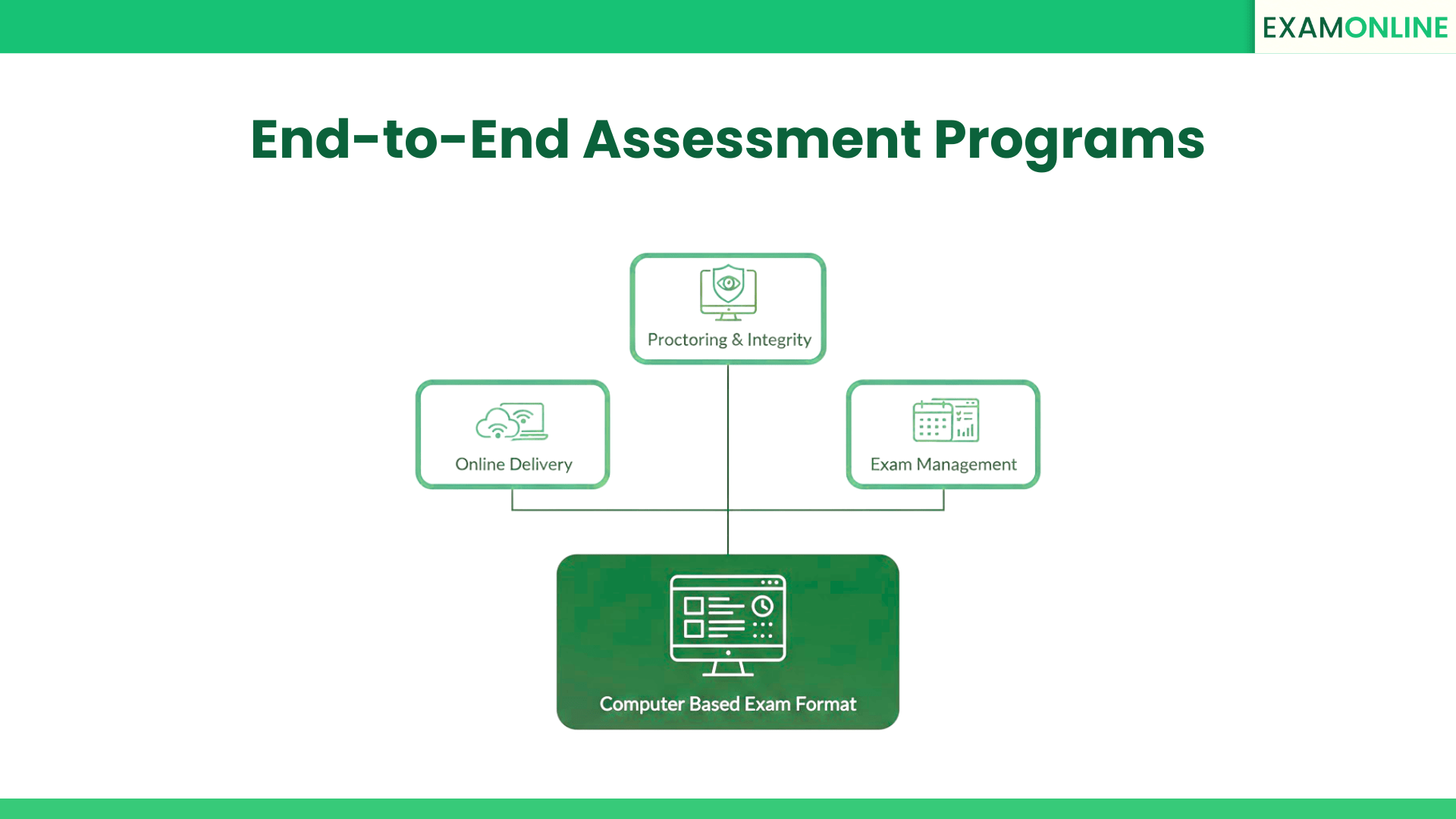
Computer based exams form the format layer of modern digital assessment ecosystems. They define how questions are presented, how responses are captured, and how exam rules are enforced at the system level.
In practice, computer based exams operate alongside:
- Online delivery frameworks that enable remote access
- Proctoring mechanisms that enforce exam integrity
- Exam management systems that govern planning, execution, and reporting
The technology layer that enforces monitoring rules, evidence capture, and exam controls at scale is covered in exam supervision and enforcement platforms.
Each layer builds on the computer-based format without replacing it.
From Exam Format to End-to-End Assessment Programs
As assessment programs grow in scale and frequency, institutions integrate computer based exams into structured operational workflows. Planning, scheduling, monitoring, evaluation, and record management are coordinated through centralised systems.
These governance and lifecycle considerations are addressed in large-scale exam administration frameworks.
When Consistency and Standardisation Are Critical
Computer based exams are the right choice when institutions require uniform exam conditions for every candidate, whether exams are conducted at physical centres or delivered remotely. Unlike paper-based exams, where invigilator behaviour, centre environments, and manual handling can introduce variation, computer based formats enforce exam rules directly through software.
By embedding timing, navigation, instructions, and submission logic into the exam system itself, computer based exams ensure that candidates experience the same assessment structure and constraints, independent of location or delivery model. This makes them especially suitable for assessments where comparability, repeatability, and defensibility of results are non-negotiable.
How Computer Based Exams Enforce Uniformity
Computer based exams standardise assessment delivery by embedding rules into the exam system itself, rather than relying on human interpretation.
Key elements that ensure consistency include:
- Fixed time limits applied equally to all candidates
- Uniform navigation rules and question sequencing
- Automated response capture with autosave protection
- Identical instructions and interfaces across exam sessions
This level of standardisation is essential in academic grading, certifications, and hiring assessments where outcomes must be comparable, repeatable, and defensible.
When Computer Based Exams Are the Right Choice
Computer based exams are the right choice when organisations need controlled, repeatable, and scalable assessments that can be delivered consistently across candidates, locations, and exam cycles. Rather than being a situational alternative, computer based exams act as a baseline assessment format on which additional delivery and integrity layers can be applied.
They are particularly effective when:
- Large candidate volumes must be assessed efficiently
- Uniform exam rules and evaluation standards are required
- Faster evaluation and result processing are important
- Physical logistics such as printing, storage, and manual handling need to be reduced
These conditions are common across education, certification, hiring, and institutional testing environments. Computer based exams allow organisations to standardise assessment execution while remaining flexible enough to adapt to different delivery contexts.
How ExamOnline Supports Computer Based Exams
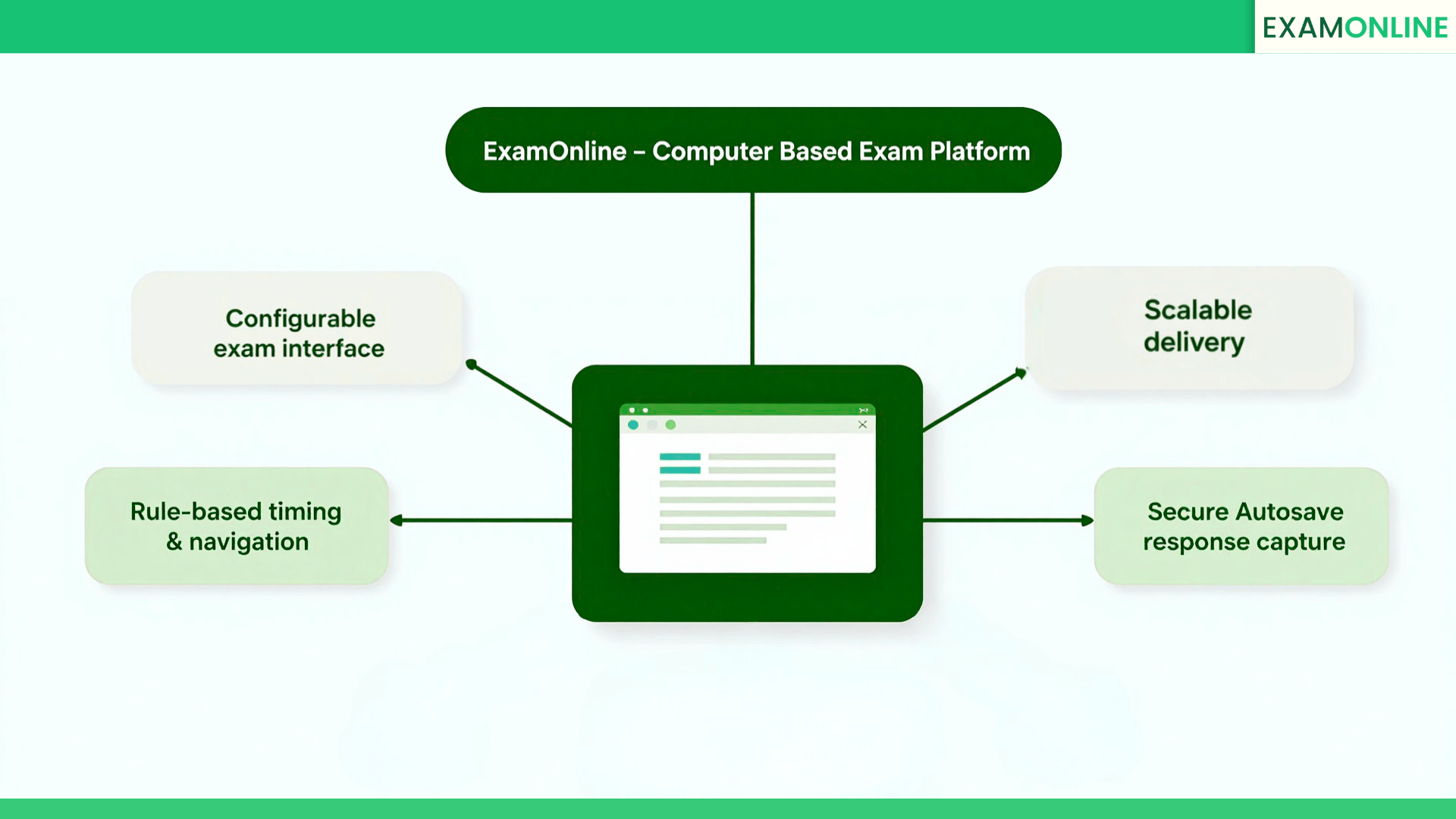
ExamOnline supports computer based exams as a standardised assessment format across centre-based and remote execution models. Institutions can conduct exams within physical centres using controlled infrastructure and supervised environments, while applying the same computer based exam structure, rules, and evaluation logic consistently across candidates.
The same exam format can also be extended to remote candidates when required, without altering exam design, timing rules, navigation controls, or scoring workflows. This allows organisations to choose the most appropriate delivery context for each assessment while preserving standardisation and result comparability.
By clearly separating exam format from exam delivery, ExamOnline enables institutions to operate computer based exams as repeatable, governed assessment programs rather than isolated implementations, supporting long-term academic, certification, hiring, and institutional testing needs.
Used by 250+ organisations across 25+ countries, ExamOnline supports academic, certification, hiring, and institutional assessments that require consistency, scale, and defensible outcomes.

Frequently Asked Questions (FAQs)
What is a computer based exam?
A computer based exam is an assessment conducted using a computer interface where questions are presented digitally and responses are captured electronically under predefined rules.
Are computer based exams the same as online exams?
No. Computer based exams refer to the assessment format, while online exams describe the delivery method. Computer based exams can be conducted in centres or remotely.
Can computer based exams be used for high-stakes assessments?
Yes. When combined with appropriate security, supervision, and governance layers, computer based exams are widely used for high-stakes academic, certification, and hiring assessments.
What devices are required for computer based exams?
Computer based exams typically require a desktop or laptop computer. Device requirements may vary based on exam rules and delivery context.
How do computer based exams improve evaluation efficiency?
They enable automatic response capture, faster scoring workflows, reduced manual handling, and structured reporting, improving speed and consistency of evaluation.
Do computer based exams require an internet connection?
Not always. Some computer based exams are conducted on local networks at exam centres, while others require internet connectivity for remote delivery, monitoring, or result processing.
Can computer based exams support different question formats in a single test?
Yes. Computer based exams can combine objective, descriptive, coding, and multimedia questions within the same assessment while applying uniform rules and evaluation logic.


