
Table of Contents
The exam was over. The results were verified and published on schedule. Every candidate who passed had access to their scorecard through the result portal. Three weeks later, an HR manager at a hiring firm called the certification body’s helpdesk for the ninth time that month. A candidate’s paper certificate had arrived damaged in the post. Another candidate’s certificate showed the wrong examination date. A third candidate’s employer wanted to verify the credential, but the certification body’s verification process required a formal written request and a five-business-day response window. The exam had been flawless. The exam certification process had let the institution down at the final step.
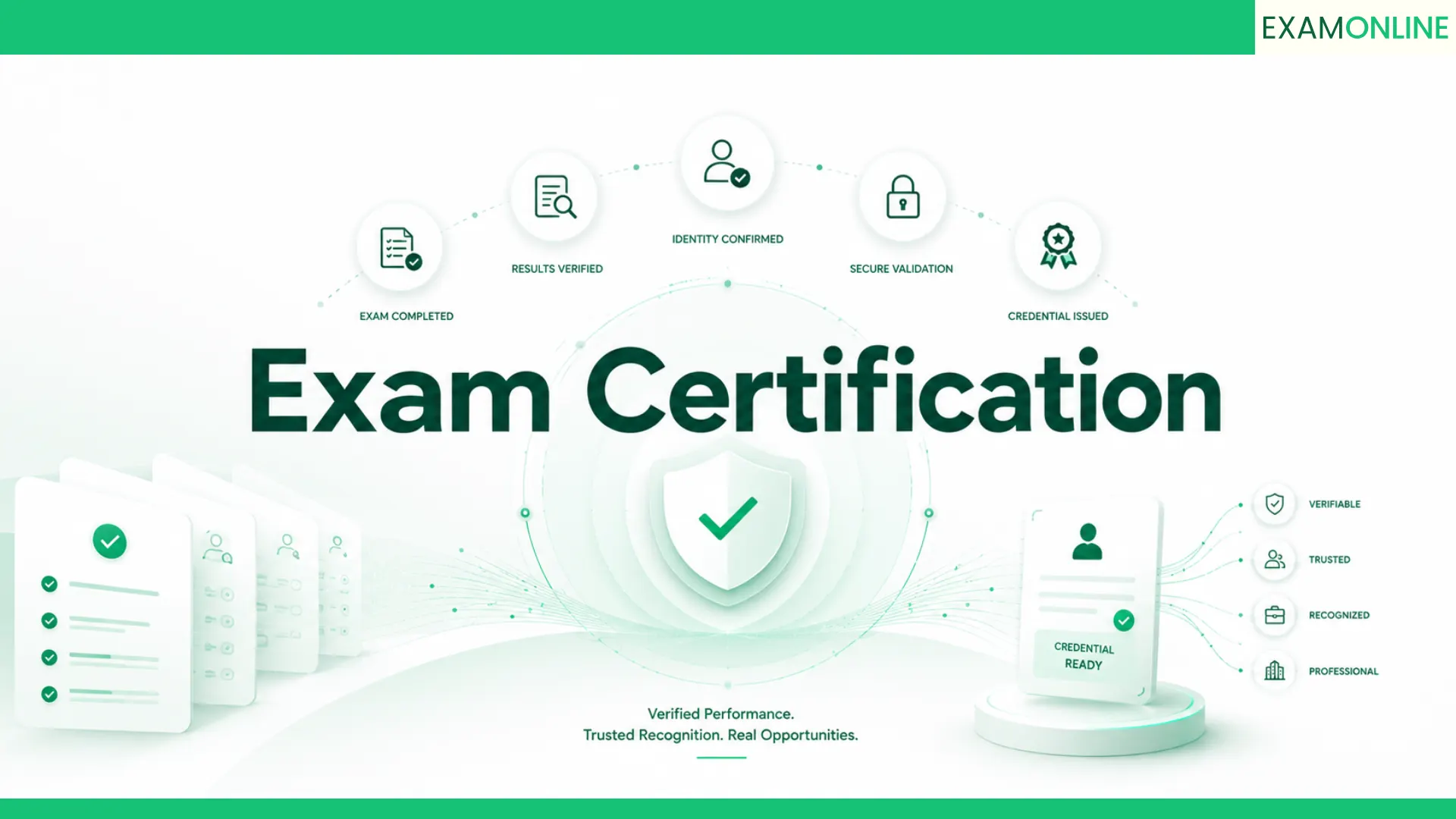
Exam certification is the final stage of the online exam lifecycle, and it is the stage that determines how long the value of the entire assessment event lasts. A credential issued quickly, formatted professionally, and verifiable instantly retains its value for the full duration of the candidate’s career. A credential that arrives late, looks generic, cannot be verified by an employer in under sixty seconds, or is stored only as a PDF that candidates can alter has an integrity problem that the exam itself may have been perfectly designed to prevent. The certification stage is where assessment quality either becomes credential trust or fails to complete that translation.
This is Post 5 of the ExamOnline five-part series on the online exam lifecycle, and the final post in this series. It covers every element of exam certification from the verified scorecard produced in the exam result processing stage through digital certificate generation, credential issuance, verification architecture, badge integration, compliance, and certificate tracking. Read the complete series overview in the online exam lifecycle guide for the full picture, or start from Post 1: Online Exam Registration to follow the full lifecycle from the beginning.
➤ Following the series in order? Welcome to the final post. Or revisit the full series in the Online Exam Lifecycle Guide
The Credential Gap That Follows Every Passed Exam
Every candidate who passes a high-stakes exam faces the same problem in the hours after their result is confirmed. They have performed. They have a score. They have a scorecard. What they lack is proof of their achievement that an employer, institution, or professional body will accept instantly without needing to contact the issuing organisation, wait for a verification process, or question the authenticity of a PDF certificate attached to an email. This gap between a verified result and a trusted credential is the exam certification gap, and for many organisations running assessments, it lasts days, weeks, or in some cases months after the result is released.
The credential gap is a business problem as much as it is a candidate experience problem. Every day a qualified candidate waits for their formal certificate is a day their hiring process is delayed. Every time an employer requests manual credential verification from the issuing body, a staff member at that body spends administrative time on a process that an automated certificate verification system would resolve in seconds. Every fraudulent credential that circulates because the issuing body has no public verification infrastructure undermines the value of every legitimate credential issued alongside it. The exam certification gap costs candidates, employers, and institutions simultaneously and continuously.
The gap exists because most organisations treat exam certification as the final administrative step in the exam process rather than as a designed system with its own infrastructure requirements. Certificate templates are created in document software. Certificates are issued as PDFs by email. Verification is handled by a phone call or a formal written request. This is the paper certificate workflow applied to digital assessment, and it fails at every scale above a few hundred candidates per year. Digital credential infrastructure has matured significantly over the past decade, and the organisations that close the credential gap permanently are the ones treating exam certification as a connected, automated stage of the exam lifecycle rather than a manual post-exam activity.
The credential gap also widens with assessment volume. An organisation issuing twenty certificates a month can manage a manual process with effort. An organisation issuing twenty thousand certificates a month from across multiple exam sittings, assessment types, and qualification levels needs automated certificate generation, a digital credential platform, and a public verification infrastructure that operates without administrator intervention at any volume. Explore ExamOnline’s certification exam platform to see how the credential gap is closed through connected, automated exam certification built into the full assessment lifecycle from registration through to verified digital credential.
Every Step in the Exam Certification Stage Explained
Exam certification is a sequence, and like every stage in the online exam lifecycle, the quality of each step determines the reliability of the next. The certification stage begins where exam result processing ends: with a verified scorecard confirming the candidate’s performance and integrity status. It closes with a tamper-proof digital certificate delivered to the candidate’s registered contact and stored in a system that any authorised employer or institution can query for instant verification. Every step between those two points is a decision about the trust and utility of the credential being issued to every qualifying candidate.
The first decision in the exam certification stage is whether the candidate’s verified result triggers a certificate generation event. In a professional certification context, only candidates whose score meets or exceeds the configured qualifying threshold receive a certificate. In a course completion context, every candidate who submitted their assessment within the configured parameters receives a completion certificate regardless of score. In a graded completion context, candidates receive certificates reflecting their performance tier. Each triggering condition is configured in the exam administration software before the assessment opens, meaning the exam certification decision is automatic and consistent across every candidate in the cohort without any manual review.
After the triggering condition is confirmed, the certificate generation engine populates the digital certificate template from the candidate’s verified record. Every field on the certificate draws from the same candidate data layer used across the full exam lifecycle: the name registered at online exam registration, the exam title and date, the score or grade where it appears on the certificate, the qualifying threshold, the digital signature of the issuing authority, the unique certificate ID, and the verification URL or QR code linking to the official record. The certificate is generated dynamically rather than assembled manually, which means every certificate in every cohort is accurate and consistent across the full candidate population.
The Complete Exam Certification Sequence
Here is the full ten-step sequence that makes up a well-managed exam certification workflow from verified scorecard to delivered credential:
- Qualifying threshold check confirming the candidate’s verified score meets the certificate triggering condition configured for this exam
- Certificate generation trigger dispatched automatically to the certificate generation engine on threshold confirmation
- Candidate data retrieval from the verified result record and the registration database on the same connected platform
- Dynamic certificate template population with all candidate-specific and exam-specific fields from the verified record
- Digital signature application from the issuing authority’s authenticated signing key for tamper-evident certification
- Unique certificate ID generation and assignment linked permanently to the verified result record in the credential management system
- Verification URL and QR code generation linking the certificate to the official result in the public verification portal
- Digital certificate delivery to the candidate through registered email and the online certificate portal simultaneously
- Certificate record storage in the credential management system for employer verification queries at any future date
- Certificate tracking event logged to the audit trail with issuance timestamp and delivery confirmation for every candidate
Each of these ten steps, when automated and connected to the exam result processing stage on a single platform, produces a digital certificate that every candidate receives immediately and every employer can verify instantly. Explore ExamOnline’s online examination solution for a view of how the full certification sequence operates within the connected exam lifecycle platform from first registration to final credential.

Why Paper Certificates Fail Modern Hiring Processes
Paper certificates were designed for a world where hiring decisions were made slowly, verification was conducted in person or by post, and credential fraud was difficult because reproduction required physical access to secure printing materials and equipment. None of those conditions apply in modern hiring environments. Hiring decisions in competitive markets are made in hours rather than weeks. Credential verification is expected in seconds rather than days. Certificate fraud is achievable with basic document editing software that any motivated candidate can access freely. The paper certificate is a trust mechanism designed for a different era and applied to a different threat model, and it consistently fails both.
The employer experience of verifying a paper certificate reveals its limitations immediately. The employer receives a PDF certificate attached to a candidate’s application. That PDF may have been generated by the legitimate certification body, or it may have been edited using any of the widely available document editing tools accessible to any candidate. The only way to confirm which is true is to contact the issuing body directly. That contact requires finding the right contact point, submitting a request, waiting for a response, and receiving a confirmation. In a competitive hiring process where a strong candidate has multiple simultaneous offers, that verification lag is a hiring process failure regardless of whose administrative bandwidth it consumes.
Digital certificate fraud is the downstream consequence of paper certificate workflows applied to digital assessment at scale. When certificates are issued as unprotected PDFs without embedded verification links, without a public registry query capability, and without tamper-evident formatting, they are functionally equivalent to a document any competent candidate could fabricate with sufficient motivation. The certification body bears the reputational consequences of fraud committed with a certificate format they issued, even though the fraud was made possible by a certificate infrastructure they chose. The decision to issue unverifiable certificates is a credential security decision with long-term institutional reputational implications that compound with every cohort issued.
The comparison between paper certificates and digital credentials is clear across every dimension that matters to a modern hiring process. Digital certificates with embedded verification links resolve employer queries in seconds. Digital certificates stored in a credential management system are tamper-evident by design. Digital certificates delivered through a digital credential platform are accessible on any device, immediately shareable with any employer, and permanently retrievable through the online certificate portal regardless of whether the candidate still has access to the original email they received on results day.
Paper Certificates vs Digital Certificates: A Direct Comparison
| Dimension | Paper Certificate | Digital Certificate |
|---|---|---|
| Verification speed | Days via phone call or formal written request | Seconds via URL click or QR code scan |
| Fraud resistance | Easily reproduced with standard document editing software | Tamper-evident with cryptographic digital signature |
| Delivery method | Physical post or unsecured PDF email attachment | Secure portal delivery with permanent online access |
| Storage and retrieval | Physical storage or unsecured file on candidate’s device | Permanent record in credential management system |
| Sharing capability | Physical copy or email attachment only | Direct link shareable on any platform or application |
| Employer experience | Manual verification with multi-day wait for response | Instant query against public verification portal |
| Issuing cost at scale | Printing, posting, and manual processing per certificate | Automated generation at near-zero marginal cost |

Designing Digital Certificates That Carry Real Weight
A digital certificate that looks like a scanned version of a paper certificate carries the same credibility problems as the paper original, only in a format that can be shared more widely and questioned more rapidly. The design decisions in a digital certificate are trust signals, and they operate before the employer reads a single word of content. An employer who receives a digital certificate evaluates it in the first ten seconds: does it look like it was issued by a credible organisation, does it contain the information needed to assess the qualification, and can it be verified without a phone call. Those three evaluations happen at the design level, and they are determined by decisions made at the exam certification stage.
The information architecture of a well-designed digital certificate covers every field an employer or institution needs to make a qualification decision without contacting the issuing body. The candidate’s full name exactly as registered. The qualification or exam title. The issuing organisation’s name and official mark. The date of exam certification. The score, grade, or performance tier where the exam format includes one. The unique certificate ID. The verification URL and QR code. The digital signature of the authorised signatory. Each field is non-negotiable in a professional certification context, and each one draws from the verified result record on the exam certification platform to ensure accuracy and consistency across every candidate’s certificate.
Visual design in digital certificate creation serves a specific function beyond aesthetics: it signals institutional credibility to an employer making a rapid assessment judgment under time pressure. A certificate with a well-structured layout, consistent typography, the issuing body’s official branding, and a clearly marked verification element communicates institutional seriousness before a word is read. A certificate that appears to have been produced in a general-purpose document template communicates the opposite impression, regardless of the exam’s actual rigour and the candidate’s genuine achievement. Digital certificate design is the certification stage’s direct contribution to the institution’s professional brand.
Certificate personalisation at scale is the capability that distinguishes a professional digital certificate platform from a template tool. In a large certification programme, different qualification levels, performance tiers, and exam types all require certificate variants assigned automatically based on the candidate’s result record. The certificate generation software that handles this personalisation correctly does so without any administrator involvement, producing the correct certificate variant for every candidate automatically from the configuration established at the exam certification setup stage, at any cohort volume, across any number of simultaneous exam programmes running on the platform.

How Open Badges Are Redefining Skill Verification
Open badges are changing what exam certification means for candidates who build their qualifications across multiple platforms, institutions, and time periods throughout a career. A digital badge is a verifiable digital credential embedded with metadata describing the skill, qualification, or achievement it represents: who issued it, what was required to earn it, when it was issued, and how it can be verified independently. Unlike a certificate stored as a PDF on a candidate’s device, a digital badge is hosted in a digital badge platform and shareable directly on professional networks, portfolio sites, and job applications in a format that any viewer can query for verification in real time without contacting the issuing organisation.
The Open Badges standard, developed by IMS Global and now maintained as a widely adopted digital credential specification, defines the technical requirements that make digital badges interoperable across platforms and verifiable by any compliant viewer. A badge issued on one platform can be displayed on a completely different platform, verified by an employer using their own system, and stored in the candidate’s own badge wallet alongside badges from other issuers. This portability is the characteristic that makes open badges significantly more useful than platform-specific certificates in the modern credential ecosystem, where candidates build qualifications across multiple institutions, employers, and learning contexts over the full arc of a professional career. Explore the W3C Verifiable Credentials data model for the technical standard that underpins interoperable digital credential verification across platforms and organisations.
For certification bodies and corporate learning teams, digital badges serve a function that paper certificates and PDF digital certificates are structurally unable to fulfil: they create a real-time, publicly queryable record of skill certification that follows the candidate rather than sitting in the issuing organisation’s database. When a candidate earns a professional certification and receives a digital badge, they add it to their professional network profile, their portfolio, or their email signature. Every person who clicks that badge goes directly to the verified record in the issuing platform’s credential management system. That direct verification link creates a marketing function for the certification body that no paper certificate format can replicate.
Corporate exam certification programmes that issue digital badges alongside formal digital certificates report significantly higher candidate engagement with the certification achievement. A badge that a candidate can immediately share on professional networks, incorporate into their professional profile, and display alongside other verified credentials from other programmes creates a visible incentive for completion and achievement that a certificate stored in a downloads folder simply cannot generate. Explore ExamOnline’s approach to creating an online certification program for a complete view of how badge issuance connects directly to the exam certification and result processing stages within the platform.

Building Verification Into Every Digital Certificate
Verification is the function that transforms a digital certificate from a display document into a trust document. A digital certificate that is visually professional and information-complete but carries no verification mechanism is still a certificate that an employer has to accept on faith. A digital certificate with an embedded verification URL, a QR code linking to the official record, a tamper-evident digital signature from the issuing authority, and a real-time query capability against the credential management system is a certificate that an employer confirms in seconds. The difference between those two certificates is the verification infrastructure behind them, and it is built at the exam certification stage.
The verification architecture in a modern digital certificate platform operates at three levels simultaneously. The first level is the certificate itself: the embedded unique certificate ID, the QR code, and the verification URL are all present as visible elements that invite verification rather than obscuring the process. The second level is the public verification portal: a web address where any employer can enter the certificate ID or scan the QR code and receive immediate confirmation that the certificate is authentic and matches the issuing organisation’s record. The third level is the API layer: a queryable endpoint that enterprise HR systems can call directly to verify credentials at scale without manual lookups. UIDAI’s digital identity framework and India’s national digital infrastructure provide the trusted identity layer that connects candidate authentication during the exam to the credential verification event at the employer’s end.
Tamper-evident formatting in digital certificates is the technical layer that makes certificate alteration detectable rather than simply undesirable. A digital certificate with a cryptographic digital signature from the issuing authority’s authenticated key produces a signature value that changes if any element of the certificate is modified after issuance. An employer or verification system that checks the signature confirms that the certificate they received is byte-for-byte identical to the certificate the issuing organisation produced. Any alteration, even a single character change anywhere in the document, invalidates the signature and flags the certificate as potentially modified, making the fraud attempt immediately visible rather than invisibly successful.
Instant employer verification is the operational outcome of a well-designed certificate verification architecture in the exam certification platform. An employer who receives a digital certificate verifies it in three actions: open the verification URL, confirm the certificate ID matches the record, and confirm the candidate details on the certificate match the record in the credential management system. The entire process takes under sixty seconds from receipt to confirmed authentic. That verification speed is what makes exam certification genuinely useful in a fast-moving hiring process rather than an additional administrative step that slows down the employment decision. Explore DigiLocker as India’s national digital document verification infrastructure and how it integrates with online certificate verification for government-compatible credential issuance.
Certificate Verification Architecture Checklist
- Embed a unique certificate ID on every issued certificate that is queryable against the official credential management system record
- Include a verification URL and QR code on every certificate that links directly to the public verification portal
- Apply a cryptographic digital signature from the issuing authority’s authenticated key to every certificate at generation
- Ensure the public verification portal is live and tested before any certificates are delivered to candidates
- Configure the verification portal to return real-time status from the credential management system rather than a static cached response
- Provide API access for enterprise HR systems requiring automated credential verification at scale across large candidate populations
- Test the end-to-end verification workflow from QR code scan to confirmed authentic result before the first batch of certificates is issued
- Configure the revocation update pathway so that any revoked certificate reflects revoked status on the verification portal immediately
Automated Certificate Generation From Score to Send
Automated certificate generation is the exam certification capability that eliminates the lag between a verified result and a delivered credential entirely. In a manual exam certification process, the result is confirmed, the administrator identifies the qualifying candidates, the certificate template is populated individually or in a batch operation, the certificates are checked, and they are dispatched by email. Each step consumes time and creates an opportunity for error. In an automated certification system, all of those steps run without human involvement the moment the verified result record confirms a candidate’s qualifying status against the configured threshold.
The trigger architecture in automated certificate generation determines how quickly the credential reaches the candidate after the result releases. In an immediate-trigger configuration, the certificate generation engine activates the moment a candidate’s result passes the verification stage with a qualifying status confirmed. The certificate is generated, the digital signature is applied, the verification record is created in the credential management system, and the delivery event is dispatched, all within minutes of the result being confirmed. The candidate who earned their qualification receives their digital certificate before they have finished sharing their result with the people who matter most to them.
Batch certificate generation is the mode that handles high-volume exam certification events where the full cohort’s results release simultaneously. The certificate generation engine processes the full qualifying cohort in parallel rather than sequentially, producing and dispatching every certificate in the cohort within a single automated operation. For an examination with ten thousand qualifying candidates, batch certificate generation produces ten thousand individually populated, individually signed, individually referenced digital certificates and dispatches every one of them through the correct channel to the correct candidate without any administrator processing individual records one at a time.
The e-certificate delivery architecture determines how candidates receive and access their digital credentials after generation. Email delivery with the certificate attached as a protected PDF is the primary channel for most exam certification workflows. Portal delivery, where the candidate logs into the online certificate portal using their exam login credentials and downloads their certificate in their preferred format, provides a permanent access point that survives email deletion, inbox changes, and device changes over the full lifetime of the credential. SMS notification confirming certificate availability covers candidates whose primary access is through a mobile device rather than an email client on the day of result release.
Automated Certificate Generation: Do’s and Don’ts
| Do This | Avoid This |
|---|---|
| Trigger certificate generation automatically when qualifying results are confirmed | Wait for administrator approval before generating any certificate after result release |
| Configure certificate templates for all qualification tiers before the exam opens | Design certificate templates after results are published under result-day time pressure |
| Test certificate generation with a representative sample cohort before going live | Generate certificates for the first time on the full cohort immediately after result publication |
| Deliver certificates through at least two channels simultaneously | Rely on a single delivery channel that fails if the candidate’s email is inactive or full |
| Store every issued certificate in the credential management system with a unique ID | Issue certificates without creating a corresponding verification record in the management system |
| Configure the public verification portal before certificate delivery begins | Add verification infrastructure after candidates have already received their certificates |
| Set up expiry notifications for time-limited certifications before first issuance | Manage certification expiry through manual calendar tracking and individual email reminders |
Certificate Tracking Beyond the Day of Issuance
Exam certification does not end when the certificate is dispatched. The credential management lifecycle extends far beyond the issuance event into a period of verification queries, revocation events, reissuance requests, and expiry management that can span years or decades depending on the qualification type and professional context. An exam certification platform that manages only the issuance event leaves the institution with an incomplete credential management infrastructure that creates administrative overhead every time a candidate, employer, or regulator queries a certificate issued more than six months ago.
Certificate tracking in a modern credential management system covers every event in the post-issuance lifecycle of every certificate issued through the platform. The initial issuance event, the delivery confirmation, every employer verification query against the certificate record, every reissuance request from a candidate who lost access to the original delivery, every update to the certificate record where the issuing organisation’s details change, and every revocation event where a certificate needs to be formally withdrawn from active circulation. Each event is logged with a timestamp and stored in the permanent certificate record, creating a complete, auditable lifecycle history for every credential ever issued by the organisation.
Certification expiry management is the tracking capability that professional certification bodies require for qualifications with defined validity periods. A professional certification valid for two years from the date of issue requires the system to track the expiry date, notify the candidate before expiry, manage the renewal assessment process, and update or replace the certificate record when renewal is completed. An exam certification platform with integrated expiry management handles this cycle automatically, preventing the situation where an expired credential continues circulating in the candidate’s professional profile because neither the candidate nor the issuing body actively managed the expiry event before it occurred.
Certificate revocation is the tracking function most certification bodies never configure until they need it urgently. When a certificate is revoked following a confirmed integrity finding, a data correction, or a policy change, the revocation must be reflected immediately in the public verification record so that any employer query against that certificate ID returns the revoked status rather than the original issued status. An exam certification platform with real-time revocation capability updates the verification record instantly, meaning the certificate cannot be presented as valid by the candidate after the revocation event has been processed in the system.
Certificate Tracking Events in a Credential Management System
Here are the key events that a well-configured exam certification platform tracks across the full post-issuance credential lifecycle:
- Initial certificate issuance event with timestamp, candidate ID, certificate variant, and delivery channel confirmation logged
- Email delivery confirmation or portal access event confirming the candidate successfully received their digital certificate
- Employer verification query events with timestamp, querying organisation reference, and query outcome logged to the record
- Reissuance request events where a candidate requests a replacement certificate due to access loss or preferred format change
- Certificate data update events where the issuing organisation’s name, logo, or authorised signatory details are updated on issued certificates
- Expiry notification events dispatched automatically at configured intervals before the certificate’s validity period closes
- Renewal assessment link events connecting the expiry management workflow to the next exam certification cycle for the candidate
- Revocation events with timestamp, reason code, and automatic verification record update to reflect the revoked status immediately
Compliance and Security in Digital Credential Systems
Exam certification is a compliance domain as much as an operational one. The credentials issued by assessment organisations are relied upon by employers, regulators, professional bodies, and government agencies to make consequential decisions about individuals and about access to protected roles, qualifications, and privileges. The systems that issue those credentials must meet security, data protection, and integrity standards that reflect the significance of what is being certified. An exam certification platform that stores credential records insecurely, issues certificates without tamper-evident signatures, or fails applicable data protection requirements creates liability for the issuing organisation across multiple dimensions simultaneously.
Data protection compliance in exam certification covers all candidate data stored within the credential management system throughout the full certificate lifecycle. Candidate name, assessment result, qualification details, and identity verification records are all personal data under applicable frameworks including India’s Digital Personal Data Protection Act. The exam certification platform must implement data minimisation, storage limitation, and access control policies reflecting the applicable requirements for the certification context. Enterprise exam certification programmes operating across jurisdictions must additionally navigate the data residency and cross-border transfer requirements of each jurisdiction where candidates are registered and credentials are issued.
Certificate integrity in a compliant digital credential system is maintained through the combination of cryptographic digital signatures, immutable audit trails, and real-time verification infrastructure operating together. The digital signature applied at certificate generation is derived from the issuing authority’s authenticated private key, meaning any modification to the certificate after issuance produces a signature mismatch detectable by any verification system checking the signature value. The audit trail of every event in the certificate’s lifecycle is stored in a write-once format that prevents retrospective alteration of the record, making the audit trail itself a reliable compliance document rather than a system log that can be manipulated.
Credential fraud prevention in a secure exam certification system extends beyond the certificate itself into the assessment events that produced it. A credential issued by a platform maintaining end-to-end integrity from candidate registration through online exam delivery, online exam proctoring, exam result processing, and certification is a credential whose provenance can be verified at every stage of the lifecycle. An employer or regulator questioning a certificate’s authenticity can be directed to the complete exam lifecycle audit trail: the registration event, the authenticated exam session, the proctoring record, the verified score, and the certificate issuance event. That depth of provenance is the characteristic that distinguishes enterprise-grade exam certification from a certificate issued at the end of a disconnected, manually managed assessment process.

How ExamOnline Turns Scorecards Into Trusted Credentials
ExamOnline delivers exam certification as the final stage of a connected, automated assessment lifecycle rather than as a separately managed post-exam activity. The certification stage activates directly from the verified scorecard produced in the result processing stage, with no manual export, no manual import, and no administrator involvement required between a candidate’s result confirmation and their certificate delivery. Every digital certificate issued through ExamOnline is generated from the same verified candidate data that every other stage of the exam lifecycle reads from, populated dynamically, signed digitally, and delivered through the candidate’s preferred channel within minutes of the qualifying result being confirmed.
The platform supports exam certification across the full range of certificate types and qualification contexts. Professional certifications with defined pass thresholds, graded completion certificates where the certificate reflects the performance tier, attendance and participation certificates for training programmes, and corporate skill certifications for employee assessment programmes all run on the same certification infrastructure with variant-specific templates configured before the assessment opens. Digital badges compliant with the Open Badges standard are generated alongside certificates for programmes where the issuing organisation wants shareable, platform-portable credentials in addition to the formal digital certificate. Explore the guide to scaling certification programmes for a detailed look at how this infrastructure supports high-volume credential issuance across complex certification ecosystems.
What ExamOnline Delivers at the Certification Stage
Here is what the ExamOnline platform delivers across the complete exam certification lifecycle from verified scorecard to trusted credential:
- Automated certificate generation triggered by verified qualifying results without any administrator action required at any point in the process
- Dynamic certificate template population from the verified candidate record with the correct variant for every qualification level and assessment type
- Digital signature application from the issuing authority’s authenticated key for tamper-evident certification across every issued certificate
- Unique certificate ID generation linked to the official credential management system record enabling instant employer verification
- Public verification portal where employers confirm certificate authenticity by ID or QR code scan in under sixty seconds
- Digital badge generation compliant with Open Badges standard for shareable, platform-portable skill credentials alongside formal certificates
- Multi-channel certificate delivery including email, online certificate portal, and mobile notification dispatched simultaneously on generation
- Credential management dashboard with full post-issuance tracking including verification queries, expiry management, and revocation capability
- API access for enterprise HR systems requiring automated credential verification at scale without manual lookups or helpdesk involvement
- Integration with DigiLocker and India’s national digital credential infrastructure for government-compatible certificate issuance and verification
ExamOnline supports exam certification across higher education entrance and academic qualifications, corporate hiring and talent assessment programmes, professional certification bodies, learning and development programme completions, and competitive examinations at national scale. Create an online certification programme from scratch with ExamOnline’s end-to-end infrastructure covering every stage from registration to credential, and explore how online proctored exams work to understand how the integrity layer that precedes every certificate issuance is built and managed.
The credential a candidate holds after reading this series is the product of every stage covered across all five posts: the registration that validated their identity, the delivery that gave them a fair exam, the proctoring that protected the integrity of their session, the result processing that verified their score, and the certification stage that transformed that score into a trusted, verifiable digital credential. That is the complete online exam lifecycle. And ExamOnline manages every stage of it on one connected platform.
➤ See how all five stages work together. Explore ExamOnline’s Online Examination Solution

The Complete Series: A Final Note
Five posts. Five stages. One complete picture of how online assessment works from the moment a candidate registers to the moment they hold a trusted digital credential. This series was built for the people who carry real accountability for assessment quality: the exam administrators, certification managers, HR leads, L&D directors, and operations teams who run the exams that matter to candidates and institutions alike.
Thank You for Following the Complete Series
Here is every post in the series, in the order they were designed to be read:
- Post 1: Online Exam Registration: From Sign-Up to Admit Card – how registration forms the verified data foundation that every downstream stage depends on
- Post 2: Online Exam Delivery: From Admit Card to Live Test – the infrastructure decisions that determine whether exam day runs smoothly or becomes a recovery operation
- Post 3: Online Exam Proctoring: From Live Test to Verified Score – how integrity monitoring protects every score and every credential issued from it
- Post 4: Exam Result Processing: From Score to Scorecard – how raw answers become verified, published scorecards that candidates and employers trust
- Post 5: Exam Certification: From Scorecard to Credential – you are here – how verified scorecards become tamper-proof digital credentials that last a career
Every post in this series was built around one belief: that assessment should be fair, accessible, secure, and credible at every stage of the lifecycle. ExamOnline was built around exactly the same belief, and the platform manages every stage described across these five posts on a single connected infrastructure. If any stage of your current exam lifecycle needs attention, the series gives you the framework to identify exactly where the gap exists and what a well-designed solution looks like in practice. Explore the complete online exam lifecycle guide as the permanent series hub, and revisit any post whenever a specific stage of your assessment operation becomes the priority to address.
This series is complete, but ExamOnline’s commitment to helping assessment professionals run better exams continues without pause. The next series will go deeper into specific topics that this one introduced: AI proctoring in depth, assessment analytics for enterprise teams, building online certification programmes from scratch, result processing at national scale, and more. Stay tuned to the ExamOnline blog for the next series, and explore the existing library of guides and resources in the meantime for everything your assessment operation needs right now.
We would love to hear what you found most valuable in this series and what you want us to cover next. Drop your suggestions, questions, and topic requests in the comments below or reach out to the ExamOnline team directly through the website. If there is a specific stage of the exam lifecycle, a specific industry context, or a specific assessment challenge you want explored in a future series, tell us. Every post in this series was informed by real challenges that exam administrators, certification teams, and HR professionals face every day, and the next series will be shaped by your suggestions too.
Frequently Asked Questions
What is exam certification?
Exam certification is the final stage of the online exam lifecycle where a candidate’s verified exam score is converted into a tamper-proof digital credential and delivered through a managed certificate issuance platform. It covers certificate generation, digital signing, credential storage, delivery, verification infrastructure, and post-issuance tracking. Exam certification transforms a verified scorecard into a document that employers, institutions, and regulatory bodies can verify independently without contacting the issuing organisation. Read the complete series overview in the online exam lifecycle guide for the full five-stage assessment lifecycle context.
What is a digital certificate in exam certification?
A digital certificate in exam certification is a structured, tamper-evident electronic document recording a candidate’s qualification, the issuing organisation’s identity, the date of certification, and a unique verification reference linking to the official record in the credential management system. Digital certificates are generated dynamically from the verified result record, signed with the issuing authority’s authenticated digital signature, and delivered through email, online certificate portal, and mobile notification simultaneously. They can be verified instantly by any employer using the embedded verification URL or QR code without contacting the issuing body.
What is the difference between a digital certificate and a digital badge?
A digital certificate in exam certification is a formal qualification document issued in a standard format containing the candidate’s result and the issuing authority’s authentication mark. A digital badge is a verifiable digital credential compliant with the Open Badges standard designed for sharing on professional networks, portfolio platforms, and job applications with embedded metadata. Both can be issued simultaneously from the same exam certification event, with the certificate serving formal qualification purposes and the badge serving professional profile and networking purposes across any compatible platform.
How does exam certification connect to the result processing stage?
Exam certification receives the verified scorecard from the result processing stage as its input. In an integrated online exam lifecycle platform, the qualifying threshold check, certificate generation trigger, and credential issuance all activate automatically from the verified result record without any manual handoff between stages. Candidates whose scores meet the qualifying threshold trigger certificate generation immediately on result confirmation. The certification stage in this context is a direct, automated continuation of the result processing stage rather than a separate activity managed days or weeks after result publication.
How does ExamOnline handle exam certification at scale?
ExamOnline handles exam certification at scale through automated certificate generation, digital signing, and multi-channel delivery running on the same connected platform as registration, delivery, proctoring, and result processing. Certificates are generated and dispatched within minutes of qualifying results being confirmed, with batch generation handling full cohorts simultaneously without administrator intervention. The credential management system stores every certificate record with full post-issuance tracking, and the public verification portal handles employer verification queries in real time at any volume. Explore ExamOnline’s certification exam platform and the guide to creating an online certification programme for the full specification.


