
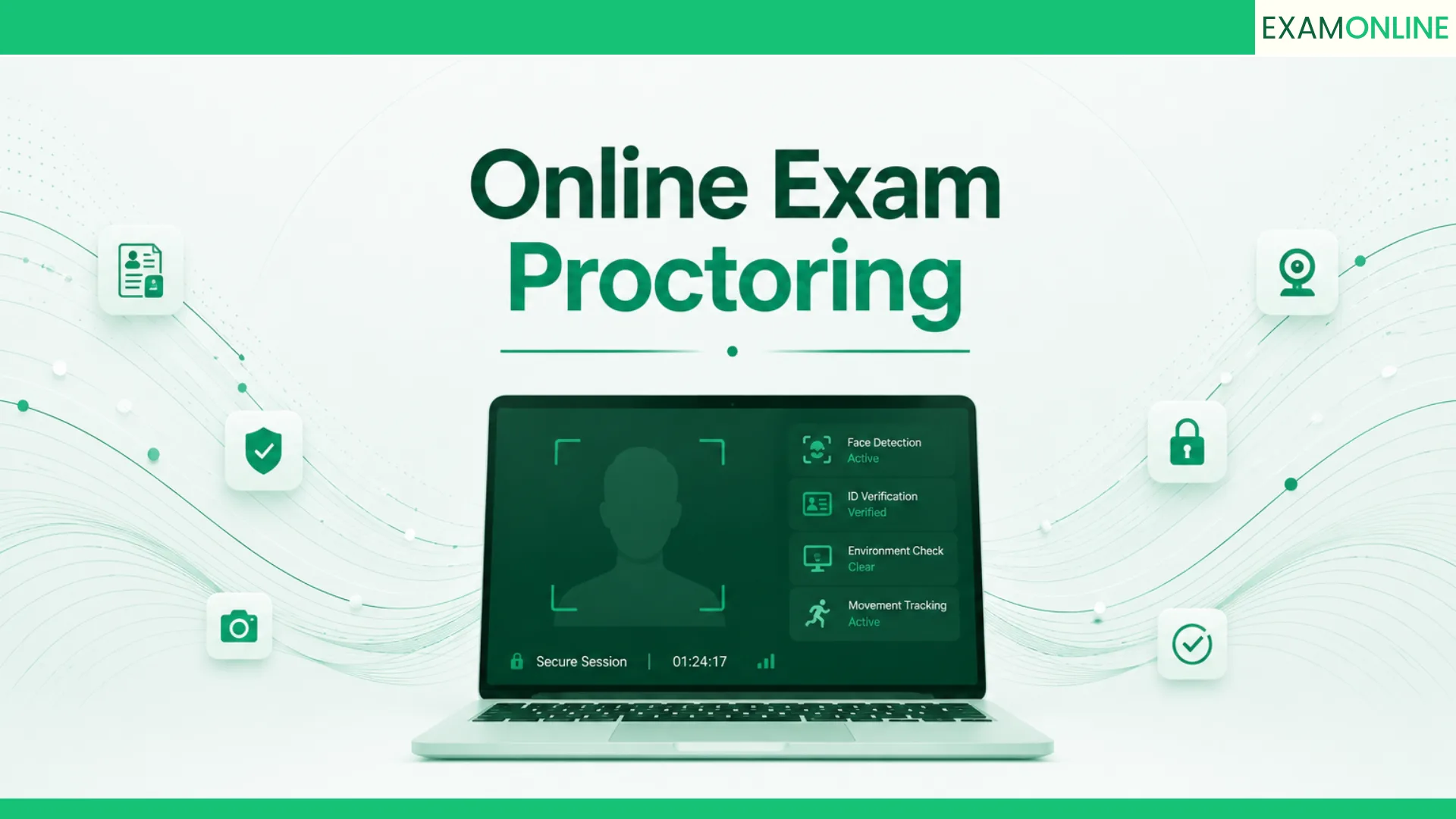
A results dispute landed on an administrator’s desk three days after a high-stakes certification exam. The highest-scoring candidate in the cohort had been flagged by the proctoring system for unusual gaze behaviour during the session. The flag was reviewed. The review team found a second device visible in the camera frame for eleven of the ninety exam minutes. The score was invalidated. The credential was withdrawn. The institution’s integrity remained intact, but only because the online exam proctoring layer had captured, timestamped, and logged every second of the active session with enough detail to support a defensible decision.
Online exam proctoring is the integrity layer of the assessment lifecycle, and it is also the most misunderstood one. Most organisations treat proctoring as a single feature rather than a multi-layer architecture. Effective online exam proctoring combines identity verification at session start, real-time behavioural monitoring throughout the exam, AI-powered anomaly detection, human review for escalated flags, and an audit trail that connects every observed event to a specific candidate, session, and timestamp. Each of these layers is a distinct decision, and the quality of the verified score that emerges depends entirely on how well each layer is designed and connected to the others.
This is Post 3 of the ExamOnline five-part series on the online exam lifecycle. It covers every element of online exam proctoring from the moment a live test begins through to the moment a verified score is confirmed and passed to result processing. The exam delivery stage that creates the active session is covered in Post 2. The result processing stage that reads from proctored session data is covered in Post 4. Read the complete series overview in the online exam lifecycle guide for the full context before continuing.
➤ Arriving at Post 3 first? Start from the beginning. The Online Exam Lifecycle: A Complete 5-Part Guide
When Exam Integrity Becomes the Only Thing That Matters
Exam integrity is the invisible foundation that every assessment result is built on. When it holds, scores are trusted, credentials carry weight, and institutions earn the confidence of the industries that rely on their certifications and qualifications. When it fails, a single cheating incident can trigger result disputes, legal challenges, and a reputational event that takes years to recover from. Academic dishonesty research consistently shows that the organisations investing in rigorous online exam proctoring are the ones that have either experienced the consequences of a proctoring failure or have studied closely the institutions that have.
The scale of academic dishonesty in digital assessment environments is greater than most administrators want to acknowledge openly. Candidates under performance pressure find creative ways to gain unfair advantage: second devices positioned outside the camera frame, pre-prepared notes displayed below the screen, external communicators feeding answers through a secondary audio channel, and in some cases proxy candidates sitting the exam under the registered candidate’s credentials entirely. Each of these methods has become more sophisticated as digital assessment has become more widespread, and each one requires a specific detection capability in the online exam proctoring architecture to address reliably.
The cost of undetected cheating extends far beyond the candidate who cheated. In a recruitment assessment context, a fraudulently obtained high score places an unqualified candidate in a role they are unable to perform, costing the hiring organisation significantly more than the assessment itself ever cost. In a certification context, a fraudulently obtained credential undermines the value of every legitimate credential issued by the same body, eroding the trust of every employer, institution, or regulator that relies on those credentials to make consequential decisions. The reputational and financial cost of one undetected fraud event in a high-stakes assessment almost always exceeds the full cost of the proctoring infrastructure that would have prevented it.
Online exam proctoring is therefore the stage of the assessment lifecycle where the return on investment is most clearly and immediately quantifiable. Explore ExamOnline’s online examination solution to see how the proctoring layer is built into the platform as a core capability rather than a separately licensed add-on, and explore the complete guide to online exam proctoring software for a detailed breakdown of the technical architecture behind a modern online exam proctoring deployment.

The Full Scope of Online Exam Proctoring Explained
Online exam proctoring is a term that covers a significant range of capabilities depending on the platform and the exam context it is deployed for. At its most basic, proctoring means monitoring a candidate during an active exam session. At its most complete, online exam proctoring means identity verification at session start, continuous behavioural monitoring through the session, AI-powered anomaly detection and severity-scored flagging, human review of escalated flags, a complete and timestamped audit trail of every session event, and a verified outcome that the result processing stage can treat with full confidence.
The scope of online exam proctoring also covers the pre-exam and post-exam phases of the session, extending well beyond the active test window itself. Pre-exam proctoring activities include the identity verification check at login, the environmental scan of the candidate’s physical space, and the confirmation that the secure exam browser lockdown is fully active before the question paper is served to the session. Post-exam proctoring activities include the flag review process, the decision workflow for escalated cases, and the session data handoff to the result processing stage with each candidate’s integrity status clearly documented alongside their submitted answers.
Understanding the full scope of online exam proctoring is the starting point for evaluating whether a proctoring platform is suited to a specific exam context. An organisation running a low-stakes internal training assessment has different proctoring requirements from one running a high-stakes national entrance examination. A recruitment assessment platform evaluating candidates for a technical role has different requirements from a university managing semester examinations for enrolled students. The right online exam proctoring configuration for one exam type is often inadequate or disproportionate for another, and choosing correctly requires a clear picture of the full scope available.
The Complete Online Exam Proctoring Sequence
Here is the full sequence of events that make up a well-managed online exam proctoring session from start to verified score:
- Pre-session identity verification using live photograph comparison against the registration image and government-issued ID
- Environmental scan of the candidate’s physical space to identify risk factors before the exam question paper is served
- Secure exam browser lockdown confirmation ensuring the full examination environment is active and all exit paths are closed
- Continuous video and audio monitoring throughout the full active exam session from first question to final submission
- AI-powered behavioural anomaly detection running in real time against the candidate-specific baseline established at session start
- Gaze tracking and eye movement analysis to identify off-screen attention patterns and external reference consultation
- Secondary device and secondary person detection through continuous camera frame analysis throughout the session
- Tab switch and focus loss detection with timestamped logging and configurable alerts for immediate review
- Severity-scored flag escalation with supporting video, audio, and browser evidence for human reviewer prioritisation
- Post-session audit trail generation with a complete, timestamped event record linked to the verified score outcome
Each of these ten elements represents a distinct technical and operational decision in the online exam proctoring architecture. Explore how online proctored exams work for a technical breakdown of how each element operates within a connected proctoring platform, and review ExamOnline’s remote proctoring solution for the specific configuration options available across AI, live, and recorded proctoring delivery modes.

Three Proctoring Types and When to Use Each One
Online exam proctoring is available in three primary configurations, each suited to different assessment contexts, security requirements, and candidate experience priorities. The three types are AI proctoring, where automated software monitors the full exam session and generates severity-scored flags for post-session review; live proctoring, where a trained human invigilator monitors the candidate in real time through a video connection; and recorded proctoring, where the full session is captured and reviewed after the exam by a trained reviewer. Each type offers a different balance of security rigour, candidate experience, scalability, and cost.
AI proctoring is the configuration that scales most readily to high-volume online exam delivery. The AI monitoring layer activates at session start, runs continuously throughout the exam without human involvement in the active session, and generates a prioritised flag report for post-session review by the exam administration team. It is the right choice for large-scale recruitment assessments, competitive entrance examinations, and online certification exams where the candidate volume makes individual human monitoring impractical. The AI layer catches the behavioural patterns that correlate with academic dishonesty without the fatigue, inconsistency, and bandwidth limitations that affect human proctors monitoring multiple sessions simultaneously.
Recorded proctoring is the configuration that offers the most cost-effective coverage for low-to-medium stakes assessments where real-time intervention is less critical than documentation and auditability. The full session is recorded and reviewed by a trained reviewer after the exam closes, with flagged events identified and escalated for decision through the standard flag review workflow. It is the right choice for internal employee assessments, formative evaluations, and training certifications where the exam result matters but the consequences of a missed event are lower than in a summative high-stakes context requiring immediate action.
Hybrid proctoring configurations, combining AI monitoring for the full candidate population with live proctoring escalation for candidates who generate high-severity flags, deliver near-live-proctoring security outcomes at near-AI-proctoring cost levels for large-scale exams. Explore ExamOnline’s proctoring as a service for the managed live proctoring option available to organisations that need real-time human oversight without building an in-house proctoring team, and read the complete guide to online exam proctoring software for a full evaluation framework across all three proctoring types.
Which Proctoring Type Fits Your Exam: A Quick Comparison
| Dimension | AI Proctoring | Live Proctoring | Recorded Proctoring |
|---|---|---|---|
| Monitoring approach | Automated software runs throughout the full session | Human invigilator monitors in real time via video | Full session recorded and reviewed post-exam |
| Concurrent scale | Unlimited sessions simultaneously | 2 to 8 sessions per invigilator | Unlimited sessions, review is post-exam |
| Intervention capability | Post-session review and decision workflow | Real-time warning, session pause, termination | Post-exam review and escalation decision |
| Best suited for | High-volume recruitment, entrance exams, certification | High-stakes licensing, professional certification | Low-to-medium stakes internal or formative assessment |
| Cost per candidate | Lowest across all three types | Highest due to human invigilator bandwidth | Medium, review cost scales with flag volume |
| Score release timeline | Same day with prioritised review queue | Immediate integrity decisions during session | 24 to 48 hours post-exam for reviewed cohort |
The OECD Education research on digital assessment integrity consistently shows that proctoring type selection is the single biggest determinant of candidate trust in online examination outcomes. Organisations that match proctoring intensity to assessment stakes produce higher candidate satisfaction scores and significantly fewer post-result disputes than those applying a single proctoring configuration uniformly across all exam types regardless of risk profile.
Building the Authentication Layer Before Exam Begins
Identity verification is the first act of online exam proctoring and the most consequential one. Everything that follows in the proctoring session depends on the accuracy of the identity check at the start. If the person who enters the authenticated session is the person who registered for the exam, the proctoring layer is monitoring the right candidate throughout. If authentication was passed by a proxy, every hour of monitoring that follows is monitoring the wrong person, and the exam integrity the proctoring layer is designed to protect has already been compromised before the first question was answered by the wrong person.
Modern online exam proctoring platforms perform identity verification across multiple simultaneous checks at session start. The live camera captures the candidate’s face and compares it against the photograph submitted during online exam registration using facial recognition software. The candidate presents their government-issued photo ID to the camera for a manual or AI-assisted verification check. The exam admit card is verified to confirm the candidate is accessing the correct session at the correct scheduled time. All three checks must pass before the secure exam browser releases the question paper to the active authenticated session.
Biometric authentication layers add significant depth to the identity verification architecture beyond the session-start check. The Biometrics Institute identifies continuous facial verification throughout an exam session as the most reliable method for preventing mid-session impersonation, the scenario where an authenticated candidate is replaced by a proxy after the initial check has passed. Continuous facial recognition running at regular intervals throughout the session compares the live feed against the verified identity established at login and flags any significant deviation in face match confidence for immediate human review and escalation.
The authentication event at session start also activates the proctoring baseline: the candidate’s initial behavioural profile against which the AI monitoring layer measures anomalies throughout the entire session. Gaze patterns, typing dynamics, response timing, and physical positioning are all captured in the first minutes of the authenticated session and used as the personalised reference point for every anomaly detection event that follows. The quality of the authentication layer therefore determines the quality of every detection event in the active online exam proctoring window, which is why pre-exam identity verification investment pays returns across the full proctoring architecture.
Authentication Checklist for Online Exam Proctoring
- Verify that live photograph comparison against the registration image is active at every session start without exception
- Confirm that government-issued ID presentation and verification is required before the question paper is released to the session
- Enable continuous facial recognition throughout the session at configurable intervals rather than only at the session entry point
- Configure the system to flag and escalate face match confidence drops below the threshold score during the active session
- Test the authentication workflow under variable lighting conditions representative of the candidate population’s likely exam environments
- Confirm that authentication failure at session start holds the question paper delivery until a manual review decision is made
- Verify that the authentication event and its outcome are timestamped and stored as part of the session audit trail
- Establish a clear escalation protocol for authentication failures that balances candidate experience with integrity requirements

What Real-Time Exam Surveillance Actually Monitors
Real-time exam surveillance in an online exam proctoring system monitors far more than whether a candidate is looking at their screen. The monitoring layer captures and analyses video, audio, browser activity, device behaviour, and in some configurations network traffic simultaneously throughout the active exam session. Each data stream is processed by the AI layer against a combination of general anomaly patterns and the candidate-specific baseline established at authentication. The result is a continuous, multi-dimensional picture of the candidate’s behaviour that is far more complete and consistent than any human invigilator managing multiple simultaneous sessions could maintain.
Camera-based monitoring in online exam proctoring covers gaze direction and eye movement patterns, facial expression changes that correlate with external reference consultation, head position relative to the camera suggesting attention directed outside the exam interface, and the appearance of additional individuals or devices within the camera frame. These are the visual signals that correlate most strongly with the cheating methods most commonly used in unsupervised digital assessment environments: secondary devices, printed reference materials, and external communicators operating from positions just outside the standard camera field of view.
Audio monitoring in the online exam proctoring layer detects speech, secondary audio sources, and background sounds that are inconsistent with a solo examination environment. A candidate receiving verbal answers through an earpiece creates a characteristic audio pattern of extended silence punctuated by brief acknowledgement movements that precede correct responses. A candidate consulting a pre-recorded audio resource creates a secondary audio track detectable through microphone analysis. Audio monitoring adds a detection dimension that camera-only proctoring systems are structurally unable to provide, making it an essential component of any comprehensive online exam security architecture.
Browser and device monitoring in the online exam proctoring system captures tab switches, application focus changes, clipboard activity, external keyboard or mouse input events, and network requests outside the exam session. These signals catch the category of exam interference that camera monitoring alone consistently misses: candidates using a second browser tab, a local document application, a mobile device running alongside the exam session, or a remote assistance tool on the same machine. Combined with camera and audio streams, browser and device monitoring creates a surveillance architecture that makes every commonly documented cheating method detectable within the active session.
What Online Exam Proctoring Monitors in Real Time
Here is the complete monitoring scope of a well-configured online exam proctoring session across all active detection channels:
- Gaze direction and eye movement patterns tracked continuously across the full exam session duration against the authenticated baseline
- Head position and physical orientation relative to the camera and screen surface throughout the active monitoring window
- Presence of additional individuals visible within the camera frame at any point during the active exam session
- Secondary devices including phones, tablets, and secondary laptops visible within the camera field of view
- Facial expression and behaviour patterns that deviate significantly from the authenticated candidate baseline established at session start
- Audio environment including candidate speech, secondary voices, and reference audio sources inconsistent with solo examination conditions
- Browser tab switches and application focus changes away from the secure exam interface during the active session
- Clipboard activity and keyboard shortcut patterns associated with copy-paste operations within the exam window
- Network requests originating from the exam device outside the secure exam session boundaries during the monitoring window
- Physical environment changes including significant lighting shifts, background changes, or camera obstruction events during the session

Inside AI Proctoring: What the System Sees
AI proctoring is the monitoring architecture that makes online exam proctoring scalable to any candidate volume without proportionally scaling the human oversight cost. The AI layer processes multiple simultaneous video and audio feeds, applies trained detection models to identify behaviours that correlate with academic dishonesty, assigns severity scores to each flagged event based on confidence level and contextual pattern, and delivers a prioritised review report to the exam administration team when the session closes. It does this for every candidate simultaneously, with consistent detection standards that are independent of fatigue, attention span, or the volume of concurrent sessions being processed.
The AI models powering modern automated proctoring are trained on extensive datasets of exam session recordings spanning both legitimate and fraudulent behaviours across diverse candidate populations and assessment contexts. The models learn to distinguish the gaze patterns of a candidate thinking through a difficult question from those of a candidate reading from a document outside the camera frame. They learn to distinguish the audio signature of a quiet solo examination from one where the candidate is receiving external verbal assistance. NIST guidance on AI system validation provides the evaluation framework that enterprise-grade online exam proctoring platforms use to validate their detection model accuracy, false positive rates, and demographic consistency across diverse candidate populations.
False positive management is the most operationally significant challenge in AI proctoring deployment. A monitoring system that flags every unusual gaze event generates a review workload that overwhelms the administration team and creates candidate distress events that are disproportionate to the actual risk level being flagged. A well-configured AI invigilation system applies threshold logic that filters low-confidence flags from the human review queue while escalating high-confidence flags with full supporting evidence: the specific timestamps, the video frames, the audio clips, and the behavioural context that triggered the escalation. This is what separates an AI proctoring system that is genuinely useful from one that generates unmanageable noise.
AI proctoring also enables population-level analysis of exam session data across large candidate cohorts that identifies systemic integrity risks invisible to individual session review. Cohorts with anomalously high flag rates relative to comparable exam groups signal potential organised fraud. Specific exam items with elevated flag rates across many candidates suggest answer-sharing activity for those questions within the sitting. These population-level insights are available only through automated exam monitoring at scale, and they are the insights that allow exam administrators to identify and address integrity vulnerabilities that targeted individual session review would never surface.
AI Proctoring Detection: What Gets Flagged and Why
| Detection Category | What AI Proctoring Detects | Flag Severity Level |
|---|---|---|
| Gaze and visual attention | Off-screen eye direction, prolonged gaze away from exam interface, sustained downward focus | Low to high based on duration and frequency pattern |
| Physical environment | Secondary persons in frame, secondary devices visible, environmental changes | Medium to high based on presence and interaction evidence |
| Audio environment | Candidate speech, secondary voices, reference audio sources during solo exam session | Medium to high based on audio pattern analysis confidence |
| Browser and device | Tab switches, application focus changes, clipboard activity, external input events | High based on frequency, timing, and sequence pattern |
| Identity verification | Facial match confidence drop, identity change event mid-session | Critical with immediate escalation to human review |
| Behavioural baseline | Significant deviations from the authenticated candidate profile across multiple channels | Medium to high based on deviation magnitude and consistency |
Live Proctoring: When a Human Invigilator Is Essential
Live proctoring is the online exam proctoring configuration where a trained human invigilator monitors the candidate’s session in real time through a video connection for the full duration of the exam. It is the configuration that most closely replicates the supervised examination environment of a physical exam hall and the one that provides the highest level of active intervention capability during the live session. A live proctor can warn a candidate whose behaviour is approaching a boundary, pause a session where a technical issue is creating an unfair experience, and escalate to session termination when a clear violation is confirmed, all without waiting for a post-session review cycle to complete.
The contexts where live proctoring is the right choice are those where the downstream consequences of a missed integrity event are too significant to leave to a post-session review process. Professional licensing examinations for healthcare practitioners, legal professionals, and regulated financial advisors are the clearest examples: a fraudulent credential in these contexts places public safety at risk rather than simply disadvantaging other candidates in a merit-based competition. High-value commercial certifications where the credential controls access to significant professional opportunity or compensation are a second category where real-time human oversight is clearly justified by the stakes involved.
The operational challenge of live proctoring at scale is the bandwidth and cost of providing a trained human invigilator for every active session in a high-volume exam. A single invigilator can monitor between two and eight sessions simultaneously depending on the security protocol configured for the specific exam. Explore ExamOnline’s proctoring as a service for a view of how managed live proctoring is provided at scale for organisations that need real-time human coverage without building an in-house proctoring team. The UGC guidelines on online examination conduct in India reference the need for verified invigilation in high-stakes academic assessments, making live or hybrid proctoring configurations a compliance consideration for many institutional examination contexts.
Hybrid online exam proctoring configurations combine AI monitoring for the full candidate population with live proctoring escalation for candidates who generate high-severity flags during the session. The AI layer manages the initial monitoring workload across all candidates simultaneously and surfaces the sessions most likely to involve an active integrity event based on flag severity scoring. The live proctor then focuses their attention on the specific sessions requiring real-time human judgement rather than distributing attention evenly across all active candidates regardless of risk signal. This hybrid approach delivers near-live-proctoring security outcomes at near-AI-proctoring cost levels for organisations running large-scale exams with high integrity requirements.
Live Proctoring: Do’s and Don’ts for Exam Administrators
| Do This | Avoid This |
|---|---|
| Brief live proctors on the specific exam context, prohibited materials, and escalation protocol before the session | Deploy live proctors without exam-specific briefing and rely on general training alone |
| Configure the maximum concurrent sessions per invigilator based on the security protocol for the specific exam | Allow invigilators to accept session loads above the configured maximum during busy shifts |
| Establish a clear escalation chain from live proctor to senior reviewer before the exam window opens | Expect live proctors to make high-stakes session termination decisions without an escalation protocol |
| Test the live proctoring video connection and monitoring interface at exam scale before the first live session | Test only at low load and assume performance will hold at full concurrent session volume |
| Record all live proctoring sessions for audit trail purposes regardless of whether flags are raised | Rely on live proctor notes alone as the record of session events for disputed cases |
Explore how online proctored exams work for a detailed technical breakdown of how live proctoring connects to the AI monitoring layer and the session audit trail in a connected online exam proctoring platform. For organisations running competitive examinations and higher education assessments at institutional scale, the hybrid proctoring configuration is almost always the most effective and cost-proportionate choice.
How Proctoring Data Becomes a Verified Score
The online exam proctoring session does not end when the candidate clicks submit. The session data, including the complete video and audio recording, all AI-generated flags with their severity scores, all browser and device monitoring events, and the identity verification outcomes from session start, is packaged into a session audit file that travels with the candidate’s submitted answers to the result processing stage. The verified score that emerges from result processing is the raw score qualified by the integrity status that the proctoring session data supports, making online exam proctoring the direct predecessor of every score decision in the system.
Flag review is the human layer that converts proctoring data into integrity decisions. The exam administration team reviews flagged sessions in priority order based on severity scoring from the AI layer. Each flag is reviewed against the supporting evidence: the video clip at the flagged timestamp, the audio segment, the browser event log, and the behavioural context surrounding the specific event. The reviewer makes one of three decisions for each flagged session: clear the flag as consistent with legitimate exam behaviour, note the flag as a minor concern that is documented but carries no score consequence, or escalate the flag for a formal integrity investigation that may result in score withholding or invalidation pending the outcome.
The audit trail generated by online exam proctoring is the document that makes every score decision defensible to every audience that may scrutinise it. Every flag carries a timestamp. Every timestamp links to a video frame stored in the session record. Every session record is linked to a verified identity from the authentication check at login. This chain of evidence is what allows an institution to uphold or reverse a score decision in response to a candidate challenge, a regulatory inquiry, or a legal proceeding. A score dispute without an audit trail becomes a word-against-word situation. A score decision supported by an unbroken session audit trail from a verified identity to a timestamped event stands in every forum.
The proctoring session data flowing into result processing also informs the item-level analytics available to exam administrators. Questions that generated disproportionate gaze-away flags across the candidate population signal a potential answer-sharing event for that specific item in the sitting. These insights inform the next exam cycle’s question bank refresh and integrity protocol adjustments. Explore the result processing stage in Post 4 for a detailed breakdown of how proctored session data connects to scorecard generation and verified score release, and see how ExamOnline supports scaling certification programs for a practical example of how proctoring data integrity flows through the complete assessment lifecycle.
➤ Continue to the result processing stage. Post 4: Exam Result Processing: From Score to Scorecard

The Right Proctoring Model for Your Specific Exam
Choosing the right online exam proctoring model for a specific exam requires clarity across three dimensions: the stakes of the assessment and the consequences of a missed integrity event, the candidate population and their device and connectivity environment, and the administrative capacity available for flag review and integrity decisions. An organisation that selects a proctoring model primarily on cost without factoring in all three dimensions almost always finds that the model fails to meet the requirement at the first high-volume or high-stakes exam it is deployed for.
Stakes-based selection is the most important dimension in the online exam proctoring decision. A low-stakes internal training assessment for employees with regular access to the course materials anyway has fundamentally different integrity requirements from a national entrance examination controlling access to limited postgraduate seats. Applying live proctoring to the former wastes resource and creates candidate friction that is disproportionate to the risk. Applying recorded-only proctoring to the latter creates an unacceptably wide window between the exam and the integrity decision. Matching proctoring intensity to assessment stakes is the foundation of a proctoring strategy that is both effective and proportionate.
Candidate population considerations shape the online exam proctoring model in ways that are consistently overlooked during platform selection. A candidate population with reliable high-bandwidth connectivity, modern devices, and a controlled assessment environment supports AI proctoring effectively across all monitoring streams simultaneously. A candidate population with variable connectivity, older devices, or exam access from shared or public computers may require a simplified proctoring configuration that maintains core integrity coverage without the technical demands of full concurrent video, audio, and device monitoring on every session. Accessibility requirements also shape the proctoring model, as some monitoring approaches create barriers for candidates with specific visual, auditory, or motor conditions.
Administrative capacity for flag review determines how much of the proctoring output your team can actually act on within the required score release timeline. An AI proctoring deployment that generates five thousand flags from a three-thousand-candidate exam and delivers them to a two-person review team creates a review backlog that takes weeks to clear and results in score release delays that damage candidate trust in the institution. A well-calibrated AI online exam proctoring system with appropriate threshold configuration should deliver a review queue sized to the administrative team’s realistic daily capacity, typically between fifty and one hundred prioritised flags per thousand candidates for a standard assessment context.
Online Exam Proctoring Selection Checklist
- Define the stakes level of the assessment and the specific downstream consequences of an undetected integrity event for this exam
- Assess the candidate population’s device specifications, connectivity reliability, and technical familiarity with proctoring software
- Determine the administrative team’s realistic daily capacity for post-session flag review and integrity decision-making
- Evaluate whether real-time intervention capability during the session is a specific requirement for this exam context and stakes level
- Confirm that the selected proctoring configuration meets the accessibility requirements of the full candidate population for this exam
- Establish the complete flag review workflow and escalation protocol before the exam window opens and team is briefed
- Define the score release timeline and confirm it is achievable given the selected proctoring model’s review process and flag volume
- Verify that the proctoring data audit trail meets the evidentiary standards required for your specific integrity decision and appeals context

How ExamOnline Delivers Proctoring at Any Scale
ExamOnline delivers online exam proctoring as an integrated layer of the full assessment lifecycle platform rather than a separately licensed or externally connected feature. The proctoring layer activates at session start, runs in parallel with the exam delivery stage, and feeds directly into the result processing stage without requiring manual data export or system integration between components. Every candidate’s proctoring session, every flag, every review decision, and every integrity outcome is stored on the same data layer as the registration record, the exam delivery session, and the result record, giving exam administrators a complete, connected view of every assessment event from registration to verified score.
The platform supports all three online exam proctoring configurations: AI proctoring for high-volume scalable deployments, live proctoring through ExamOnline’s managed proctoring service, and recorded proctoring for lower-stakes or cost-sensitive assessment contexts. Hybrid configurations combining AI monitoring with live proctoring escalation are also fully supported, allowing organisations to match proctoring intensity to the specific risk profile of each exam cohort without switching platforms. Explore ExamOnline’s remote proctoring solution and proctoring as a service for the specific capabilities available within each configuration for your assessment context.
What ExamOnline Delivers at the Proctoring Stage
Here is what the ExamOnline platform delivers across the complete online exam proctoring lifecycle from session start to verified score:
- Identity verification at session start using facial recognition against the registration photograph and government-issued ID simultaneously
- Environmental scan of the candidate’s physical space before the question paper is served to the authenticated session
- Continuous AI-powered monitoring of video, audio, browser, and device activity throughout the full active exam session
- Gaze tracking and eye movement analysis with real-time comparison against the authenticated candidate baseline established at session start
- Secondary device and secondary person detection through continuous camera frame analysis across the full session duration
- Severity-scored flag report with supporting video clips, audio segments, and browser event logs delivered for prioritised human review
- Hybrid proctoring option combining AI monitoring across all candidates with live invigilator escalation for high-severity flag events
- Complete session audit trail with timestamps, video, audio, and device event logs for every flag and every integrity decision
- Direct integration with the result processing stage, passing integrity status alongside submitted answers for verified score generation
- Support for high-volume concurrent online exam proctoring across centre-based, remote, and hybrid delivery configurations at any scale
ExamOnline supports online exam proctoring across higher education entrance and internal examinations, corporate hiring and talent acquisition assessments, certification exam delivery, learning and development certifications, and competitive examinations at national scale. For organisations running centre-based testing with local invigilator support, or fully remote examination delivery with end-to-end AI proctoring, the platform delivers consistent integrity coverage across every delivery configuration.
ExamOnline gives exam administrators the proctoring infrastructure to run high-integrity assessments at any scale, with the monitoring depth to detect fraud reliably and the audit trail to defend every score decision confidently. Explore the online examination solution to see the complete proctoring platform in detail, and continue to Post 4 for the result processing stage that converts proctored exam data into verified, distributable scorecards.
➤ Continue the series to result processing. Post 4: Exam Result Processing: From Score to Scorecard
Frequently Asked Questions
What is online exam proctoring?
Online exam proctoring is the monitoring and verification layer of a digital assessment that ensures every candidate is who they claim to be and is completing the exam without access to unauthorised assistance or resources. It combines identity verification at session start, continuous monitoring through the active exam session, AI-powered anomaly detection, human review of flagged events, and an audit trail connecting every monitoring event to the verified score. Online exam proctoring can be delivered as AI proctoring, live proctoring, or recorded proctoring depending on the stakes and scale of the assessment. Explore how online proctored exams work for a full technical breakdown.
What is the difference between AI proctoring and live proctoring?
AI proctoring uses automated software to monitor candidate behaviour throughout the exam session, generating a prioritised severity-scored flag report for post-session human review. Live proctoring assigns a trained human invigilator to monitor the candidate’s session in real time through a video connection, with the ability to intervene immediately when a violation is observed. AI proctoring scales to any candidate volume at a consistent cost per session and is the right choice for high-volume assessments. Live proctoring provides real-time intervention capability and is the right choice for high-stakes exams where immediate response to a violation event is required.
What does online exam proctoring monitor during an active session?
Online exam proctoring monitors the candidate’s video feed for gaze direction, head position, and the presence of additional persons or devices within the camera frame. It monitors the audio feed for speech, secondary voices, and reference audio sources inconsistent with a solo examination environment. It monitors browser and device activity for tab switches, application focus changes, and clipboard use. It monitors network activity for requests outside the secure exam session. All monitoring events are timestamped and linked to the candidate’s verified identity to create a defensible audit trail for every score decision.
How does online exam proctoring connect to the result processing stage?
Proctoring session data travels with the candidate’s submitted answers to the result processing stage as a verified integrity status. The raw score from the question paper is qualified by the proctoring outcome: cleared, flagged for review, or withheld pending investigation. This means the verified score released for result processing reflects both the candidate’s performance and the integrity confirmation from the proctoring session. Read Post 4: Exam Result Processing: From Score to Scorecard for the complete breakdown of how proctored session data connects to scorecard generation and verified score release.
Can online exam proctoring handle high-volume concurrent assessments?
AI proctoring scales to any concurrent session volume because automated monitoring applies the same detection models across every active session simultaneously without bandwidth constraints tied to human reviewer capacity. ExamOnline’s online exam proctoring infrastructure supports high-volume concurrent assessment across centre-based, remote, and hybrid delivery configurations, with flag reporting and review workflows scaled to the administrative team’s realistic capacity. Explore ExamOnline’s online examination solution for the specific capacity and configuration details relevant to your exam scale and integrity requirements.


