Table of Contents
Three hours before a 5,000-seat assessment, the registration portal starts misfiring. Duplicate candidate IDs flood the system. The scheduling team fields frantic calls from candidates who received conflicting slot timings. Two sessions are double-booked at the same centre. The exam goes ahead, but the damage in reputation, in candidate trust, in sheer operational overload, follows for months. This is what happens when the online exam lifecycle breaks at its seams, and it happens far more often than any institution wants to admit.
The challenge almost always traces back to the same cause. Most organizations treat registration as one problem, delivery as another, proctoring as a third, results as a fourth, and certification as something the admin team handles manually at the end. Each stage runs in isolation on different tools, maintained by different teams, with zero continuity between them. The result is a lifecycle with five separate failure points instead of one smooth, accountable process that any administrator can monitor and manage.
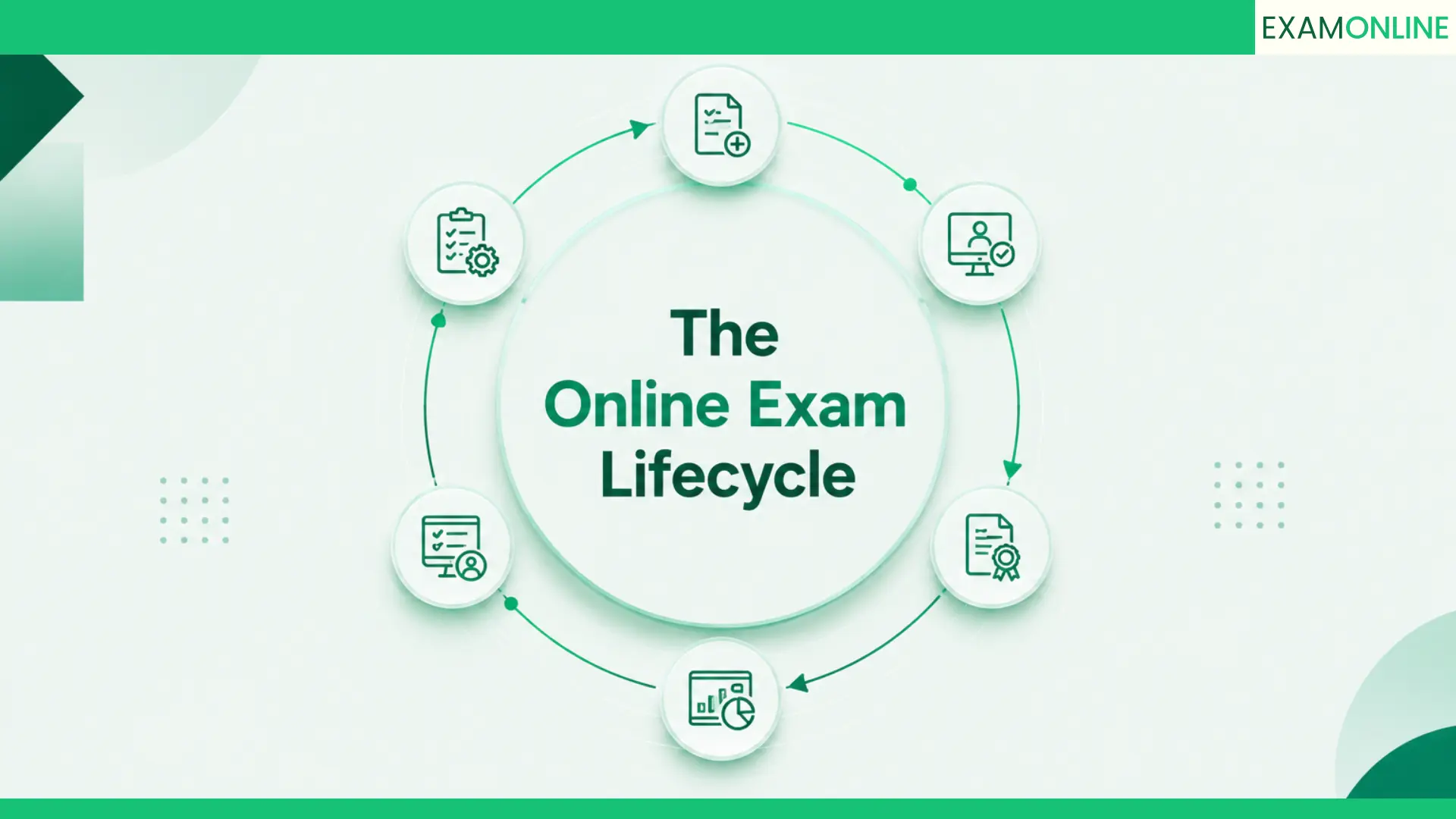
ExamOnline was built to solve this directly. The platform manages the complete online exam lifecycle from the moment a candidate submits their application to the moment a verified certificate lands in their inbox. This series breaks that lifecycle into five distinct stages and shows exactly what each stage demands, where breakdowns happen, and what a connected system looks like in practice. Every post links back to this one so the full picture stays accessible throughout. Explore the ExamOnline online examination solution to see the full platform before diving into the series.
This series is for the people running exams at scale. The administrators who feel the weight of every exam cycle and carry the accountability when something goes wrong. By the end of all five posts, the online exam lifecycle should be a clear, manageable framework. Start here. Follow the sequence. The full picture builds across all five stages.

Why Online Exam Management Feels This Complicated
Running online exams sounds like a solved problem. Technology has made assessment delivery faster, wider, and more accessible than anything paper-based testing could achieve. Yet most exam administrators will tell you the operational reality feels far harder than it should. The reason traces back to the same source almost every time: the online exam lifecycle is being managed in fragments rather than as a connected whole, and every fragment creates its own distinct set of problems.
The typical exam operation today uses a separate online application portal for candidate intake, a different platform for scheduling, a third system for exam delivery, a fourth for remote proctoring software, and a fifth for generating scorecards. Each tool was chosen to solve one specific problem. Together, they create five integration challenges, five data silos, and five independent vendor relationships to manage. Every transfer of candidate information between systems is a manual step, and every manual step is an opportunity for an error that compounds through every stage that follows.
Here are the clearest signs that your exam lifecycle is running on a fragmented setup:
- Registration data requires manual re-entry into the delivery system before each exam cycle
- Scheduling conflicts surface only after candidates have already received confirmation of their slots
- Proctoring flags are reviewed in a dashboard completely separate from the result processing workflow
- Scorecards are generated in spreadsheets and distributed by email rather than dispatched automatically
- Certificate requests arrive through a separate process weeks after results are released
- Candidate support queries during exam day require human intervention for answers that should be automated
- Post-exam performance analysis requires extracting data manually from three or more platforms
- Audit trails for grievance redressal are assembled by hand from records across several systems
The human cost of this fragmentation is measurable and significant. Exam administrators spend the majority of their pre-exam preparation time reconciling data between systems rather than preparing for the assessment itself. HR teams managing bulk hiring assessments field candidate queries that a configured exam management software solution would handle automatically. University registrars cross-check eligibility records manually that a properly structured system validates in seconds with greater accuracy. The frustration is legitimate, and it is entirely avoidable.
The organisations running online exams with confidence have stopped treating each stage as a separate problem. They adopted exam administration software that connects every stage on a single data layer. Candidate information flows from registration into delivery without manual transfer. Proctoring data feeds directly into result processing. Certificates generate automatically from confirmed results. Here is what the difference looks like between a fragmented approach and a connected online exam lifecycle:
| Fragmented Approach | Connected Online Exam Lifecycle |
|---|---|
| Separate platform for each lifecycle stage | Single platform managing all five stages on one data layer |
| Manual data transfer between every stage | Automatic data flow from registration through to certification |
| Multiple admin dashboards to monitor simultaneously | Single operations dashboard with full lifecycle visibility |
| High risk of data errors accumulating across stages | Validated candidate data from registration to certificate |
| Candidate queries handled by staff manually | Automated communication triggered at every lifecycle milestone |
| Certificates dispatched manually in batches | Instant digital certificate issuance on result confirmation |
| Multiple vendor contacts for support | Single point of accountability across the full lifecycle |

Why Organisations Are Shifting to Online Exams
The shift from paper-based testing to computer based testing has been building for years, but the pace of adoption has accelerated beyond early projections. Universities, corporate training departments, certification bodies, and government recruitment agencies have all reached a common conclusion: the cost and complexity of running physical assessments at scale has become prohibitive. Digital assessment through a structured online examination system was initially a response to logistical pressure. It has since become a strategic choice driven by measurable, reportable outcomes.
The World Economic Forum’s Future of Jobs Report projects that 44 per cent of worker skills will face significant disruption over the next five years. Scalable, continuous assessment infrastructure has moved from an administrative consideration to a business priority for any organisation serious about workforce readiness.
Organisations that have moved to a structured online exam platform consistently report improvements across the metrics that matter most. Candidate registration accuracy increases when an exam registration system applies eligibility rules automatically. Scheduling conflicts drop to zero when slot allocation is governed by a platform with real-time capacity data. Exam security measurably improves when ai proctoring software monitors candidate behaviour throughout the session, offering visibility that physical invigilators in a room with limited sightlines simply cannot match. The case for computer based testing keeps getting stronger with every exam cycle that runs on a connected platform.
The employee skill assessment use case has been a significant driver of adoption in the corporate sector. Companies running large-scale recruitment drives, annual performance evaluations, and mandatory compliance certifications have found that a secure assessment platform makes it possible to evaluate thousands of candidates with consistent standards and minimal coordination overhead. Organisations running corporate hiring assessments at scale have discovered the same truth: the standardisation previously available only to large institutions is achievable by any organisation with the right online testing software and lifecycle structure in place.
The motivation driving adoption is shifting too. Early adoption was about cost reduction and logistical simplification. The current wave is driven by data strategy. A properly structured online exam lifecycle generates performance intelligence that paper-based testing is unable to match. Item-level analytics, candidate behaviour data, cohort comparison reports, and real-time assessment dashboards give organisations the information they need to design better assessments and make sharper decisions. Explore how this applies to learning and development assessments and higher education exam management for sector-specific context. Today, the best exam management software does far more than administer tests. It drives institutional strategy from a foundation of real-time assessment data.

Five Stages That Define a Smooth Online Exam
The online exam lifecycle is a connected sequence, and every stage depends on the accuracy of what happened before it. Candidate data collected during registration underpins delivery. Delivery infrastructure determines the conditions under which proctoring operates. Proctoring data informs result processing. Result accuracy drives certification credibility. Understanding all five stages, what each demands, and how they connect is the framework this entire series is built around.
Stage 1: Registration and Candidate Management
The online exam process begins before the exam itself opens. Online exam registration, eligibility verification, slot allocation, online admit card generation, and all pre-exam candidate communication belong to this stage. When the exam registration system is automated and well-configured, every downstream stage runs on clean, validated data. When registration is manual, every downstream stage inherits whatever errors were made here. Post 1 covers this stage in depth: Online Exam Registration: From Sign-Up to Admit Card
Stage 2: Exam Delivery and Scheduling
Exam delivery software handles the technical infrastructure of the assessment itself: secure browser lockdown, question paper delivery, time management, concurrent user load balancing, and candidate session management. A reliable online exam delivery environment means candidates experience the assessment exactly as it was designed. Post 2 covers every element of this stage: Online Exam Delivery: From Admit Card to Live Test
Stage 3: Proctoring and Invigilation
Online exam proctoring is the integrity layer of the lifecycle. It encompasses live online proctoring, automated proctoring, and recorded proctoring, each suited to different assessment contexts and risk profiles. Explore the full breakdown of how online proctored exams work and read the complete online exam proctoring software guide for deeper context. Post 3 covers how to choose the right approach: Online Exam Proctoring: Which Type Suits You
Stage 4: Result Processing and Scorecards
Online grading software and automated result processing platforms translate raw exam data into meaningful candidate outcomes. Automated scoring, score normalisation, result release workflows, and scorecard generation all belong here. The speed and accuracy of result processing directly affects candidate trust and institutional credibility. Post 4 covers this stage in full: Exam Result Processing: From Score to Scorecard
Stage 5: Certification and Credential Issuance
The online exam lifecycle closes with certification. Online certification, digital badge platform integration, online certificate verification, and automated credential delivery are the outputs of this stage. A well-managed certification process means candidates receive verified, tamper-proof credentials the moment results are confirmed, and institutions maintain a complete audit trail of every certificate issued. Explore the full guide on certification exam solutions for detailed context. Post 5 covers this stage: Exam Certification: From Scorecard to Credential
Each post in this series delivers the operational depth, decision frameworks, and platform considerations for its stage. Reading all five in sequence builds a complete picture of how to design and manage an online exam lifecycle that scales with your volume, adapts to different exam formats, and runs with a fraction of the administrative overhead most organisations currently invest.

What You Can Run Better After This Series
Reading all five posts will change how you approach the online exam lifecycle. The change is practical rather than theoretical. Each post is built around operational decisions that exam administrators, HR managers, and certification teams are already making or are about to make. The framework built across five posts gives you a structured approach to each stage and a clear view of how decisions made at one stage shape the performance of every stage that follows.
Here is what you will be equipped to do once you have worked through all five posts in this series:
- Design a registration workflow that eliminates the manual data reconciliation that consumes the majority of pre-exam preparation time for most exam teams running assessments at scale
- Configure eligibility screening that runs automatically at the point of application, surfacing exceptions for review rather than requiring administrator sign-off on every individual registration
- Choose the right proctoring approach for your specific exam context, candidate population, and security requirements, with a clear decision framework rather than a default choice
- Set up automated result processing that dispatches scorecards the moment results are confirmed rather than queuing them for manual preparation and batch distribution
- Issue verifiable digital certificates at scale with zero manual effort per candidate, complete with audit trail and online certificate verification capability
- Generate performance analytics that give your leadership team the reporting they want without requiring manual data extraction from multiple independent systems
- Run candidate communication on autopilot from registration confirmation through slot allocation, admit card dispatch, exam reminders, result release, and certificate delivery
- Build an assessment operation that scales with your exam volume and candidate base without proportionally scaling your administrative team or coordination overhead
Exam administrators managing large-scale assessments will find the clearest path toward eliminating the manual work that currently consumes the days and hours before every exam. The online exam registration stage can shift from a consistent source of candidate complaints and data errors to a self-managing process that surfaces exceptions automatically and keeps every candidate informed at every step. The combination of a structured exam management software approach and properly configured communication automation transforms pre-exam preparation from a crisis management exercise into a predictable, controlled operation.
HR teams and learning and development managers running employee skill assessments and online aptitude test platforms will find a framework for choosing the right configuration for their candidate populations, generating the analytics leadership teams want, and building an assessment process that grows with hiring volume. The shift from running assessments to running intelligent assessments begins with understanding how each stage of the online exam lifecycle produces data that informs the next decision in the chain.
Certification bodies and university registrars will find specific, actionable guidance on the online certification stage that most platform discussions skip over entirely. The operational requirements of online certificate verification, digital badge integration, and the audit trail requirements for high-stakes credentialing deserve dedicated attention. Reading this series in full gives any assessment operation the clarity to design a lifecycle that is robust at scale, flexible across exam formats, and efficient enough to run well with the team already in place. Read the guide on scaling certification programs for a practical example of the online exam lifecycle applied to a specific institutional context.

Who Gets the Most Value From This Guide
This series was written for the people carrying operational accountability for online assessments. Every post addresses the full online exam lifecycle from an administrator’s perspective, covering the decisions, tradeoffs, and pressures that come with managing assessments at scale. If exam performance is your responsibility, this guide was designed for your context.
This guide is the right read for you if any of the following describe your situation:
- You manage exam operations for a university, institution, certification body, or corporate training and development function running assessments for hundreds or thousands of candidates
- You are evaluating online exam platforms and want to understand what each stage of the assessment lifecycle actually requires from a platform before committing to a selection decision
- You are dealing with a breakdown in one specific stage of your current exam process and want to understand how it connects to and affects the stages around it
- You want to move from a multi-tool, multi-vendor assessment setup to a connected lifecycle platform with a single point of accountability and a single dashboard
- Your current exam process is consuming far more administrative resource than it should, and you want a framework for understanding exactly where the inefficiency lives
Exam administrators at universities and institutions managing entrance exams, semester assessments, and large-scale internal evaluations will find direct application across all five posts. The accountability that comes with running high-stakes assessments for thousands of candidates simultaneously, with absolute requirement for technical reliability and data integrity, is the exact operating environment this series addresses. Every stage from online exam registration through to online certification is treated with the operational specificity that large-scale assessments demand. Explore ExamOnline’s approach to higher education exam management for context on how the platform supports this audience.
HR managers and talent acquisition leads using online aptitude test platforms for bulk hiring, campus recruitment, or internal mobility assessments will find strong relevance in Posts 1 through 4. The challenge of maintaining assessment consistency across large candidate volumes while managing security, candidate experience, and data integrity is addressed directly in each post. The exam monitoring software and secure assessment platform decisions that shape large-scale recruitment assessments are covered with practical specificity rather than generic guidance.
Certification bodies, professional membership organisations, and corporate training departments running online certification exams will find Posts 3, 4, and 5 most immediately applicable. The intersection of online exam security, online grading software accuracy, and online certificate verification integrity is where the credibility of a certifying body lives. This series addresses that intersection with the depth and specificity it deserves. Regardless of which role best describes your situation, start with the post that addresses your most immediate operational challenge and work through the rest in sequence to build the complete picture.
Start Here, Then Follow the Full Series
The online exam lifecycle is one connected journey. Reading any single post gives you insight into one stage. Reading all five builds a complete operational picture of how assessment management works end to end, and how to design your systems so each stage makes the next one easier rather than harder. The recommended reading order follows the lifecycle sequence from registration through to certification. Each post is also self-contained for anyone who needs to go directly to the stage most relevant to their immediate challenge.
ExamOnline manages the complete online exam lifecycle on a single connected platform, from the first candidate registration through to the final verified certificate. If you want to see what a unified assessment lifecycle looks like before working through the series, the ExamOnline online examination solution is a strong starting point. You can also explore proctoring as a service for the invigilation layer, or review UNESCO’s digital education framework for the broader global context around online assessment adoption.
| Post | Title | What It Covers |
|---|---|---|
| Introduction (You Are Here) | The Online Exam Lifecycle: A Complete 5-Part Guide | Series overview, the five stages, who this guide is for, and full series navigation |
| Post 1 | Online Exam Registration: From Sign-Up to Admit Card | Candidate intake, eligibility verification, slot allocation, admit card generation, pre-exam communication |
| Post 2 | Online Exam Delivery: From Admit Card to Live Test | Delivery infrastructure, scheduling, concurrent users, secure browser, candidate session management |
| Post 3 | Online Exam Proctoring: Which Type Suits You | AI proctoring, live proctoring, recorded proctoring, integrity monitoring, invigilation workflows |
| Post 4 | Exam Result Processing: From Score to Scorecard | Automated grading, score normalisation, result release workflows, scorecard generation and dispatch |
| Post 5 | Exam Certification: From Scorecard to Credential | Digital certificate generation, badge platform integration, certificate verification, credential audit trails |
Bookmark this page as your series hub. Every post in the series links back here so the complete picture stays accessible throughout. India’s National Education Policy 2020 highlights the national push toward digital assessment infrastructure, making the transition to a connected online exam lifecycle more than an operational upgrade. It is aligned with where education and credentialing is heading. The five posts that follow give you the operational framework to lead that transition rather than react to it.
Frequently Asked Questions
What is the online exam lifecycle?
The online exam lifecycle is the complete sequence of stages that make up a digital assessment, from candidate registration and exam delivery through proctoring, result processing, and final certificate issuance. A well-managed online exam lifecycle connects all five stages on a unified platform so candidate data flows cleanly from one stage to the next. This eliminates the manual handoffs and data reconciliation that create errors and operational delays in fragmented, multi-tool assessment setups. When the lifecycle is connected, each stage reinforces the one that follows rather than creating new problems for it to inherit.
How many stages does a complete online exam have?
A complete online exam lifecycle has five stages: registration and candidate management, exam delivery and scheduling, proctoring and invigilation, result processing and scorecard generation, and certification with credential issuance. Each stage depends on the accuracy of the stage before it, which is why a connected platform approach delivers significantly better outcomes than managing each stage on separate tools with manual data transfers in between. This series covers all five stages across five dedicated posts, each of which can be read independently or as part of the full series.
What is online exam management software?
Online exam management software is a platform that handles the operational requirements of running digital assessments across all five lifecycle stages. This includes exam registration system functionality, exam delivery software, remote proctoring software, online grading software, and certification management. The most effective platforms manage the complete online exam lifecycle on a single data layer rather than requiring separate tools and separate vendor relationships for each stage. ExamOnline’s end-to-end examination solution is built around this connected lifecycle model, giving administrators a single dashboard for every stage.
Which types of organisations benefit most from a structured exam lifecycle?
Universities and academic institutions, corporate HR and learning and development teams, certification bodies and professional membership organisations, and government recruitment agencies all benefit significantly from a structured approach to the online exam lifecycle. Any organisation running assessments at scale, with accountability for the accuracy of results and the integrity of credentials, operates more effectively with a connected, stage-by-stage exam management framework. Explore sector-specific approaches for corporate hiring assessments, learning and development assessments, and certification exam delivery for detailed context by audience type.
How does ExamOnline support the full online exam lifecycle?
ExamOnline provides end-to-end assessment management across all five lifecycle stages on a single connected platform. The system handles online exam registration, exam delivery and scheduling, AI-powered and live proctoring, automated result processing and scorecard generation, and digital certificate issuance with verification. Every stage operates on the same candidate data layer, eliminating the manual reconciliation and data transfer that create operational delays in multi-tool setups. Administrators manage the complete online exam lifecycle from a single dashboard with full visibility at every stage. Explore the complete ExamOnline platform to see how a unified lifecycle looks in practice.