
Table of Contents
Introduction
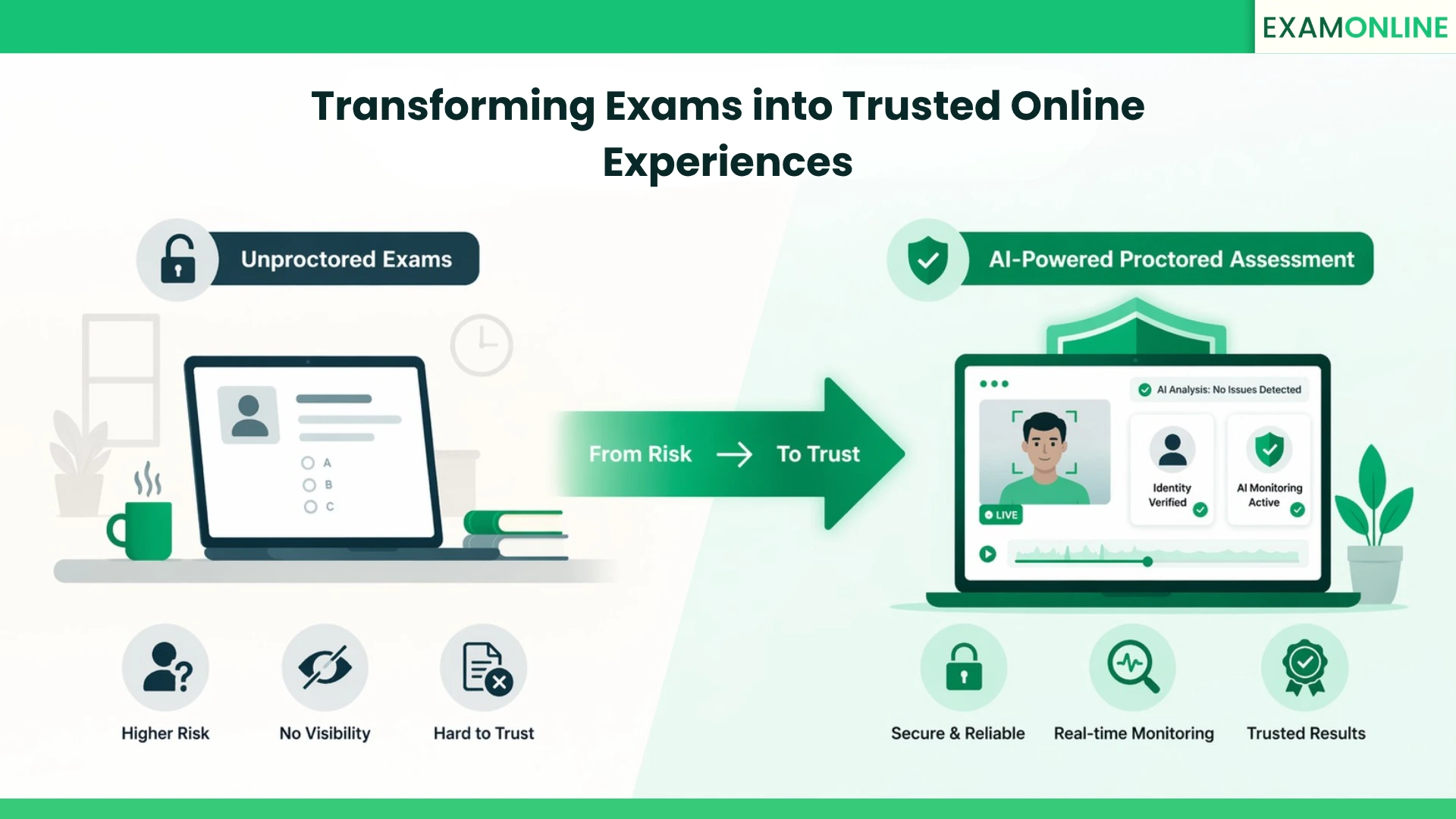
Online assessments made exams and assessment accessible and easy to scale with minimal operation load, but they have introduced a more critical challenge – how to trust the outcomes from online assessments.
In physical environments, invigilation is visible and enforceable. In digital environments, integrity must be engineered into the system. Impersonation, multi-device usage, and external assistance are no longer exceptions – they are predictable risks.
For certification bodies, universities, and employers, this is not a technical concern. It is a governance and credibility issue. If an assessment cannot be validated with evidence, its outcome becomes difficult to defend.
This is where online proctoring evolves from a monitoring tool into a system of assessment control.
Why Online Proctoring Requires System-Level Thinking
From Monitoring to Defensibility
Most organisations approach online proctoring as a feature – something that runs during the exam. In practice, integrity depends on how well control is maintained before, during, and after the assessment.
A system that only observes behaviour without enforcing conditions or generating evidence creates visibility, but not accountability. This distinction is critical in large-scale environments where decisions must be justified consistently.
This broader view of proctoring as an integrated system is explained through online proctoring software frameworks, where monitoring is only one component of a larger integrity architecture.
Where Conventional Proctoring Approaches Fall Short
The Limits of Manual and Automated Models
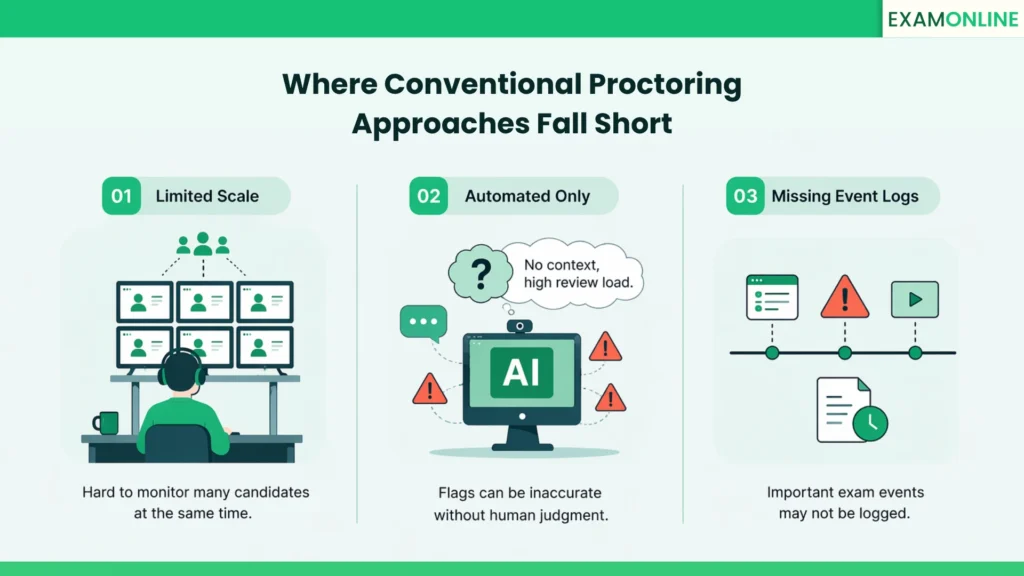
Manual proctoring introduces human judgement but struggles with consistency at scale. Fatigue, subjectivity, and coordination complexity reduce reliability as volumes increase.
Automated systems, while scalable, often generate signals without sufficient context. A flagged behaviour without structured validation creates ambiguity rather than clarity. This increases review effort without improving decision quality.
The Missing Layer – Auditability
The most critical gap is the absence of structured audit trails. Without logs, recordings, and event timelines, organisations cannot reconstruct exam sessions or defend decisions when challenged.
Understanding how monitoring, validation, and review interact in real-world scenarios is essential, which is why remote proctoring workflows emphasize that proctoring is a sequence of controlled processes rather than a single action.
What a Reliable Online Proctoring System Must Deliver
Control Across the Assessment Lifecycle
A reliable system establishes control at multiple stages.
Before the exam, identity verification ensures that the correct candidate is entering the system. This reduces impersonation risk at the source.
During the exam, monitoring must combine behavioural, environmental, and device-level signals. Video, audio, and interaction data must be interpreted together to create meaningful context.
After the exam, flagged events must translate into structured review. Evidence should be organised in a way that allows organisations to validate incidents and make consistent decisions.
Understanding Proctoring Model Trade-offs
Different proctoring models introduce different operational implications. Automated systems enable scale but require validation frameworks. Live proctoring introduces oversight but increases cost. Recorded models depend on post-exam review quality.
A structured comparison of these approaches, such as in proctoring model evaluation, shows that effectiveness depends on how these models are combined rather than selected in isolation.
How ExamOnline Structures Proctoring as a System
Contextual Monitoring Instead of Isolated Detection
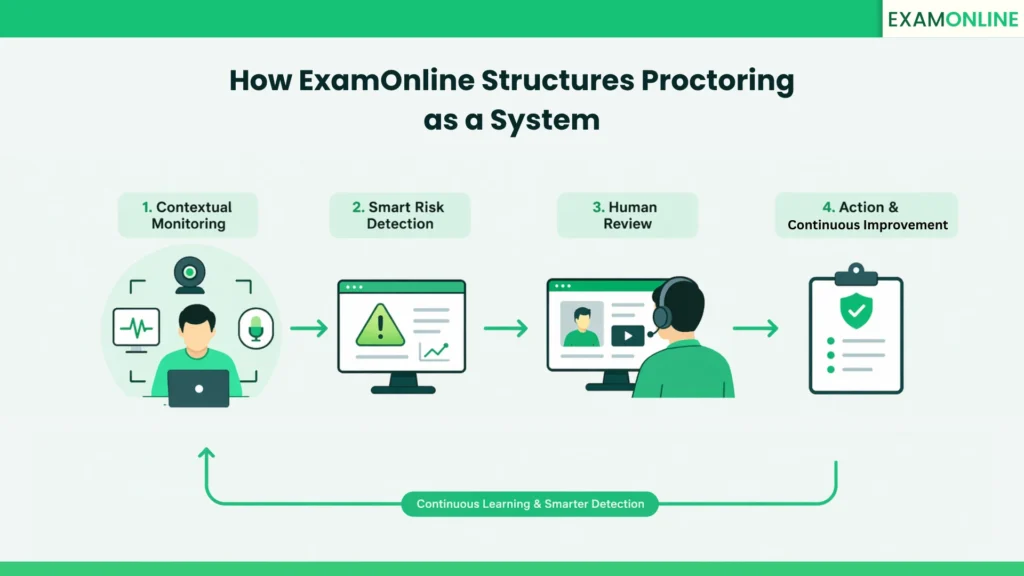
ExamOnline evaluates candidate behaviour by combining multiple signals rather than relying on isolated triggers. This allows anomalies to be interpreted with context, improving both accuracy and relevance.
Instead of generating excessive false positives, the system focuses on producing actionable signals that can be validated during review.
Consistent Environment Control
The platform enforces exam conditions uniformly across candidates by restricting navigation, access, and device behaviour. This ensures that rules are applied consistently, reducing dependency on manual supervision.
Consistency at this level is essential for fairness and comparability across assessments.
Evidence-Based Review WorkflowsE
ExamOnline treats flagging as the beginning of a process. All incidents are recorded with supporting data, enabling structured review workflows.
This allows organisations to validate events, resolve disputes, and maintain consistency in decision-making across cohorts.
End-to-End Assessment Workflow and Continuity
Integrity Beyond the Exam Window
Proctoring is often treated as a real-time activity. In practice, integrity depends on continuity across the entire lifecycle.
ExamOnline supports the full workflow, including candidate onboarding, slot booking, secure exam delivery, monitoring, structured review, multiple attempt handling, and certification output.
This ensures that integrity is not concentrated in a single phase but maintained throughout the assessment process.
Governance, Auditability, and Organisational Impact
Defensibility as a Decision Requirement
For employers and certification bodies, the ability to defend outcomes is critical. A proctoring system must enable decisions to be explained, validated, and repeated consistently.
ExamOnline generates structured audit trails that allow sessions to be reconstructed and reviewed. This ensures that outcomes are not only observed but also defensible under scrutiny.
ExamOnline generates all activity reports post completion of exams, providing online exam insights to the admin – assisting in understanding and data-driven decision making.
Scaling Without Compromising Control
As assessment volumes increase, maintaining consistency becomes more complex.
ExamOnline enables organisations to scale across geographies while maintaining uniform standards. This reduces operational complexity and ensures that integrity does not degrade with growth.
How ExamOnline Supports Secure and Scalable Online Proctoring
ExamOnline has been in the online assessment space since 2009. Over the past 16 years, we have helped universities, certification bodies, and organisations conduct secure online exams across academic, hiring, and professional certification environments. To date, we have administered over 20 million assessments across India and internationally — making us one of the most experienced online examination platforms in the region.
The platform enables end-to-end assessment workflows, including registration, slot booking, multiple attempts, payment integration, identity verification, and certificate generation with automated distribution. This ensures that organisations can manage the entire lifecycle within a single system.
By combining monitoring, control, and structured review, ExamOnline enables organisations to move from basic proctoring to complete assessment governance.
ExamOnline’s Remote Proctoring Solution covers the exam creation, delivery, exam security and integrity, evaluation and post exam analysis – covering the complete lifecycle of remote online examination.
This approach ensures that assessments are not only secure during execution but remain verifiable, auditable, and defensible over time.

Frequently Asked Questions (FAQ)
What is online proctoring software?
Online proctoring software is a system that monitors, controls, and records candidate behaviour during online assessments to ensure integrity and prevent malpractice.
How do organisations choose the right proctoring solution?
Organisations evaluate proctoring systems based on their ability to provide identity verification, continuous monitoring, structured review workflows, and auditable evidence that supports defensible decision-making.
What are the main risks in online proctoring?
Key risks include impersonation, multi-device cheating, false positives from automated systems, and lack of audit trails that prevent organisations from validating exam outcomes.
Is AI-based proctoring reliable?
AI-based proctoring is effective for scalability, but its reliability depends on how well it is combined with validation mechanisms and structured review processes.
Why is auditability important in proctoring?
Auditability ensures that every exam session can be reconstructed and reviewed. This is essential for resolving disputes, maintaining compliance, and ensuring that assessment outcomes are defensible.


