
Table of Contents
Introduction
Hiring decisions directly influence productivity, team performance, and long-term organizational success. Yet many companies still rely heavily on resumes and interviews to evaluate candidates. While these methods reveal background and experience, they do not always measure actual capability.
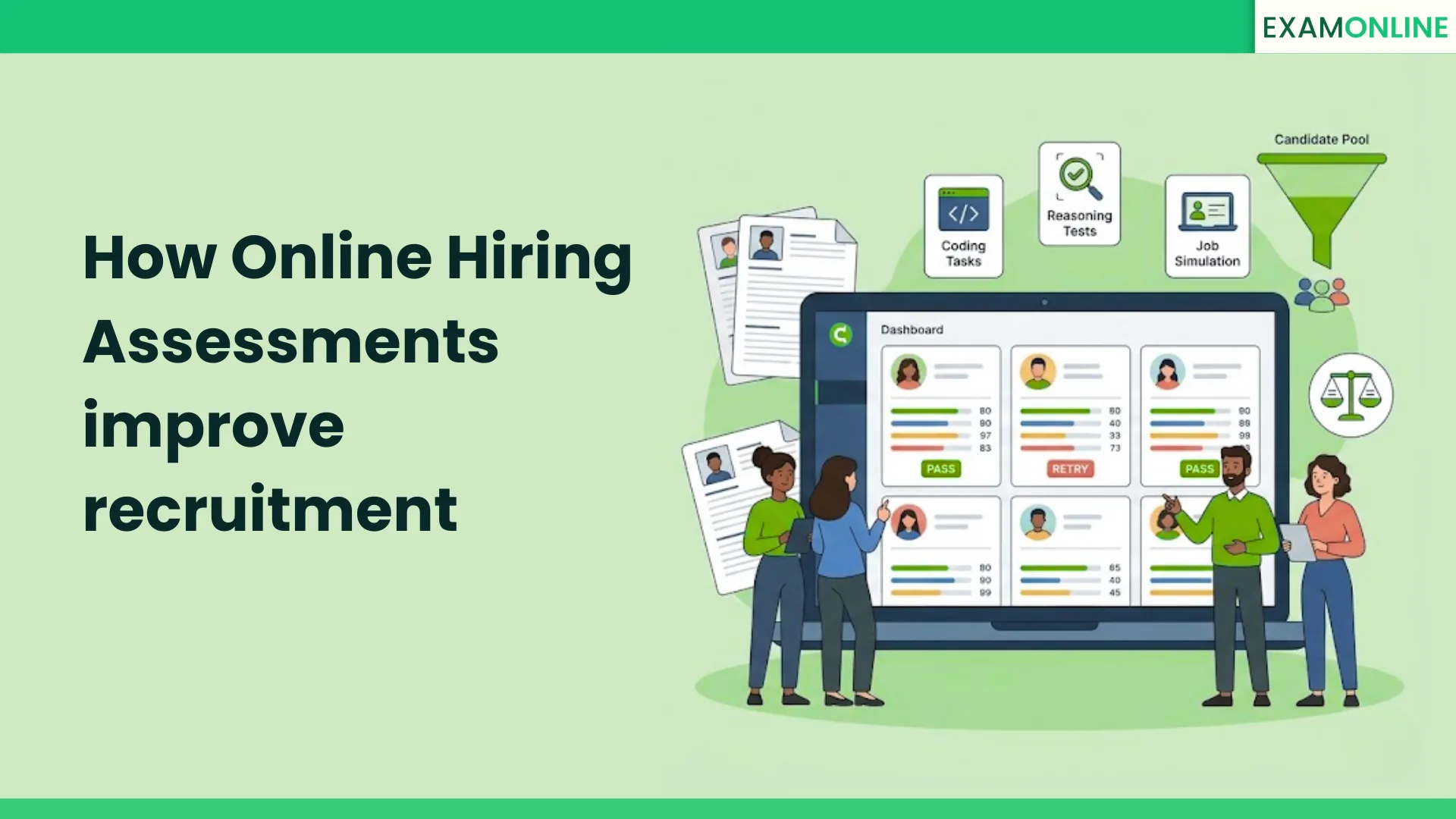
Online hiring assessments are changing how employers evaluate talent. Instead of relying solely on resumes, organizations now use structured digital tests to measure a candidate’s skills, reasoning ability, and job readiness before moving forward in the recruitment process.
As companies expand recruitment across regions and remote work becomes common, employers increasingly use online hiring assessments to screen large candidate pools efficiently. These assessments introduce measurable evaluation standards that help recruiters identify qualified candidates early while reducing subjectivity in hiring decisions.
What Are Online Hiring Assessments?
Online hiring assessments are structured digital tests used by employers to evaluate candidates during the recruitment process. These assessments are delivered through secure digital platforms and measure a variety of competencies depending on the job role.
Unlike traditional interviews that depend largely on human judgment, online hiring assessments apply standardized evaluation criteria. Every candidate completes the same tasks or answers the same questions, allowing recruiters to compare results objectively.
Organizations commonly use online hiring assessments to evaluate:
- cognitive ability and logical reasoning
- technical or domain-specific skills
- situational decision-making ability
- personality traits and behavioral tendencies
These tests often appear early in the recruitment pipeline. By evaluating candidates before interviews, organizations can filter large applicant pools and focus on individuals who demonstrate the strongest potential for the role.
Online hiring assessments are often integrated with online examination systems that manage candidate authentication, test delivery, scoring, and reporting.
Why Companies Use Hiring Assessments Over Resume Screening
Resumes summarize education and experience, but they rarely provide reliable evidence of actual skill. Employers increasingly recognize that job titles and credentials alone cannot predict how well a candidate will perform in a role.
Online hiring assessments allow recruiters to evaluate what candidates can actually do, rather than relying solely on self-reported qualifications.
Several recruitment challenges have accelerated the shift toward structured online assessments.
Resume Inflation and Skill Misrepresentation
Candidates often exaggerate their experience or technical capabilities. Online assessments require candidates to demonstrate their knowledge through problem solving or practical tasks, providing measurable skill validation.
Large Candidate Volumes
Modern recruitment campaigns can attract hundreds or thousands of applicants. Reviewing resumes individually becomes time-consuming and inconsistent. Online hiring assessments enable recruiters to filter candidates efficiently using standardized scoring systems.
Remote and Global Hiring
Organizations increasingly recruit talent across cities and countries. Digital assessments allow companies to evaluate candidates regardless of location, making remote recruitment scalable.
High-volume hiring environments, including virtual campus recruitment, frequently rely on online hiring assessments to identify qualified candidates before interviews.
Benefits of Online Hiring Assessments for Employers
Online hiring assessments provide several advantages that improve recruitment efficiency and accuracy.
Objective Candidate Evaluation
Standardized testing ensures that all candidates are evaluated using the same criteria. This reduces subjectivity and helps recruiters compare applicants fairly.
Faster Candidate Screening
Online assessments allow employers to filter large candidate pools quickly. Recruiters can identify top performers early in the recruitment process and prioritize interviews accordingly.
Reduced Hiring Errors
Assessments provide measurable evidence of skill and reasoning ability. By evaluating candidates before interviews, organizations can reduce the risk of hiring individuals who lack the required competencies.
Scalable Recruitment
Companies conducting large-scale hiring campaigns can evaluate hundreds or thousands of candidates simultaneously through online assessments without requiring physical test centers.
For many organizations, structured pre-employment assessments have become a critical tool for improving hiring accuracy.
Resume Screening vs Online Hiring Assessments

Traditional recruitment methods often begin with resume screening. While resumes provide useful background information, they do not reliably measure candidate capability.
| Evaluation Factor | Resume Screening | Online Hiring Assessments |
| Skill verification | Limited | Directly measured |
| Evaluation consistency | Subjective | Standardized |
| Scalability | Low for large candidate pools | High |
| Bias risk | Higher | Lower when standardized |
| Evidence of ability | Weak | Strong |
Employers increasingly prefer online hiring assessments because they introduce measurable evaluation criteria into recruitment decisions. Instead of relying solely on written resumes, recruiters can evaluate how candidates solve problems, interpret information, or perform job-related tasks.
Types of Online Hiring Assessments Used by Employers
Different job roles require different competencies. As a result, employers use multiple types of online hiring assessments depending on the skills required for the position.
Aptitude Assessments
Aptitude tests measure cognitive abilities such as logical reasoning, numerical analysis, and problem solving. These assessments help employers evaluate how candidates process information and approach unfamiliar problems.
Technical Skill Assessments
Technical assessments evaluate job-specific skills and domain knowledge. For example, software developers may complete coding tasks, while finance professionals may analyze datasets or interpret financial reports.
Employers frequently rely on technical hiring assessments to verify whether candidates possess the practical capabilities required for specialized roles.
Situational Judgement Tests
Situational judgement tests present candidates with workplace scenarios and ask them to select the most appropriate response. These assessments evaluate decision-making ability, professional judgment, and communication style.
Personality and Behavioral Assessments
Personality assessments measure behavioral tendencies, motivation, and interpersonal traits. While these tests do not measure technical ability directly, they provide insight into how candidates may interact with teams or adapt to organizational culture.
How Online Hiring Assessments Improve Hiring Accuracy
Online hiring assessments introduce structured evaluation into recruitment processes that would otherwise rely heavily on subjective judgment.
Standardized Candidate Evaluation
All candidates receive identical questions or tasks. This ensures that performance comparisons are fair and based on consistent evaluation conditions.
Data-Driven Hiring Decisions
Digital assessment platforms automatically record candidate responses and generate performance metrics. Recruiters can analyze scores, completion times, and response patterns to gain deeper insight into candidate capability.
Early Identification of High-Potential Candidates
Assessments allow recruiters to identify candidates who demonstrate strong reasoning ability or technical expertise before scheduling interviews. This reduces interview load and improves recruiter efficiency.
Challenges of Online Hiring Assessments
Although online hiring assessments improve recruitment efficiency, they must be designed carefully. Poorly implemented assessments can produce misleading results or discourage candidates from completing the process.
Test Relevance
Assessments must measure competencies directly related to the job role. Generic or poorly designed tests may fail to identify candidates with the skills required for the position.
Candidate Experience
Excessively long assessments can lead to candidate fatigue or drop-off. Organizations must balance evaluation depth with reasonable test duration.
Cheating and Impersonation Risks
Remote assessments create opportunities for candidates to receive outside assistance or allow another person to take the test on their behalf. Employers must address these risks through secure assessment systems.
Risks and Integrity Concerns in Online Hiring Assessments

Organizations implementing online hiring assessments must consider governance and defensibility in recruitment decisions. Hiring processes must demonstrate fairness, consistency, and integrity.
Several risks can undermine the credibility of digital recruitment assessments.
Identity Fraud
Candidates may attempt to have another person complete the assessment on their behalf. Identity verification mechanisms help ensure that the registered applicant is the individual taking the test.
Unauthorized Assistance
Candidates may attempt to use external resources or collaborate with others during assessments. Secure testing environments restrict unauthorized applications and browsing.
Test Leakage
If assessment questions circulate publicly, future test results may become unreliable. Organizations must protect question banks and monitor candidate activity during testing.
Strong governance practices ensure that online hiring assessments produce results that employers can trust.
How Companies Secure Online Hiring Assessments
Maintaining assessment integrity is essential for reliable hiring decisions. If test results cannot be trusted, the recruitment process loses credibility.
Secure online hiring assessments rely on several safeguards.
Identity Verification
Authentication checks confirm that the candidate completing the assessment is the registered applicant.
Controlled Testing Environment
Secure platforms restrict access to unauthorized applications, websites, and communication tools during assessments.
Monitoring and Behavioral Analysis
Candidate activity can be monitored to identify unusual behavior patterns that may indicate cheating or external assistance.
These safeguards are typically implemented within broader online examination systems that manage digital assessments from candidate authentication to final scoring.
Where Online Hiring Assessments Fit in the Recruitment Process
Online hiring assessments typically appear early in the recruitment process and act as a structured screening stage before interviews.
A typical recruitment workflow using online assessments may follow this sequence:
Application submission
↓
Online hiring assessment
↓
Automated score analysis
↓
Shortlisting of qualified candidates
↓
Interviews and final evaluation
By introducing objective evaluation early in the process, organizations reduce the time recruiters spend reviewing unqualified applicants. Hiring teams can focus their efforts on candidates who demonstrate strong assessment performance.
This approach improves recruiter productivity and helps organizations conduct large-scale hiring campaigns without increasing manual screening effort.
How to Design Effective Online Hiring Assessments
The effectiveness of online hiring assessments depends on careful test design. Employers must ensure that assessments measure relevant capabilities while remaining fair and accessible to candidates.
Align Tests with Job Requirements
Assessment questions should reflect real tasks associated with the role. Coding exercises may be appropriate for developers, while analytical reasoning tests may be more suitable for consulting roles.
Combine Multiple Assessment Types
Using a mix of aptitude, technical, and situational judgement tests provides a broader understanding of candidate ability.
Maintain Appropriate Test Length
Shorter assessments help maintain candidate engagement while still generating meaningful evaluation insights.
When designed properly, online hiring assessments provide reliable indicators of candidate capability and potential job performance.
Conducting Secure Online Hiring Assessments with ExamOnline
Organizations conducting digital recruitment assessments require systems that combine secure test delivery with scalable candidate management. ExamOnline provides an end-to-end platform designed to support structured hiring assessments across industries.
Operating in 25+ countries and 250+ organisations, the platform manages the full assessment lifecycle, including candidate registration, slot booking, multiple attempts, payment gateway integration, identity verification, and automated certificate generation where required.
ExamOnline enables organizations to conduct secure online hiring assessments while maintaining integrity across remote recruitment environments.
Organizations seeking a scalable online hiring assessment platform can use ExamOnline to manage recruitment tests, evaluate candidates consistently, and maintain defensible hiring processes.
Employers increasingly rely on online hiring assessments not simply to digitize recruitment, but to ensure that candidate evaluation remains measurable, fair, and defensible.

Frequently Asked Questions (FAQ)
What are online hiring assessments?
Online hiring assessments are digital tests used during recruitment to evaluate candidate skills, reasoning ability, and job readiness before interviews.
Are online hiring assessments reliable?
When designed properly and delivered through secure platforms, online hiring assessments provide consistent and measurable evaluation criteria that improve recruitment accuracy.
How long should an online hiring assessment be?
Most hiring assessments last between 20 and 60 minutes depending on the complexity of the role and the number of competencies being evaluated.
Can candidates cheat in online hiring assessments?
Cheating risks exist in any remote assessment. Secure platforms use identity verification, restricted browser environments, and monitoring technologies to reduce dishonest behavior.
Do online hiring assessments replace interviews?
Online hiring assessments complement interviews rather than replace them. Assessments evaluate skills and reasoning ability, while interviews help employers evaluate communication skills and cultural fit.


