
Table of Contents
Hiring is fundamentally a prediction exercise. Employers attempt to estimate future job performance using limited observable signals – resumes, interviews, certifications, and test scores.
The debate around cognitive ability vs technical skills in hiring emerges from this prediction challenge. Technical skills reflect current task competence. Cognitive ability reflects learning capacity and problem-solving strength. The tension between the two shapes hiring accuracy.
Cognitive ability predicts long-term adaptability.
Technical skills predict immediate task execution.
Accurate hiring depends on understanding which predictor carries more weight under specific role conditions.
What Is Cognitive Ability in Hiring?
Cognitive ability in recruitment refers to a candidate’s capacity to reason, analyse information, identify patterns, and learn efficiently. It measures mental processing strength rather than job-specific knowledge.
In structured hiring systems, cognitive ability tests for recruitment are used to evaluate learning agility before technical exposure.
Why Cognitive Ability Predicts Adaptability
Across industries, general cognitive ability consistently correlates with job performance – especially in roles requiring analytical thinking and decision-making.
Cognitive ability influences:
- Learning speed in new environments
- Ability to handle complexity
- Logical reasoning accuracy
- Adaptation to new tools or processes
In fast-changing industries, the ability to acquire new skills often outweighs static knowledge.
Cognitive Ability vs Experience as a Hiring Signal
Experience is often used as a proxy for competence. However, experience measures exposure, not necessarily capability.
Two candidates may have similar years of experience. The one with stronger reasoning ability typically:
- Requires less supervision
- Transfers learning across tasks
- Solves unfamiliar problems faster
Pre-employment cognitive testing allows organisations to measure this capacity directly instead of inferring it from resumes.
Implication for Predictive Hiring
When organisations ask how to predict job performance before hiring, cognitive ability becomes central. It reflects future growth potential rather than past task completion.
However, cognitive ability alone does not guarantee job readiness. It must be evaluated alongside role-specific requirements.
Technical Skills as a Measure of Immediate Role Competence
Technical skills refer to the functional knowledge required to perform defined job tasks. Examples include coding ability, financial modelling, regulatory compliance procedures, data analysis, or domain-specific operations.
Unlike cognitive ability, technical skills are role-bound and context-dependent.
Why Technical Skill Testing Dominates Recruitment
Technical skills assessments are widely adopted because they measure task performance directly and objectively.
Their advantages include:
- Clear alignment with job description
- Immediate productivity validation
- Standardised scoring
- Stakeholder confidence in measurable outputs
Structured evaluation models for skill validation are discussed in Why Technical Assessments Drive Smarter Hiring?.
For operational or specialised roles, technical skills assessment for hiring can strongly predict short-term effectiveness.
The Limitation of Skill-Only Hiring Models
While technical validation confirms readiness for today’s tasks, it does not necessarily predict performance in evolving environments.
Risks of over-reliance include:
- Skill obsolescence
- Interview coaching inflating results
- Memorisation without conceptual depth
- Limited adaptability under ambiguity
In industries undergoing rapid transformation, technical skills alone may not sustain long-term performance.
Role Sensitivity in Hiring Decisions
For stable, repetitive roles, technical competence may dominate predictive value.
For strategic, analytical, or high-growth roles, cognitive ability becomes more influential.
Understanding this distinction is essential when designing a structured hiring assessment framework.
Cognitive Ability vs Technical Skills in Hiring – A Predictive Comparison

The question is not which is superior in isolation. The key issue is which dimension better predicts job performance under specific organisational conditions.
| Dimension | Cognitive Ability | Technical Skills |
| Predicts immediate task execution | Moderate | High |
| Predicts learning speed | High | Low to Moderate |
| Stability over time | Relatively stable | Can decay |
| Vulnerability to coaching | Low | Moderate |
| Value in dynamic industries | High | Variable |
| Role-specific precision | Lower | High |
What This Means for Employers
Technical skills predict short-term execution.
Cognitive ability predicts long-term growth and adaptability.
Technical skills answer: Can the candidate perform the job today?
Cognitive ability answers: Can the candidate handle the job tomorrow?
Organisations seeking accurate hiring outcomes should interpret both measures within a structured assessment architecture. This data-driven recruitment approach is further examined in How Pre-Employment Assessments Drive Accurate, Predictive Hiring.
From Signals to Measurable Evaluation
Resume screening and interviews blend subjective perception with visible credentials. Structured online assessments separate measurable cognitive potential from measurable technical competence.
When hiring systems shift from assumption-driven evaluation to structured measurement, predictive accuracy improves.
Hiring Accuracy Is a Governance and Risk Management Issue
Hiring errors are not merely performance gaps. They are governance failures.
When organisations rely on unstructured interviews or inconsistent scoring criteria, hiring becomes vulnerable to bias and unpredictability. Predictive hiring must be framed as a risk management decision.
Hiring predictability affects compliance integrity, workforce quality, and long-term organisational stability.
The Cost of Misjudging Predictors
Incorrect weighting of cognitive ability and technical skills can result in:
- High early attrition
- Low training return on investment
- Inconsistent performance across teams
- Promotion misalignment
If technical skills are over-weighted, organisations may hire candidates who perform well initially but struggle with change. If cognitive ability is over-weighted without technical validation, immediate productivity may suffer.
Balanced evaluation reduces both risks.
Structured Digital Evaluation Improves Defensibility
Predictive hiring improves when organisations move from informal judgment to measurable criteria within controlled environments.
Standardised Online Exam Systems provide:
- Consistent candidate evaluation
- Scalable benchmarking
- Audit-ready scoring records
- Reduced interviewer bias
Governance maturity in recruitment depends on how structured and digitally managed the assessment process is.
Designing a Balanced Hiring Assessment Framework
The objective is not to choose between cognitive ability and technical skills. The objective is to sequence and integrate them intelligently.
A balanced hiring framework evaluates:
- Baseline reasoning ability
- Role-specific technical competence
- Consistency across stages
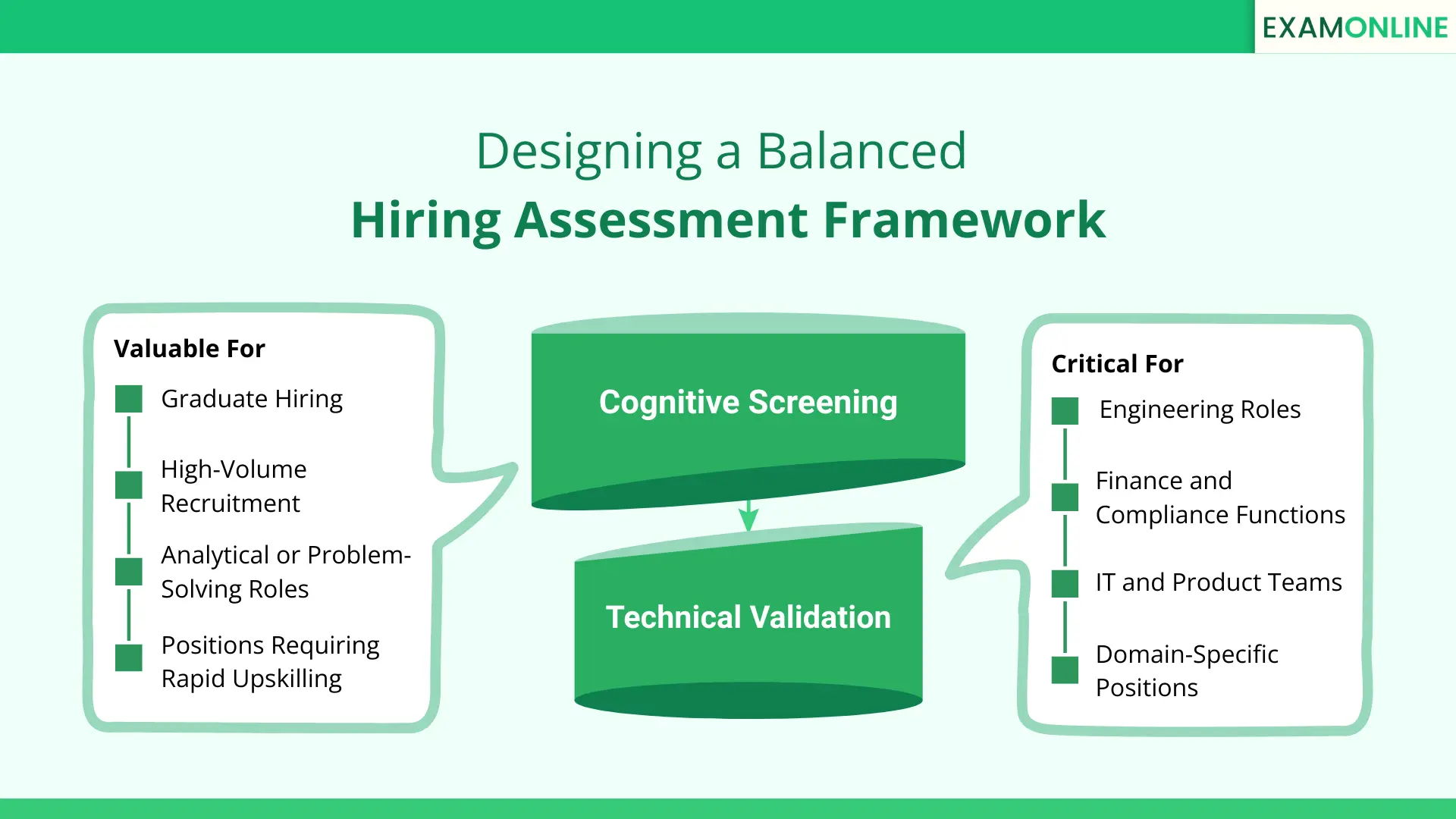
Layer 1 – Cognitive Screening
Cognitive screening is particularly valuable for:
- Graduate hiring
- High-volume recruitment
- Analytical or problem-solving roles
- Positions requiring rapid upskilling
It reduces over-dependence on resume assumptions.
Layer 2 – Technical Validation
Technical validation is critical for:
- Engineering roles
- Finance and compliance functions
- IT and product teams
- Domain-specific positions
Together, these layers improve both short-term productivity prediction and long-term growth forecasting.
Why Sequencing Strengthens Predictive Hiring
Conducting technical tests before assessing reasoning ability may eliminate high-potential candidates prematurely. Conducting cognitive tests without technical validation may create role misalignment.
Structured sequencing increases hiring accuracy and defensibility.
Enabling Predictive Hiring Through Scalable Assessment Infrastructure
Balanced hiring requires infrastructure capable of delivering, monitoring, and documenting assessments consistently across geographies and volumes.
ExamOnline supports structured hiring workflows across 25+ countries and 250+ organisations through an end-to-end digital assessment ecosystem.
The platform supports the full recruitment lifecycle – from candidate registration and slot booking to multiple attempts, integrated payment gateways, secure identity verification, and automated certificate generation and distribution.
Through Corporate Hiring Solutions, organisations can combine cognitive testing, role-specific technical evaluation, and secure online proctoring within one unified workflow.
When predictive hiring is supported by structured digital infrastructure, organisations improve consistency, scalability, compliance readiness, and decision defensibility.
Employers do not debate cognitive ability vs technical skills – they build structured hiring systems that measure both to predict performance with defensibility.

Frequently Asked Questions (FAQs)
Is cognitive ability more important than technical skills in hiring?
Neither predictor is universally superior. Cognitive ability predicts learning speed and adaptability, while technical skills predict immediate task execution. Their importance depends on role complexity and industry volatility.
Do technical skills alone predict long-term job performance?
Technical skills strongly predict short-term productivity. Long-term performance in dynamic environments depends more heavily on cognitive adaptability and learning capacity.
How can employers measure job performance potential before hiring?
Employers can use pre-employment cognitive testing combined with structured technical skills assessment within a digitally managed evaluation system.
Are cognitive ability tests suitable for all roles?
Cognitive tests are particularly effective for analytical, leadership, and high-growth roles. For repetitive or narrowly defined tasks, technical validation may carry greater weight.
What is the most accurate approach to predictive hiring?
The most reliable method integrates cognitive screening and technical validation within a structured, scalable, and audit-ready assessment framework.


