
Table of Contents
When One Exam Puts Your Reputation at Risk
A certification result carries more weight than a score on a screen. Employers rely on it, candidates invest time in earning it, and issuing organizations attach their reputation to every successful result. A single disputed examination can create weeks of investigation and uncomfortable conversations with stakeholders. AI exam monitoring gives assessment teams a structured way to observe remote sessions and retain relevant evidence. The real objective is a defensible process that earns confidence at every stage.
Consider a professional association preparing to expand its certification program across several countries. Its examination team wants wider access, predictable delivery, and a consistent standard for every candidate. Yet more test windows also create more identity checks, incident reports, and review work. AI exam monitoring can bring these activities into a coordinated workflow with configurable monitoring rules. That consistency becomes valuable as candidate volumes and business expectations grow.
For HR leaders, the pressure feels equally familiar. A hiring assessment may influence interviews, shortlists, and expensive recruitment decisions. Managers need confidence that each applicant completed the same evaluation under comparable conditions. AI exam monitoring supports this goal by capturing defined signals during the assessment. Pairing those signals with thoughtful human review helps teams make decisions using context and evidence.
What Automated Proctoring Really Means
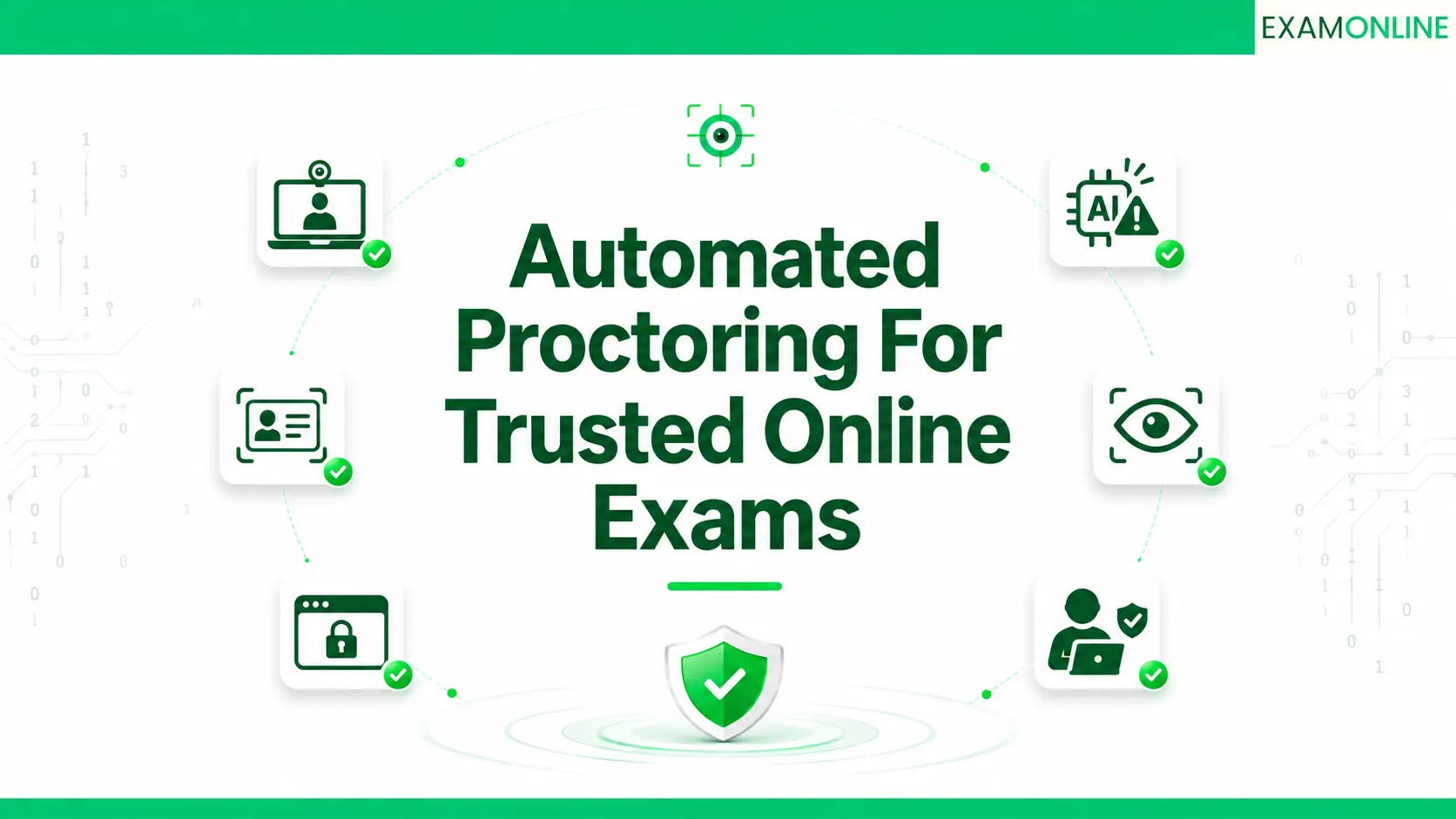
Automated proctoring uses software to monitor online exams and flag risks. Automated proctoring helps teams review alerts and protect exam integrity. The system highlights events that deserve attention and can assemble them into a reviewable session record. A flagged event is a signal for investigation rather than a final judgment about a candidate. This distinction is essential for fair and credible assessments.
The phrase AI AI exam monitoring often refers to models that recognize patterns such as an additional face, prolonged absence, or an unusual object in the testing environment. A secure browser can add controls around applications, navigation, and permitted resources. Identity verification adds another layer before the examination begins. Together, these functions create an automated exam proctoring workflow that supports administrators from entry through review. The precise capabilities depend on the selected platform and examination policy.
For a deeper look at practical deployment, ExamOnline explains its remote proctoring solution and the role of human oversight. Its approach combines configurable exam monitoring, browser security, and reviewable reports. Automated proctoring works best when the technology reflects the actual risk of the examination. A low stakes training quiz may require lighter controls than a professional license assessment. Matching the controls to the purpose creates a smoother experience for everyone.

How Automated Proctoring Works
A successful AI exam monitoring session starts long before the first question appears. Administrators define the examination rules, permitted materials, identity checks, and review thresholds. Candidates receive instructions about equipment, lighting, privacy, and the examination environment. The platform then guides each candidate through the required checks. Clear preparation reduces avoidable interruptions during the scheduled assessment.
The Candidate Journey
- Create the exam and select the monitoring policy
- Invite candidates through the assessment platform
- Complete identity and equipment verification
- Confirm webcam, microphone, and screen permissions
- Launch the controlled examination environment
- Capture permitted activity signals during the exam
- Flag events based on configured rules
- Review session evidence and candidate context
- Record the outcome with an audit trail
During the examination, automated proctoring software can mark events with timestamps so reviewers can reach relevant moments quickly. Some deployments also provide live escalation for urgent situations. At the end, administrators review the session record alongside the candidate result and examination policy. An isolated movement or a temporary connection issue deserves context before any consequential decision. A documented review process protects both the organization and the candidate.
The NIST digital identity guidelines provide useful background for designing identity assurance and authentication processes. Their framework helps procurement teams ask better questions about the strength of candidate verification. Identity proofing and exam supervision are distinct activities with complementary purposes. AI exam monitoring should sit within a wider identity, access, and assessment governance process. This layered approach is especially useful for high value credentials.

The Features That Protect Every Exam
Feature lists can look impressive while hiding important operational gaps. Buyers gain more value by asking what each feature helps their team verify, control, or explain. Automated proctoring should make relevant evidence easier to locate and decisions easier to defend. The right combination depends on exam duration, candidate geography, and the consequences of an incorrect outcome. A practical feature checklist keeps procurement discussions grounded in daily operations.
Nine Capabilities Worth Testing
- Candidate identity verification and clear exception handling
- Webcam monitoring with configurable event detection
- Screen activity capture with meaningful timestamps
- Secure browser controls suited to the exam format
- Audio monitoring where policy and consent permit
- Human review access to relevant evidence
- Administrator roles and access permissions
- LMS or assessment platform integration
- Retention controls and exportable audit reports
AI exam monitoring becomes more useful when the review interface presents a clear sequence of events. An administrator should be able to understand the reason for an alert, examine the evidence, and record the disposition. Reporting should also help managers identify recurring operational issues across sessions. For teams operating a larger exam program, online exam conducting software connects security with scheduling and delivery. The value comes from an organized workflow rather than a collection of isolated features.
Ask vendors to demonstrate a real candidate session from setup to final review. Include a brief connection interruption, a permitted accommodation, and an ordinary environmental distraction. Watch how the system communicates with the candidate and how reviewers interpret the resulting alerts. Automated proctoring software should provide a clear explanation of its settings and review permissions. This demonstration often reveals more than a long product brochure.
Where Automated Proctoring Creates Value
Different organizations buy AI exam monitoring for different reasons. A university may prioritize academic integrity and accessible participation across campuses. A certification body may care most about credential credibility and international scheduling. An employer may focus on consistent candidate evaluation across hiring locations. The shared need is dependable evidence with manageable administrative effort.
Business Use Cases
- Professional certification and recertification programs
- Enterprise recruitment and screening assessments
- University semester and entrance examinations
- Employee compliance and policy examinations
- Corporate learning and development assessments
- Healthcare knowledge and competency tests
- Partner accreditation and channel certification
- Government and public sector recruitment tests
- Training provider final assessments
Automated proctoring for recruitment helps talent teams apply consistent monitoring rules to geographically distributed applicants. In certification programs, AI exam monitoring can support flexible examination windows while retaining session records for quality assurance. Learning teams can use lighter settings for internal skills validation and stronger settings for regulated credentials. The right policy should reflect the stakes and candidate population. ExamOnline provides dedicated hiring and recruitment assessment solutions for organizations building secure selection workflows.
Certification providers can connect this decision to the wider operating model described in scaling certification programs. As participation grows, manual coordination becomes a significant management burden. Automated proctoring creates an opportunity to standardize supervision while reserving specialist attention for meaningful exceptions. Strong candidate communication remains essential during expansion. Trust grows when every location receives a consistent and clearly explained process.

Automated vs Live Proctoring
Choosing between AI exam monitoring and live supervision is a business design decision. Each approach offers a different balance of scheduling flexibility, immediate intervention, and review workload. Some organizations use automated monitoring for routine sessions and live invigilators for selected high stakes examinations. Others combine both in a hybrid model. The strongest choice reflects candidate risk, staffing capacity, and policy requirements.
| Decision factor | Automated proctoring | Live proctoring |
| Monitoring | Rules and AI assisted event detection | Human observation during the session |
| Staffing | Reviewers focus on flagged events | Proctors attend scheduled sessions |
| Scheduling | Flexible asynchronous review options | Depends on live staff availability |
| Escalation | Alerts and defined escalation workflows | Direct human response during the exam |
| Best fit | Scalable routine and distributed assessments | Sensitive exams requiring active oversight |
| Evidence | Timestamped events and recorded artifacts | Human observations with available recordings |
Automated proctoring often helps teams handle larger candidate volumes with a more structured review queue. Live invigilation provides the benefit of immediate human interaction when examination rules call for active supervision. A hybrid approach can combine these advantages for different candidate groups or assessment stages. The cost model should include reviewer time, support needs, storage, and peak capacity. Compare complete operating costs rather than the price per session alone.
For organizations using an existing test engine, proctoring as a service offers another purchasing route. ExamOnline describes integration paths including LMS connections and API based implementation. This can help teams add monitoring to established assessment workflows. AI exam monitoring may therefore be procured as part of a complete examination platform or as a dedicated service layer. Integration planning should begin with the systems already used by administrators.
What False Alerts Can Cost Your Team
An alert can be technically accurate while its interpretation remains uncertain. A candidate may look away while thinking, shift position to relieve discomfort, or experience a temporary camera interruption. Automated proctoring should make those events visible to reviewers while keeping disciplinary conclusions subject to review. Review teams need consistent guidance for examining evidence and recording decisions. Fairness is a practical requirement for protecting assessment credibility.
The strongest review policy defines event severity, supporting evidence, escalation paths, and candidate appeal procedures. It also identifies who can view recordings and who can authorize an outcome. AI exam monitoring software should make it easy to separate technical interruptions from suspected rule violations. A second reviewer may be useful for sensitive cases with major consequences. Clear governance reduces disputes and supports consistent treatment across cohorts.
NIST recommends testing automated media analysis against genuine and manipulated examples and supplementing automated decisions with manual review in identity proofing contexts. Its identity proofing requirements offer a useful model for asking vendors about error rates and evaluation practices. These principles can inform exam monitoring procurement even though the guidance addresses digital identity systems. Automated proctoring buyers should request performance evidence relevant to their candidate population. A vendor demonstration should include ordinary behaviors as well as deliberate policy violations.
Privacy And Accessibility Build Trust
A candidate opening an examination should understand what the system observes and why those signals matter. AI exam monitoring introduces responsibilities around consent, lawful processing, access control, retention, and candidate support. Privacy information should use clear language before the session begins. Organizations also need a practical process for responding to data access and deletion requests where applicable. Transparent communication can reduce anxiety and improve completion rates.
For international programs, the European Commission guidance on automated decisions is a valuable reference. Certain decisions with legal or similarly significant effects may trigger additional safeguards under data protection law. The GDPR legal text explains relevant rights and responsibilities. Automated proctoring policies should be reviewed with the organization privacy and legal teams. Candidate consent and other lawful bases require context specific assessment.
Accessibility deserves the same level of attention as security. The W3C accessibility guidelines provide established criteria for accessible digital experiences. Procurement teams should test keyboard access, readable instructions, screen reader behavior, and accommodation workflows. AI exam monitoring must be configured with care for candidates using approved assistive technologies. Inclusive delivery protects participation while preserving examination standards.

How to Choose Proctoring Software
Procurement meetings often begin with a polished dashboard and a long list of detection features. A better conversation starts with the examinations your organization actually conducts. Define the candidate volume, peak concurrency, assessment stakes, countries served, and existing software. Then ask each vendor to demonstrate the full journey using those constraints. Automated proctoring should be judged by operational fit and documented evidence.
Ten Buyer Questions
- Which monitoring signals can administrators configure?
- How are identity checks completed and reviewed?
- What happens during a network interruption?
- How are false alerts investigated and closed?
- Which candidate accommodations are supported?
- What evidence is retained and for how long?
- Which data locations and access controls are available?
- How does the system connect to our LMS or HR tools?
- What are the peak concurrency and support commitments?
- How is total pricing calculated across exam volumes?
Ask for a pilot involving real administrators and representative candidates. Include at least one accessibility scenario, one technical exception, and one policy review case. Measure completion, support requests, alert volume, review time, and candidate feedback. AI exam monitoring is easier to evaluate when every vendor faces the same test conditions. The pilot should conclude with documented findings and clear next actions.
The UNESCO guidance on generative AI in education highlights the importance of human centered governance as educational technology evolves. Its accompanying research publication provides further background for institutional policy discussions. Although its subject is broader than exam supervision, the emphasis on human agency is relevant. Automated proctoring decisions benefit from transparent rules and accountable review. These are useful standards to include in a vendor evaluation.
Launch Automated Proctoring With Confidence
Implementation becomes easier when ownership is clear from the beginning. Examination leaders define the policy, IT teams confirm the technical environment, and support teams prepare candidate instructions. Privacy specialists review data handling, while reviewers agree on how alerts will be resolved. AI exam monitoring then becomes a coordinated service rather than a last minute addition. A small pilot gives every team space to refine its responsibilities.
A Practical Launch Checklist
- Confirm the purpose and risk level of each exam
- Select the monitoring and identity policies
- Document permitted materials and accommodations
- Test browsers, devices, and network conditions
- Review candidate privacy information
- Train administrators on incident decisions
- Run a representative pilot session
- Prepare candidate help and escalation channels
- Review metrics before wider rollout
Start with one examination type and a manageable group of participants. Record the issues that cause support requests and revise instructions before the next session. Automated proctoring adoption improves when candidates know what to expect and administrators know how to respond. Expand to additional exam types after the first workflow operates reliably. This staged approach also creates useful evidence for internal budget approvals.
An organization running multiple assessment programs can connect monitoring with certification exam solutions and the wider ExamOnline assessment platform. For more background on AI assisted review, the AI invigilation software guide explores buyer considerations. These resources can help teams align security with exam administration. AI exam monitoring works best when setup, candidate support, and review follow one agreed process. That operational discipline matters as much as the detection technology.
Why ExamOnline Fits Enterprise Assessments
ExamOnline brings automated proctoring into a wider environment for secure online assessment delivery. Its published remote proctoring solution describes candidate verification, webcam monitoring, screen activity, secure browser controls, and post exam reports. The platform also supports human review of flagged events. This combination is useful for organizations that need evidence and practical administrative control. Feature scope and deployment requirements should be confirmed during a tailored demonstration.
Teams with an existing learning or assessment system can explore ExamOnline proctoring integration services. Certification bodies can examine dedicated workflows for professional examinations. HR departments can evaluate assessment security alongside recruitment operations. AI exam monitoring is therefore part of a broader conversation about how each organization measures skills and protects outcomes. The right deployment starts with the organization specific assessment process.
A useful first conversation covers candidate numbers, exam duration, countries, integration needs, and the desired level of supervision. ExamOnline can then discuss the relevant configuration and demonstration scope. Automated proctoring requirements become clearer when stakeholders see an end to end candidate journey. Teams can contact ExamOnline sales to explore their requirements. The next step is a practical assessment of fit, rather than a commitment based on a feature checklist.
Frequently Asked Questions
What is automated proctoring?
AI exam monitoring uses software to supervise online examinations through configured activity signals and AI assisted event detection. It may combine webcam, microphone, screen, and browser information. Administrators can review relevant events with timestamps and supporting records. The system supports an examination policy rather than defining that policy itself. Human review remains valuable for interpreting context and reaching fair outcomes.
Is automated proctoring suitable for hiring?
Automated proctoring can support remote recruitment assessments where employers need consistent examination conditions. HR teams can use defined monitoring policies across different locations. Candidate instructions and accommodation processes should be clear before testing begins. Reviewers should consider the evidence alongside the assessment rules. ExamOnline offers recruitment assessment workflows for enterprise hiring teams.
How does automated proctoring handle alerts?
AI exam monitoring software records events that match configured monitoring rules. An alert may indicate candidate movement, a browser event, or a technical interruption. Reviewers examine the relevant context and supporting information. Organizations should document the review decision and any escalation. This process supports consistency and a fair candidate experience.
Can automated proctoring support global exams?
Automated proctoring can help organizations schedule distributed examinations across locations and time zones. The operating model depends on network conditions, candidate devices, local laws, and support coverage. Administrators should test peak concurrency and regional candidate experiences. Clear policies help maintain consistent examination standards. A pilot across representative locations can reveal practical adjustments.
How should businesses compare pricing?
AI exam monitoring pricing should be assessed against the complete examination workflow. Review the session rate, candidate volume, storage, support, integrations, and reviewer effort. Some organizations prefer a complete examination platform while others need an integrated monitoring layer. A representative pilot helps estimate the real operational cost. Procurement teams can request a tailored proposal from ExamOnline.
Build Trust Into Your Next Exam
Every examination creates a promise to candidates, employers, and the organization issuing the result. Automated proctoring helps protect that promise through consistent monitoring, meaningful records, and reviewable evidence. The strongest implementations combine appropriate technology with clear rules and responsible human judgment. Teams that plan for privacy, accessibility, and candidate support build greater confidence in the process. A secure examination experience can become a lasting advantage for a growing assessment program.
Whether your organization conducts certification exams, recruitment tests, or enterprise learning assessments, the next step is to map the risks that matter most. AI exam monitoring should support your assessment goals and existing workflows. ExamOnline offers remote monitoring and examination delivery solutions for these use cases. Explore the remote proctoring platform or request a business consultation to discuss a suitable setup. Strong exam integrity begins with a clear plan and the right operational partner.


