
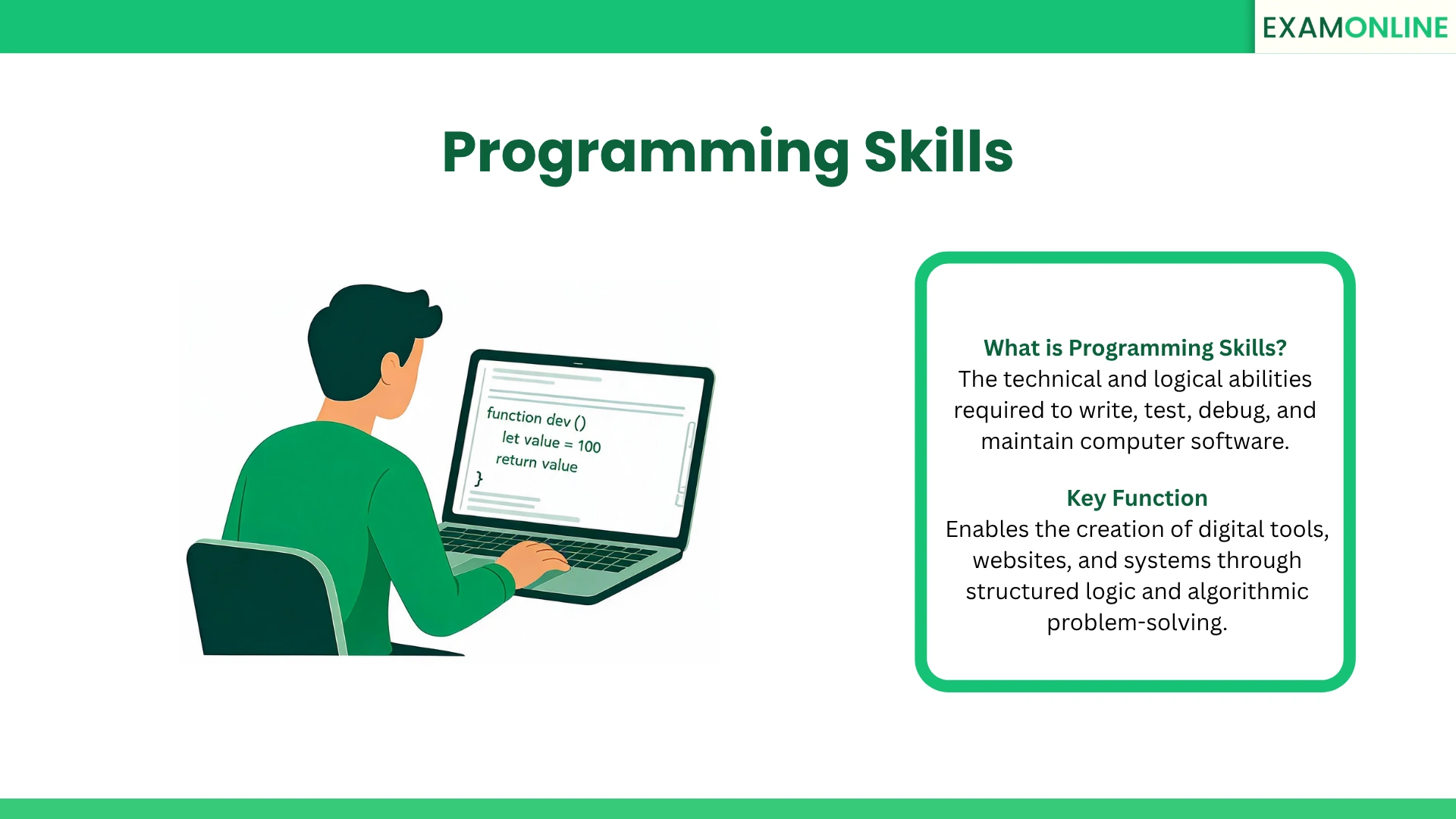
What is Programming Skills
Programming Skills refer to the combination of technical knowledge and logical problem-solving abilities required to communicate with computers.
At its core, possessing these skills means an individual can write structured instructions (code) that a machine can understand and execute to perform specific tasks. However, being a skilled programmer goes far beyond simply memorizing the syntax of a specific coding language like Python, Java, or C++.
True programming mastery involves understanding deep architectural concepts, structuring data efficiently, and designing robust systems that can scale. These skills empower individuals to build everything from simple mobile applications to massive, complex operating systems, making them one of the most highly sought-after competencies in the modern digital economy.
Key Components of Programming Skills
To become a highly effective developer, an individual must cultivate a diverse set of both technical and intellectual abilities. The foundational elements include:
- Algorithmic Thinking: The ability to break down massive, complex problems into a series of smaller, highly logical steps that a computer can sequentially execute.
- Syntax Proficiency: A deep, functional understanding of the specific grammar, vocabulary, and structural rules of chosen programming languages.
- Debugging and Troubleshooting: The analytical patience to systematically hunt down, identify, and fix hidden errors or “bugs” within thousands of lines of code.
- Data Structure Knowledge: Understanding exactly how to organize, store, and retrieve data efficiently using structures like arrays, trees, and hash maps.
- Version Control: The ability to manage codebase changes securely and collaborate with other developers using standardized systems like Git.
Types of Programming Skills
The software development field is vast, and professionals typically specialize in specific areas based on their career goals. The major categories include:
- Front-End Development: Focuses entirely on what the user sees and interacts with. It requires deep knowledge of HTML, CSS, JavaScript, and user interface (UI) design principles.
- Back-End Development: Focuses on the hidden server-side logic, database management, and application programming interfaces (APIs) that power the software from behind the scenes.
- Full-Stack Development: A hybrid skillset where a developer possesses both front-end and back-end Coding/Programming Skills, allowing them to build complete applications independently.
- Systems Programming: Involves writing highly complex, low-level code that interacts directly with computer hardware, such as operating systems and hardware drivers.
- Data Science and Machine Learning: Utilizing languages like Python and R to analyze massive datasets, build predictive models, and train artificial intelligence systems.
Why Programming Skills Matter
In a technology-driven world, the ability to write code provides immense professional and cognitive advantages across almost every industry:
- Enhanced Problem Solving: Learning to code physically alters how a person thinks, drastically improving overall Cognitive Skills and teaching individuals how to approach problems with strict, systematic logic.
- Career Future-Proofing: As automation and AI rapidly change the job market, professionals who understand how to build and maintain these systems enjoy unparalleled job security.
- Cross-Industry Application: These technical abilities are no longer restricted to tech companies; they are highly valuable when combined with specific Domain Skills in finance, healthcare, agriculture, and manufacturing.
- Empowered Creativity: Unlike physical engineering, software development requires very little overhead. Anyone with a laptop and coding knowledge can build and launch a global product from their living room.
How to Develop and Maintain Programming Skills
Technology evolves rapidly, meaning a developer’s education is never truly finished. To build and maintain these capabilities, individuals should follow these proven strategies:
- Consistent Daily Practice: Reading about code is not enough. The only way to improve is by writing code daily, making mistakes, and learning how to fix them.
- Contribute to Open Source: Collaborating on public GitHub projects exposes developers to new architectural styles and teaches them how to read and understand code written by others.
- Embrace Continuous Learning: The tech landscape shifts constantly. Developers must actively engage in Digital Upskilling to learn new frameworks, languages, and modern deployment methodologies.
- Focus on Fundamentals: Frameworks come and go, but the underlying computer science principles remain the same. Mastering algorithms and data structures makes Reskilling into a new language much faster.
- Build Real-World Projects: Transition away from theoretical tutorials as quickly as possible and attempt to build functional applications that solve actual, real-world problems.
Conclusion
Programming skills are the foundational building blocks of the modern digital world. They represent a powerful blend of strict mathematical logic and boundless creative problem-solving. By continuously developing these technical abilities, individuals empower themselves to innovate, automate tedious tasks, and build the software systems that drive modern society forward. Whether used to launch a career in software engineering or to optimize workflows in traditional industries, mastery of code is a transformative capability.
Related Terms: English Proficiency Test, Navigation, Manual Test Generation, Incident Reporting, Exam Invigilation.