
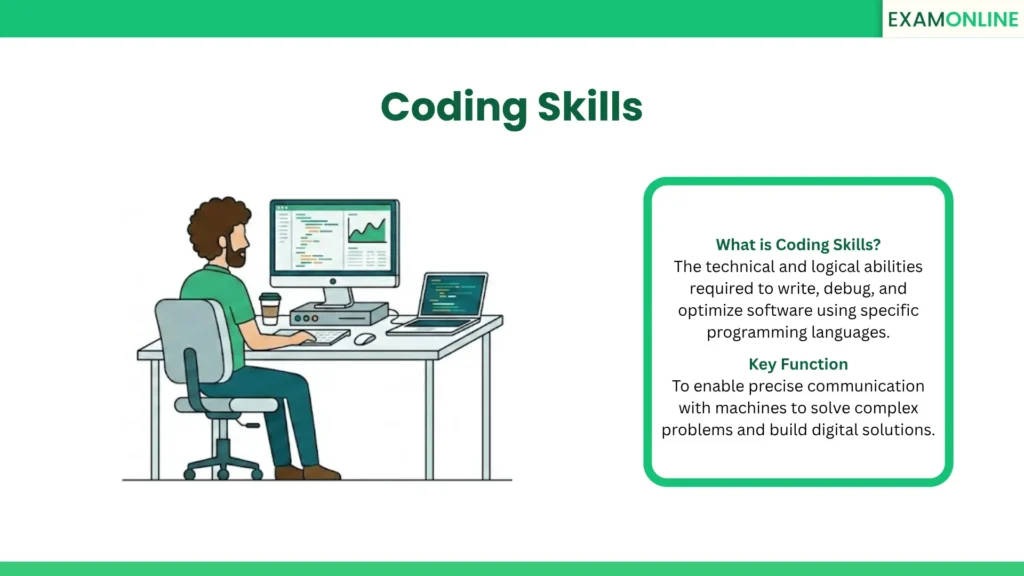
What is Coding Skill?
Coding skills, also referred to as Coding/Programming Skills, represent the technical and logical abilities required to write, debug, and optimize computer software. In the context of a modern Online Examination System, these skills are the primary benchmark for evaluating an individual’s capacity to communicate instructions to a computer in a language it understands. Unlike general computer literacy, coding requires a deep understanding of syntax, logic, and system architecture to build functional digital solutions.
For organizations managing a diverse Talent Pool, the ability to accurately measure these skills is crucial. Theoretical knowledge of a language is often secondary to the practical application of that knowledge. By utilizing a dedicated Coding Platform, recruiters can witness how a candidate translates an abstract problem into a set of executable commands.
When integrated with AI Based Proctoring, the evaluation process ensures that the demonstrated skills are authentic and that the Test Integrity of the recruitment or certification cycle remains intact.
Key Aspects of Coding Skills
Evaluating technical proficiency involves looking at several foundational dimensions that go beyond basic typing:
- Logical Reasoning: The core ability to break down a complex problem into smaller, sequential steps that a machine can follow.
- Syntax Mastery: Familiarity with the specific rules and vocabulary of a programming language, such as Python, Java, or C++, to avoid compilation errors.
- Algorithmic Thinking: The capacity to design a solution that is not only correct but efficient in terms of time and memory usage.
- Debugging and Troubleshooting: The skill required to identify, isolate, and fix errors (bugs) within a codebase to ensure the final program runs smoothly.
- Code Quality and Readability: The practice of writing clean, modular code that others can easily understand and maintain, which is essential for collaborative environments.
Types of Coding Skills
In a professional Coding/Programming Assessment, skills are generally categorized into three main areas:
- Fundamental Skills: These involve basic control structures like loops, conditionals, and variables. Every developer must master these before moving to complex tasks.
- Domain-Specific Skills: Abilities tailored to a particular field, such as backend development (SQL, Node.js), frontend development (HTML, CSS, JavaScript), or data science (R, Python libraries).
- System-Level Skills: Knowledge of how code interacts with the underlying hardware or network, including memory management, multithreading, and security protocols to prevent vulnerabilities.
Benefits of Evaluating Coding Skills
Standardizing the way your organization tests for technical talent offers several strategic advantages:
- Objective Benchmarking: Automated scoring provides a neutral, data-driven way to compare candidates, effectively removing unconscious bias from the hiring process.
- Scalable Screening: Organizations can conduct a massive Coding/Programming Assessment for thousands of applicants simultaneously across different time zones.
- Risk Mitigation: By verifying a candidate’s actual ability before onboarding, companies avoid the high costs associated with hiring developers who lack essential hands-on skills.
- Personalized Development: For existing employees, these evaluations help identify specific gaps, allowing for targeted Digital Upskilling or Reskilling programs.
- Enhanced Reputation: Maintaining a high bar for technical competence ensures that your organization’s certifications or internal standards are respected within the industry.
Features of a Coding Skills Assessment
A professional-grade Coding Platform includes specific mechanical components to ensure a fair and rigorous evaluation:
- Live IDE Environment: A browser-based editor that supports syntax highlighting and real-time execution for over 50+ programming languages.
- Automated Grading Engine: A system that runs the candidate’s code against multiple test cases (including hidden edge cases) to provide an immediate, accurate score.
- Plagiarism Detection: Algorithms that scan the submitted code against millions of online repositories and other candidates to ensure original work.
- Code Playback: A technical review feature that records the candidate’s keystrokes, allowing hiring managers to see the exact thought process and debugging steps taken.
- AI Surveillance: Integration of AI Based Proctoring to monitor webcam feeds, detect Tab Switching, and alert administrators to any suspicious behavior in real time.
Applications of Coding Skills
- Talent Acquisition: Streamlining the initial screening phase for software engineers, web developers, and technical leads.
- Academic Certifications: Providing a secure environment for computer science departments to host remote midterms or final lab examinations.
- Internal Skill Mapping: Conducting periodic assessments of a company’s engineering team to stay updated on the latest tech stacks and security best practices.
- Hackathons and Competitions: Using time-bound coding challenges to engage with the developer community and identify “diamond-in-the-rough” talent.
Conclusion
As software becomes the engine of every global industry, Coding Skills have transitioned from a niche expertise to a fundamental requirement for innovation. Relying on resumes or verbal interviews is no longer a viable strategy for building a high-performing technical team. Organizations need a way to see code in action within a secure, proctored environment. By combining an advanced Coding Platform with the protective layers of an Online Examination System, ExamOnline provides the infrastructure needed to identify, verify, and nurture top-tier technical talent.
Related Terms: Coding/Programming Skills, Coding/Programming Assessment, Coding Platform, AI Based Proctoring, Test Integrity.