
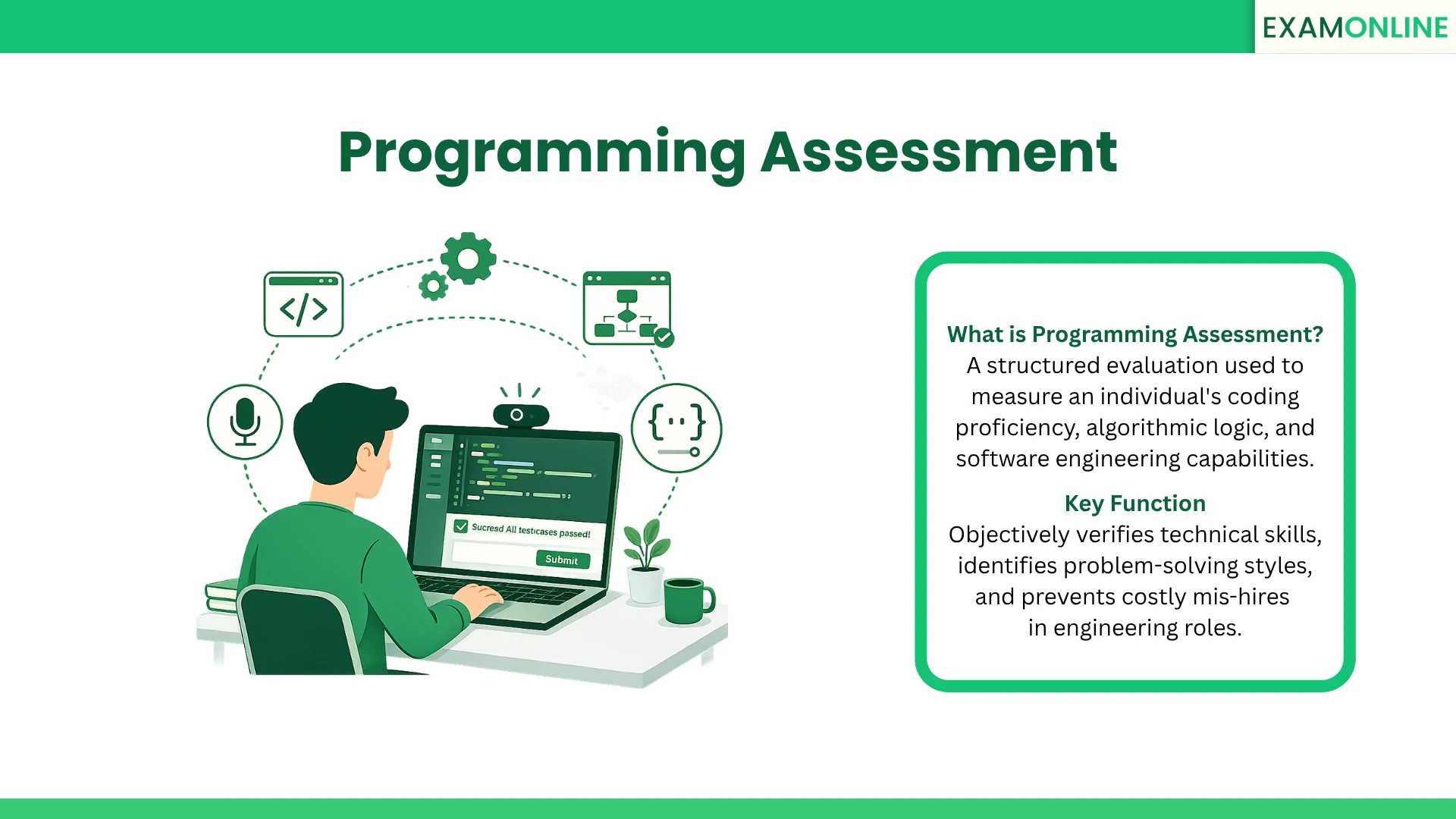
What is Programming Assessment
A Programming Assessment is a specialized, structured evaluation designed to measure an individual’s ability to write code, solve complex algorithms, and apply software engineering principles.
Unlike a standard behavioral interview that focuses on past experiences, this evaluation requires the candidate to actively demonstrate their technical capabilities in real-time or through a project-based assignment. It moves beyond simply asking a developer what they know, forcing them to prove exactly what they can build.
By deploying these evaluations, organizations can objectively measure logical reasoning, syntax proficiency, and debugging capabilities. This ensures that every technical hire possesses the exact competencies required to succeed in a demanding development role.
Key Aspects of a Programming Assessment
To accurately gauge a candidate’s technical depth, the evaluation must be structured to reflect real-world engineering challenges. The foundational elements include:
- Objective Measurement: Grading is based on the efficiency, cleanliness, and functionality of the code rather than subjective human opinion.
- Algorithmic Problem Solving: Candidates are tested on their ability to break down complex logic puzzles and apply appropriate data structures.
- Language Agnosticism (or Specificity): Depending on the role, tests may allow candidates to use any language they are comfortable with, or strictly evaluate them on a required framework.
- Scalability Evaluation: Assessors look not just at whether the code works, but whether it is optimized to run efficiently under heavy data loads.
- Debugging Proficiency: Evaluators often provide broken code to see how quickly and systematically a candidate can identify and resolve hidden errors.
Types of Programming Assessments
Different engineering roles require different evaluation methods to accurately measure a candidate’s true capability. The most widely adopted formats include:
- The Coding Interview: A live session where a candidate solves algorithms while explaining their thought process out loud to a senior engineer.
- Whiteboard Coding Interview: A traditional, though highly debated, method where candidates write out logic and syntax by hand on a physical or digital whiteboard without the help of modern software tools.
- Take-Home Projects: A larger, asynchronous assignment that mimics real-world tasks, giving candidates the time to architect a robust, multi-layered solution at their own pace.
- Pair Programming: An interactive session where the candidate and an existing team member collaborate on a single problem, demonstrating how the applicant communicates and accepts feedback.
- Automated Coding Challenges: Time-restricted online tests that automatically compile and grade code submissions against dozens of hidden test cases.
Why Programming Assessments Matter
Relying solely on a resume is highly risky when hiring for highly technical positions. Implementing a structured evaluation phase provides massive strategic advantages:
- Validates Coding/Programming Skills: It provides undeniable, concrete proof that the candidate actually possesses the technical knowledge they claim on their application.
- Reduces Costly Mis-Hires: Hiring an underqualified developer can paralyze a product roadmap. These assessments act as a critical safety net against poor hiring decisions.
- Removes Subjective Bias: Standardized code-grading algorithms evaluate everyone on the exact same logic and output, completely neutralizing interviewer bias.
- Highlights Communication Styles: Live evaluations reveal how a candidate handles high-pressure situations, answers clarifying questions, and explains complex architectural decisions.
Best Practices for Administration
To ensure the evaluation process is both effective for the company and fair to the developer, technical recruiters must follow established best practices:
- Align with Domain Skills: Ensure the test reflects the actual daily work of the role. Do not test a front-end UI developer on complex backend server-routing algorithms.
- Provide Clear Briefings: Ambiguity causes anxiety. Clearly communicate the time limits, expected deliverables, and the primary grading criteria before the assessment begins.
- Allow Standard Developer Tools: Whenever possible, allow candidates to use standard IDEs (Integrated Development Environments) and internet searches, as this mirrors how developers operate in the real world.
- Offer Constructive Feedback: Even if a candidate fails the evaluation, providing brief technical feedback builds immense goodwill and protects the company’s employer brand.
Applications of Programming Assessments
Because software drives modern business, these technical evaluations are utilized across multiple critical touchpoints:
- Corporate Talent Acquisition: The primary use case, allowing tech companies to filter thousands of engineering applicants into a highly qualified talent pool.
- Technical Training: Used internally by engineering teams to measure the effectiveness of corporate Technical Training programs and identify upskilling opportunities.
- University Computer Science Programs: Deployed by academic institutions to grade massive programming assignments automatically and fairly.
- Hackathons and Competitions: Utilized to instantly score and rank participants during global coding tournaments and innovation sprints.
Conclusion
A programming assessment is an indispensable tool for identifying true technical talent. By shifting the hiring focus from theoretical conversations to practical, verifiable coding challenges, organizations can build highly capable, efficient engineering teams. When structured fairly, these evaluations provide deep insights into a candidate’s problem-solving mindset and coding architecture.
ExamOnline can conduct programming assessments efficiently, providing organizations with the secure, scalable, and automated digital infrastructure needed to evaluate top-tier technical talent globally.
Related Terms: Psychometric Assessment, Recruitment Assessment, Voice and Accent Assessment, Talent Development, Skills Assessment.