
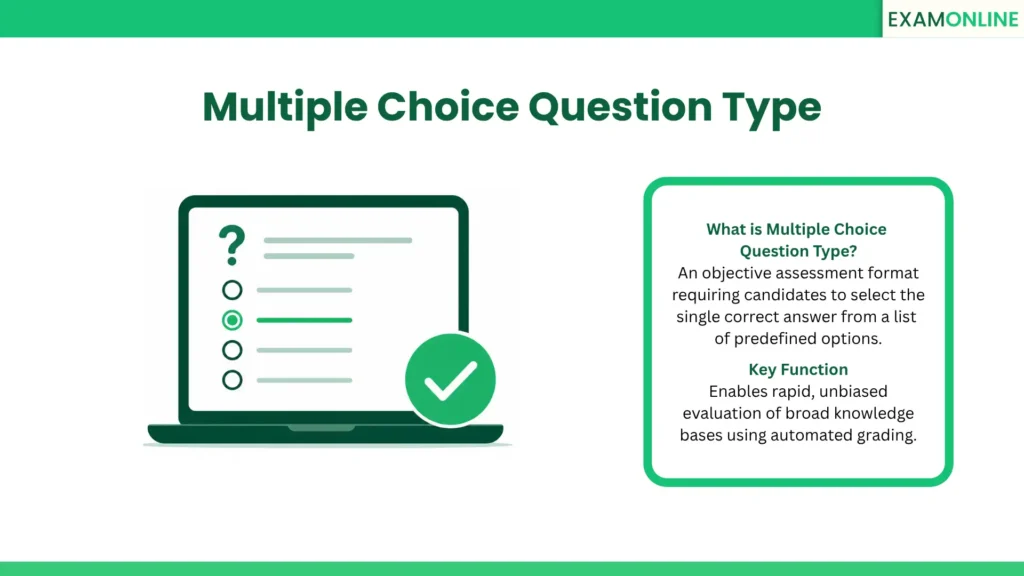
What is Multiple Choice Question Type
A multiple choice question type is an objective assessment format that requires a candidate to select the single correct answer from a list of predefined options. Educators and corporate trainers use this format extensively for high-volume testing to evaluate knowledge quickly.
This specific structure eliminates subjective grading bias completely. It guarantees a fair and standardized evaluation for every single test-taker.
Core Components
Creating an effective question requires understanding its basic structural elements. Every standard objective item includes three distinct parts:
- The Stem: The actual question or problem statement presented to the candidate.
- The Key: The single correct or best answer among the provided choices.
- The Distractors: The incorrect options designed to challenge candidates who do not fully understand the material.
Types of Objective Formats
Test creators adapt this foundational structure to test different levels of cognitive comprehension. Common variations include:
- Single Best Answer: The candidate must choose the most accurate option from a list of plausible choices.
- Multiple Response Question Type: The candidate must select all correct answers from a list, making the question significantly harder.
- Either/Or Question Type: A simplified format where the candidate chooses between only two absolute options, such as true or false.
- Matching Scenarios: The candidate selects a response from a dropdown menu to complete a specific sentence or equation.
Multiple Choice Questions vs. Essay Questions
| Feature | Multiple Choice Question | Essay Style Question |
| Grading Speed | Instant. Software scores the responses automatically. | Slow. Requires extensive human review. |
| Objectivity | Completely objective. The answer is definitively right or wrong. | Highly subjective. Evaluators can introduce bias. |
| Cognitive Level | Best for testing factual recall and broad comprehension. | Best for testing deep analysis and original thought. |
Benefits of Objective Questions
Deploying this specific format provides massive logistical advantages for large organizations. The primary benefits include:
- Automated Grading: A modern Computer-Based Examination System can score thousands of exams instantly without human intervention.
- Targeted Guidance: Platforms can provide immediate Adaptive Feedback to the learner based exactly on which incorrect distractor they selected.
- Broad Coverage: Administrators can test a vast amount of syllabus material within a very short time limit.
- Statistical Reliability: Organizations can run detailed item analysis to prove the statistical validity of the exam.
- Cost Efficiency: Eliminating human graders drastically reduces the financial cost of running a global certification program.
Challenges and Limitations of Multiple Choice
While highly efficient, organizations must recognize the inherent limitations of this testing format to ensure a well-rounded evaluation process:
- The Guessing Factor: Candidates typically have a 25% chance of guessing the correct answer on a standard four-option question, which can slightly artificially inflate competency metrics.
- Evaluating Higher-Order Thinking: While excellent for factual recall and basic comprehension, it is incredibly difficult to write a multiple-choice question that accurately measures deep analytical skills, creativity, or practical application.
- Time-Intensive Creation: Writing a truly effective question takes significant time and subject matter expertise. Creating plausible distractors that challenge the test-taker without being unfairly tricky is a highly specialized skill.
Best Practices for Writing Questions
Writing a fair and effective question requires strict attention to detail. Test creators must follow established structural guidelines:
- Establish Baselines: Calculate a mathematically sound Cut Score to determine exactly how many correct answers indicate true proficiency.
- Clear Phrasing: Write the stem as a complete, clear sentence without using confusing double negatives.
- Plausible Options: Ensure every incorrect option looks reasonable to an uneducated guesser.
- Consistent Length: Keep all answer choices roughly the same length to avoid giving visual clues to the correct answer.
Conclusion
The multiple choice question type remains the global standard for scalable, objective testing. By structuring assessments around clear stems and plausible options, organizations can evaluate broad knowledge bases accurately. This format guarantees a fair testing environment while completely removing subjective grading bias from the certification process.
The ExamOnline testing solution natively supports the multiple choice question type to streamline your evaluation process. Our platform ensures your objective assessments are securely delivered and instantly graded with absolute precision.
Related Terms: Hotspot Question Type, Non-scored Questions, Objective Question, Short Answer Question Type, Standard Question Types.