
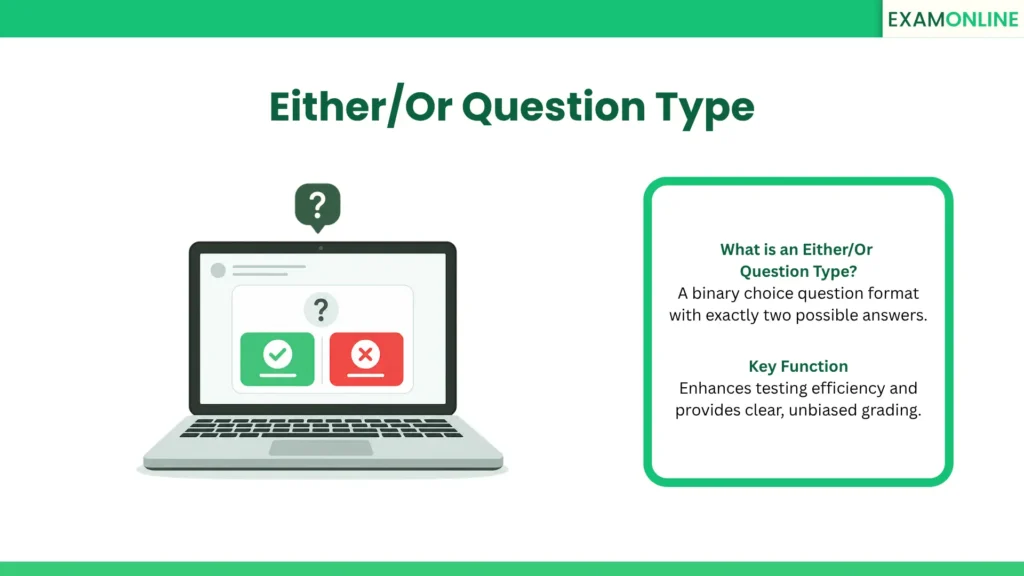
What is an Either/Or Question Type?
The Either/Or Question Type is a fundamental binary assessment format where a candidate is presented with a statement or a question and must choose between exactly two possible answers. Common examples include True or False, Yes or No, and Agree or Disagree. It is one of the most direct Standard Question Types used in digital testing today.
This format is designed to test absolute knowledge. Unlike multiple-choice questions that may offer four or five options, the either/or format removes middle-ground distractions. It forces the examinee to make a definitive judgment based on the information provided, making it an excellent tool for verifying core facts and foundational concepts.
Key Aspects and Importance of Either/Or Question Type
The primary importance of this question type lies in its simplicity and the clarity it brings to an evaluation. Because there are only two paths, the question must be phrased with high precision to avoid confusion. This makes it an essential tool for testing “black-and-white” knowledge where there is no room for interpretation.
From a strategic perspective, these questions are vital for covering a large amount of material in a short period. Because they require less reading time than complex scenarios, examiners can include more questions in a single session. This ensures a broader coverage of the syllabus or job requirements, which helps in maintaining high Test Integrity.
How Either/Or Questions Work
Within modern Assessment Software, the logic of an either/or question is straightforward yet highly effective:
- Prompt Delivery: The system presents a clear, concise statement to the candidate.
- Binary Selection: The candidate clicks on one of the two mutually exclusive buttons.
- Validation: Since it is a purely Objective Question, the system compares the selection against the pre-defined correct answer.
- Instant Scoring: Because the logic is binary, the software can process the result immediately after the candidate moves to the next item, contributing to faster overall feedback loops.
Benefits of Either/Or Questions
Using binary choice questions offers several operational advantages for both the organization and the test-taker:
- High Efficiency: Candidates can answer these questions quickly, allowing for rapid-fire assessments or pre-screening rounds.
- Ease of Development: Educators can create large banks of these questions relatively quickly compared to complex simulations.
- Reduced Cognitive Load: By focusing on only two options, candidates can focus entirely on the fact at hand rather than deciphering complex distractors.
- Unbiased Grading: Since there is only one correct answer and no subjective interpretation, the grading process is 100% fair and transparent.
Features of Either/Or Questions
While simple in concept, modern digital versions of these questions include several advanced features:
- Media Enhancement: Statements can be paired with images or videos, requiring the candidate to decide if a visual scenario is “Correct” or “Incorrect.”
- Randomization: The system can swap the order of the two choices to prevent pattern-matching or simple keyboard-based cheating.
- Time Limits: Examiners can set very short timers for these questions to test the candidate’s ability to make accurate decisions under pressure.
- Adaptive Logic: If a candidate misses a series of either/or questions, the system can automatically flag them for a more detailed review in that specific topic.
Application of Either/Or Questions
This format is highly versatile and is applied across various professional domains:
- Compliance Training: Deciding if a specific workplace action violates company policy (Yes/No).
- Safety Certifications: Determining if a piece of equipment is being handled correctly in a photo (Safe/Unsafe).
- Medical Screening: Assessing foundational knowledge of symptoms or protocols where a definitive “True” or “False” is required.
- Technical Skills: Using an Objective Question format to check if a line of code will run or crash (Success/Failure).
Conclusion
The Either/Or Question Type remains a cornerstone of effective assessment design. While it may seem basic, its ability to provide clear, decisive data on a candidate’s knowledge is invaluable. When combined with more complex question types, it helps create a balanced and thorough evaluation process.
By using this format, organizations can quickly gauge the foundational competence of their workforce and ensure that critical facts are mastered before moving to more advanced tasks.
ExamOnline’s robust Assessment Software supports a wide range of Standard Question Types, including Either/Or, to help organizations build secure and efficient examinations at scale.
Related Keywords: Advanced Question Types, Audio Capture Question Type, Drag-And-Drop Question Type, Essay Style Question Type, File Attach Question Type.