
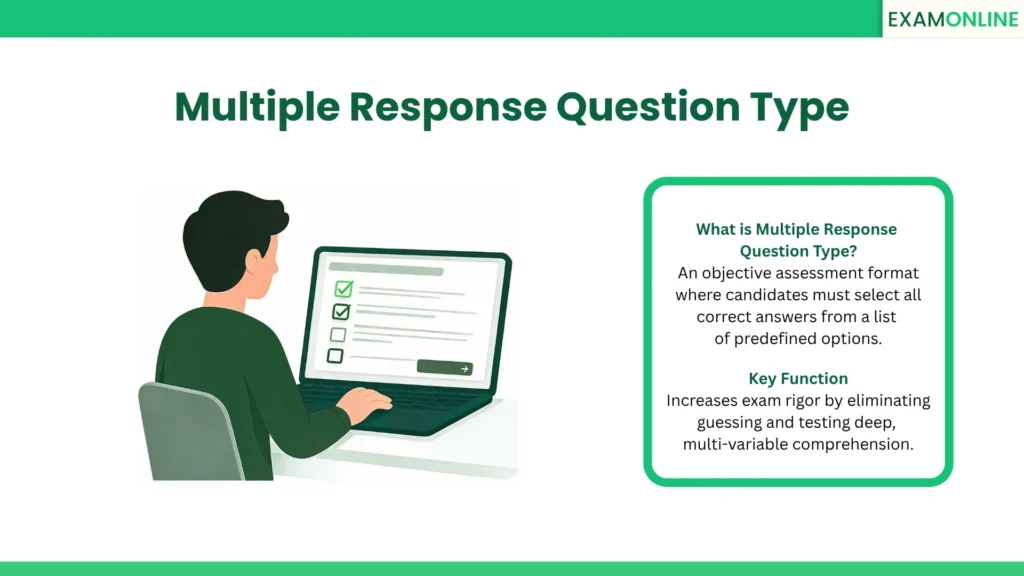
What is Multiple Response Question Type
A Multiple Response Question Type is an objective assessment format requiring candidates to identify and select more than one correct answer from a list of choices. Unlike standard single-answer formats, test-takers must evaluate every single option independently.
This format significantly increases exam difficulty by completely eliminating the probability of guessing correctly. It is highly effective for testing comprehensive knowledge rather than simple factual recall.
Administrators use this format when a scenario has several valid solutions, symptoms, or contributing factors.
Key Features
Understanding the structural capabilities of this format helps test creators build more rigorous evaluations. The primary features include:
- Checkbox Interface: Candidates use checkboxes rather than standard radio buttons, allowing them to select as many options as they deem correct.
- Variable Answers: The total number of correct answers varies per question. A five-option list might have two, three, or even four correct choices.
- Instructional Clarity: The question stem usually includes a specific directive, such as “Select all that apply,” to prevent candidate confusion.
- Complex Scoring: Evaluators can configure scoring to be strictly all-or-nothing, or they can award partial credit for partially correct selections.
Applications
Educators and corporate trainers deploy this format for highly specific testing scenarios. Common professional applications include:
- Medical Board Exams: Asking a candidate to identify all the valid symptoms of a specific disease from a randomized list.
- IT Certifications: Requiring candidates to select all the correct security steps necessary to patch a software vulnerability.
- Compliance Testing: Ensuring employees can identify all the prohibited actions under a new corporate safety policy.
- Engineering Evaluations: Testing professionals on all the viable materials that could be used to solve a specific structural defect.
Multiple Response vs. Standard Multiple Choice
| Feature | Multiple Response Question | Standard Multiple Choice |
| Correct Answers | Multiple valid choices. | Only one valid choice. |
| Guessing Probability | Extremely low. | Moderate (typically a 25% chance). |
| User Interface | Checkboxes (multi-select). | Radio buttons (single-select). |
| Analytical Depth | High. Requires evaluating every option. | Lower. Focuses on finding the single best fit. |
Benefits in Digital Testing
Utilizing this advanced format yields significant analytical advantages for certification boards and universities. Key benefits include:
- Enhanced Precision: It reduces the standard error of measurement during an e-Assessment, providing a highly accurate reflection of true knowledge.
- Actionable Insights: It highlights specific knowledge gaps, allowing educators to provide Rich Feedback based on exactly which correct options a candidate missed.
- Seamless Scalability: It integrates perfectly into any modern Delivery Platform to test deep comprehension efficiently at a global scale.
- Flexible Deployment: It serves as a highly reliable format for an On-Demand Assessment, where candidates evaluate complex scenarios at their own pace.
- Versatile Adaptation: The underlying logic can easily be incorporated into a Gamified Assessment to make rigorous testing more interactive.
Best Practices for Question Creation
To maximize fairness and reliability, test creators must follow strict drafting protocols. Important guidelines include:
- Explicit Directions: Always clearly instruct the candidate that multiple answers are possible.
- Avoid Grouping Words: Never use “All of the above” or “None of the above” as options within a multiple response list.
- Consistent Option Counts: Keep the total number of choices consistent across the exam (e.g., always provide five or six total options per question).
- System Capabilities: Ensure your testing software allows you to configure specific partial credit rules easily before launching the exam.
Conclusion
The Multiple Response Question Type is a powerful tool for measuring deep comprehension and critical thinking. By forcing candidates to evaluate multiple correct variables independently, organizations can accurately assess real-world problem-solving capabilities. This format effectively bridges the gap between simple factual recall and complex cognitive analysis.
The ExamOnline platform fully supports the multiple response question type within our comprehensive testing environment. Our solution allows administrators to easily configure complex scoring rules, ensuring precise, secure, and automated evaluations for every candidate.
Related Terms: Computer Adaptive Testing, Continuous Monitoring, Digital HR, Drag-And-Drop Question Type, Exam Automation.