
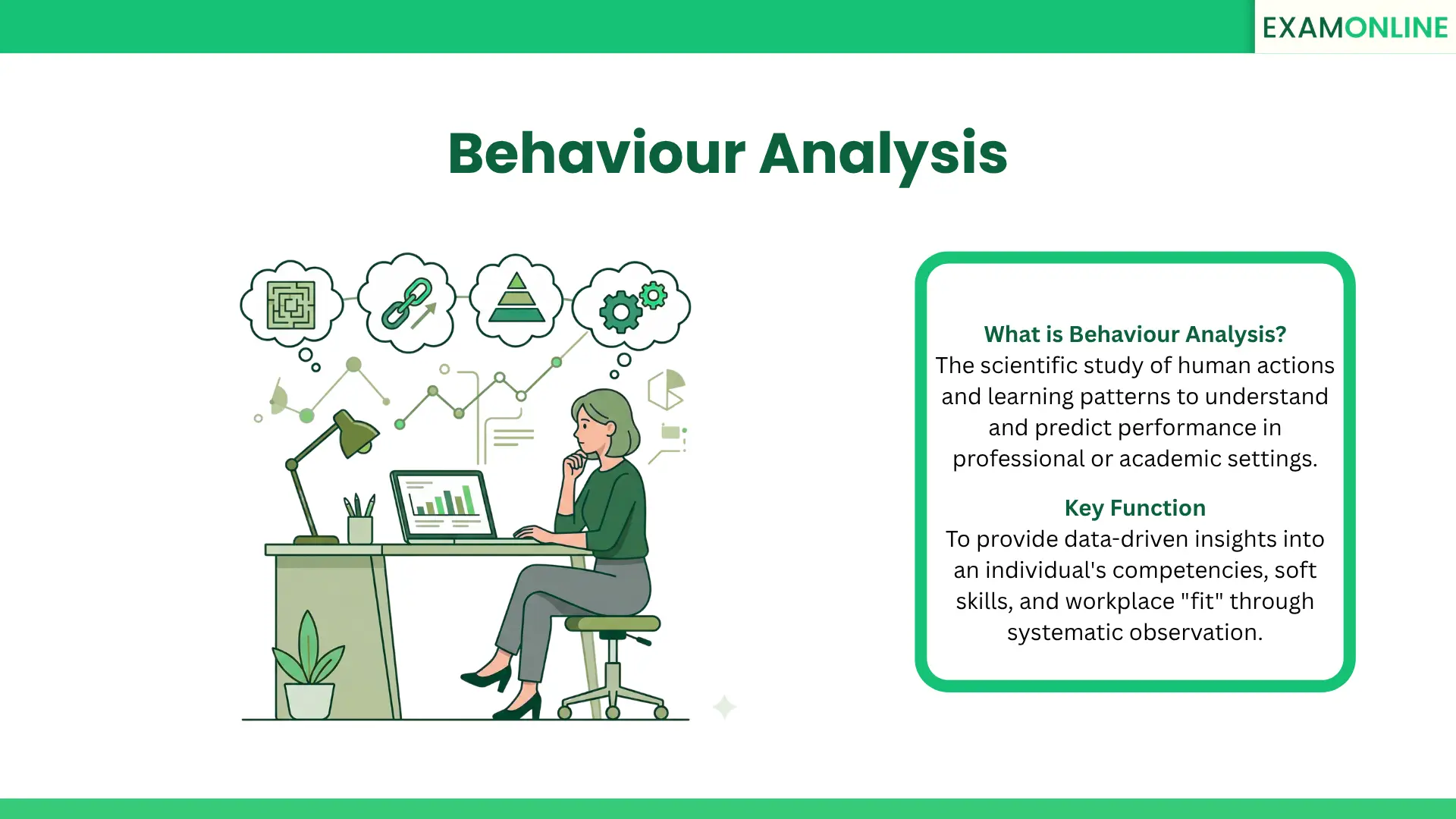
What is Behaviour Analysis
Behaviour Analysis is the scientific study of the principles of learning and behavior to understand, predict, and improve human performance within a professional or educational environment. In the context of modern talent management, it involves the systematic observation and quantification of how individuals react to specific stimuli, interact with others, and solve problems. By moving beyond subjective impressions, behaviour analysis provides a data-driven framework to identify the core drivers—such as motivation, resilience, and adaptability—that dictate an individual’s long-term success.
Within an Online Examination System, behaviour analysis transforms raw test scores into deep Talent Analytics. It allows organizations to see not just what a candidate knows, but how they apply that knowledge under pressure. This scientific approach is critical for Recruitment strategies that aim to minimize turnover by ensuring a high degree of alignment between an individual’s natural tendencies and the requirements of their role.
How Behaviour Analysis Works
The process of conducting Behaviour Analysis relies on a structured methodology to ensure that the data collected is both reliable and actionable:
- Defining Behavioral Benchmarks: Using Competency Mapping, organizations identify the specific “Success Behaviours” required for a role, such as “proactive communication” or “logical reasoning under stress.”
- Multidimensional Data Collection: Candidates are put through various scenarios, including a Job Simulation or a Psychometric Analysis, which provoke natural responses to complex workplace dilemmas.
- Functional Assessment: Analysts (or AI-driven engines) look for the “function” of a behavior—understanding why a candidate chooses a specific path of action when faced with a challenge or conflict.
- Pattern Recognition: The system tracks consistency across different modules. If a candidate demonstrates “High Ownership” in a simulation and “Decisiveness” in a questionnaire, a reliable behavioral pattern is established.
- Predictive Reporting: The final analysis translates these patterns into a “Predictive Success Score,” helping hiring managers understand the candidate’s potential “fit” and future growth trajectory.
Key Features of Behaviour Analysis
- Objective Quantifiability: Converts qualitative actions into quantitative data points, allowing for a direct comparison across a large Talent Pool.
- High Fidelity Simulations: Uses realistic environments to capture authentic behavior rather than rehearsed answers.
- Contextual Evaluation: Measures behaviors in relation to specific environmental triggers, acknowledging that people may act differently in a crisis versus a routine task.
- Trend Identification: Identifies long-term behavioral trends rather than isolated incidents, providing a more stable view of personality.
- Non-Invasive Monitoring: In a digital setting, the analysis can be performed based on interaction patterns within the assessment platform, ensuring a smooth Candidate Experience.
Benefits of Behaviour Analysis
- Accurate Performance Prediction: By focusing on observable actions, it offers a higher degree of accuracy in predicting job success than traditional interviews or CV screenings.
- Scientific Bias Mitigation: Relies on validated psychological principles and data rather than the unconscious biases of human evaluators.
- Customized Development: Provides a roadmap for post-hire training, identifying exactly which “soft skills” need further Digital Upskilling.
- Enhanced Team Synergy: Allows leaders to analyze the behavioral composition of an entire team to identify gaps in collaboration or leadership.
- Improved Retention: Ensuring that a candidate’s natural behavioral style is suited for the role leads to higher job satisfaction and lower attrition rates.
Applications of Behaviour Analysis
- High-Stakes Recruitment: Identifying candidates for mission-critical roles where specific behavioral traits (like “Vigilance” or “Stress Tolerance”) are non-negotiable.
- Leadership Succession Planning: Analyzing the behavioral readiness of internal employees for transition into executive management roles.
- Corporate Culture Audits: Assessing the collective behavior of an organization to see if it aligns with the stated company values and goals.
- Educational Interventions: Using analysis in a Virtual Classroom to identify students who may be struggling with engagement or specific learning hurdles.
- Conflict Mediation: Using behavioral data to understand the root causes of friction between employees and developing targeted intervention strategies.
Conclusion
Behaviour Analysis provides the scientific lens necessary to navigate the complexities of human nature in the workplace. By turning observable actions into strategic insights, it empowers organizations to make “people decisions” with the same precision they apply to financial or operational data. When integrated into a robust Online Examination System, it ensures that the Candidate Experience is not just a test of memory, but a true reflection of professional potential.
ExamOnline leverages these analytical principles to provide high-integrity assessments that help organizations build resilient, high-performing teams.
Related Terms: Psychometric Analysis, Talent Analytics, Job Simulation.