
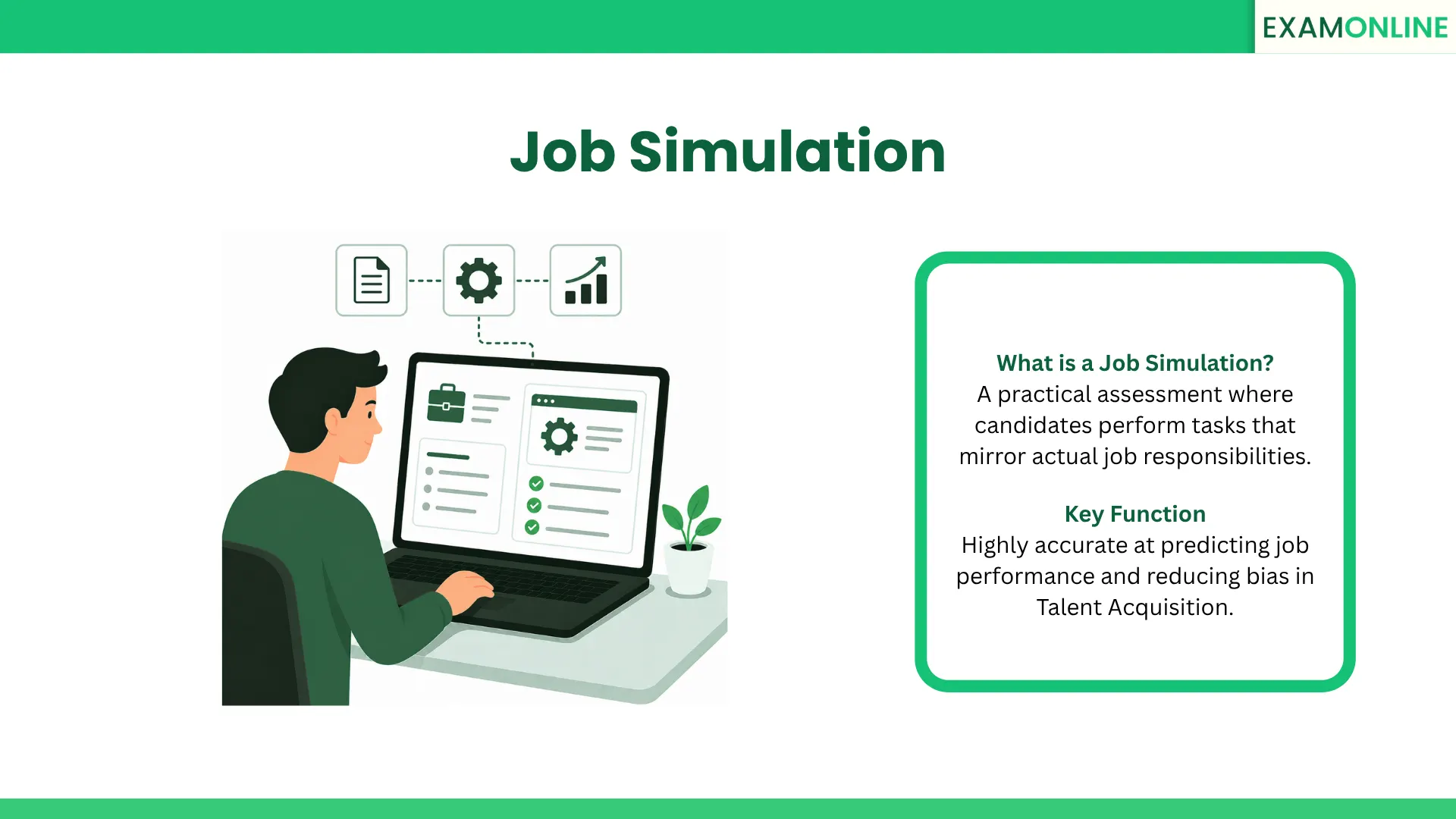
What is a Job Simulation?
A Job Simulation is a highly practical evaluation method where a candidate is asked to complete tasks that mimic the daily responsibilities of a specific role. Unlike a traditional interview that asks “how would you handle this,” a simulation asks the candidate to actually “handle it.”
In the modern Talent Acquisition process, job simulations are considered one of the most accurate predictors of future job performance. They provide a “work-sample” that allows hiring managers to see a candidate’s technical proficiency and problem-solving abilities in action, rather than relying on the claims made in a resume.
Key Components of a Job Simulation
To be effective, a simulation must be realistic and closely tied to the job’s actual requirements. Core components include:
- Task Relevance: The exercise must mirror a real-world task the employee will perform, such as writing code, handling a customer complaint, or analyzing a financial report.
- Standardized Instructions: Every candidate receives the same brief and resources to ensure the Digital Evaluation is fair and objective.
- Performance Metrics: Clear criteria for what a “successful” output looks like, often measured through speed, accuracy, and quality.
- Time Constraints: Simulating the pressure of a real workplace by giving candidates a specific deadline to complete the task.
Common Types of Job Simulations
Organizations use various simulation formats depending on the complexity of the role:
- In-Tray/E-Tray Exercises: Candidates are given a simulated inbox full of emails and tasks and must prioritize and respond to them.
- Role-Playing: Often used for sales or support roles, where a candidate interacts with an evaluator acting as a difficult client.
- Work Sample Tests: A direct technical task, such as a developer fixing a bug in a piece of code or an editor proofreading a document.
- Situational Judgment Tests (SJT): A digital format where candidates watch a video scenario and choose the most effective course of action.
Best Practices for Implementing Job Simulations
To ensure the simulation adds value to the hiring process, organizations should follow these best practices:
- Focus on Critical Skills: Don’t simulate every part of the job; focus on the “must-have” skills that are hardest to teach.
- Maintain Realism: Use the same software or tools the candidate would use on the job to improve the Candidate Experience.
- Provide Feedback: Candidates invest significant time in simulations; providing them with a brief summary of their performance builds a positive employer brand.
- Use as a Mid-Funnel Tool: Place simulations after the initial screen but before the final interview to narrow the field to the most capable applicants.
Benefits of Job Simulations
Integrating a simulation into the recruitment cycle provides several strategic advantages:
- Reduced Hiring Bias: By focusing on actual work output, managers are less likely to be influenced by a candidate’s background or charisma.
- Predictive Accuracy: Data shows that a practical Skills Assessment is more likely to predict success than years of experience.
- Realistic Job Preview: It gives the candidate a chance to see if they actually enjoy the work, which can reduce early-stage turnover.
- Rich Talent Analytics: Organizations can collect data on how different groups of candidates handle specific challenges, helping to refine future job descriptions.
Conclusion
The Job Simulation is the ultimate “audition” for a professional role. By shifting the focus from talking about work to actually doing the work, companies can make hiring decisions with absolute confidence. This method not only identifies the most skilled individuals but also ensures that the candidate understands the realities of the position they are applying for. In a world where technical skills are constantly evolving, the ability to demonstrate competence through a realistic simulation is the most effective way to secure top-tier talent.
Related Keywords: Job Behavioral Assessment, Leadership Succession Planning, Key Performance Indicators (KPI), Offline Assessment, Performance Evaluation.