
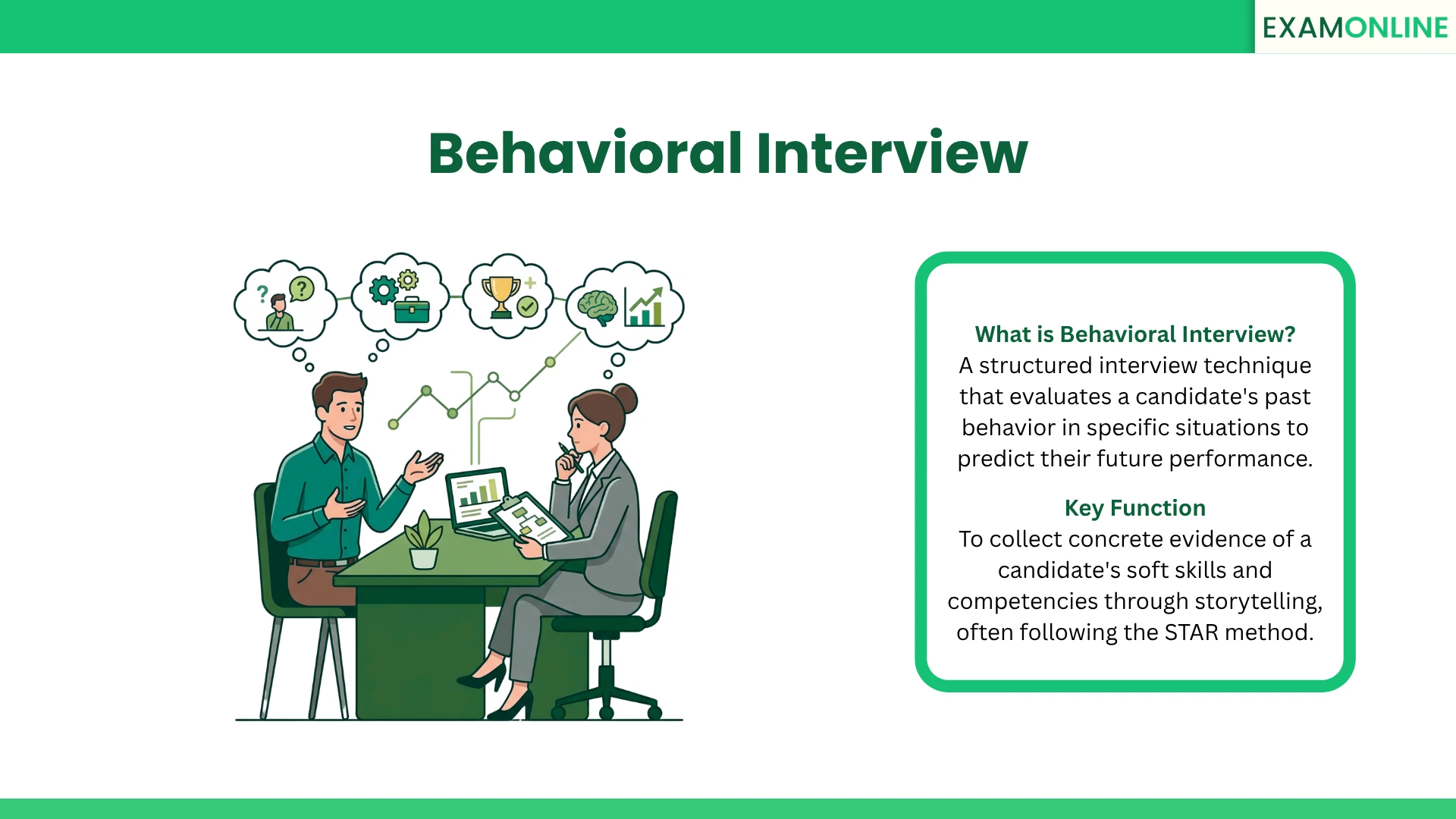
What is Behavioral Interview
Behavioral Interview is a strategic interviewing technique based on the psychological premise that a candidate’s past behavior is the most reliable predictor of their future performance. Unlike traditional interviews that often rely on hypothetical “What would you do?” scenarios, a behavioral interview asks for concrete evidence through “What did you do?” questions. Candidates are required to recount specific instances from their professional history where they demonstrated key competencies such as leadership, conflict resolution, or adaptability.
This methodology transforms the interview from a subjective conversation into an objective assessment of demonstrated skills. By forcing candidates to move beyond polished, generic answers and dive into the “who, what, and how” of their career milestones, hiring managers can verify whether a person possesses the actual grit and decision-making capabilities required for the role. In an era of high-stakes Recruitment, behavioral interviewing is the gold standard for identifying individuals who don’t just “talk the talk” but have a proven track record of “walking the walk.”
How Behavioral Interview Works
A successful Behavioral Interview follows a rigorous, evidence-based structure to ensure that the data collected is both relevant and authentic:
- Competency Identification: Before the interview, the hiring team defines the “Critical Success Factors” for the role—such as “Strategic Thinking” or “Customer Empathy.”
- The Behavioral Prompt: The interviewer poses an open-ended question designed to trigger a specific memory. Example: “Describe a time you had to manage a project with a rapidly changing deadline.”
- Active Probing: As the candidate tells their story, the interviewer uses “probing questions” to dig deeper into their personal contribution. They look for specific actions rather than collective “we” statements.
- The STAR Framework: Interviewers often evaluate responses based on the STAR method (Situation, Task, Action, Result) to map out the candidate’s journey through a challenge.
- Evidence-Based Scoring: The candidate’s response is then mapped against a standardized rubric, ensuring that the final hiring decision is based on data points rather than a “gut feeling.”
Key Features of Behavioral Interview
- Open-Ended Questioning: Questions typically start with “Tell me about a time…” or “Give me an example of…” to encourage storytelling.
- Evidence-Based Evaluation: Focuses entirely on verifiable actions and measurable results rather than theoretical knowledge.
- Probing Depth: Allows interviewers to “peel the onion” to see how a candidate truly thinks and reacts under pressure.
- Standardized Rubrics: Uses a pre-set list of competencies to ensure every candidate is measured against the same professional yardstick.
- Non-Hypothetical Focus: Prevents candidates from giving “perfect” theoretical answers by demanding real-life historical context.
Benefits of Behavioral Interview
- Higher Predictive Validity: Provides a much more accurate forecast of how a candidate will perform in the actual job environment compared to traditional methods.
- Reduced Cheating and Coaching: It is significantly harder for a candidate to “fake” a detailed, multi-layered story about a real event than it is to rehearse a hypothetical answer.
- Bias Minimization: By focusing on objective facts and specific behaviors, it helps interviewers overlook irrelevant personal traits and focus on job-related merit.
- Cultural and Values Alignment: Helps identify if a candidate’s natural way of working—their “behavioral DNA”—is compatible with the organization’s core values.
- Deeper Insight into Soft Skills: Effectively uncovers traits like resilience, emotional intelligence, and interpersonal savvy that are often invisible on a CV.
Applications of Behavioral Interview
- Executive Hiring: Evaluating the high-stakes decision-making and leadership history of potential C-suite candidates.
- Campus Recruitment: Helping fresh graduates demonstrate their potential through examples from internships, academic projects, or volunteer work.
- High-Volume Hiring: Standardizing the evaluation process for large-scale roles to ensure consistent quality across the Talent Pool.
- Internal Promotions: Using past performance within the company to determine if an employee is ready for a change in scope or a leadership position.
- Performance Gap Analysis: Using behavioral questions during a “Stay Interview” or performance review to understand why certain goals were or weren’t met.
Conclusion
The Behavioral Interview remains one of the most powerful tools in a talent acquisition specialist’s arsenal. By treating a candidate’s history as a laboratory for future success, it provides a level of clarity that simply cannot be reached through standard questioning. When implemented through a secure and structured Online Examination System, these interviews can be recorded and analyzed alongside Psychometric Analysis to provide a data-rich foundation for building world-class teams. ExamOnline facilitates this by ensuring a seamless Candidate Experience and providing the tools necessary to evaluate talent with the highest level of integrity.
Related Terms: Psychometric Analysis, Recruitment, Candidate Experience, Job Simulation.