
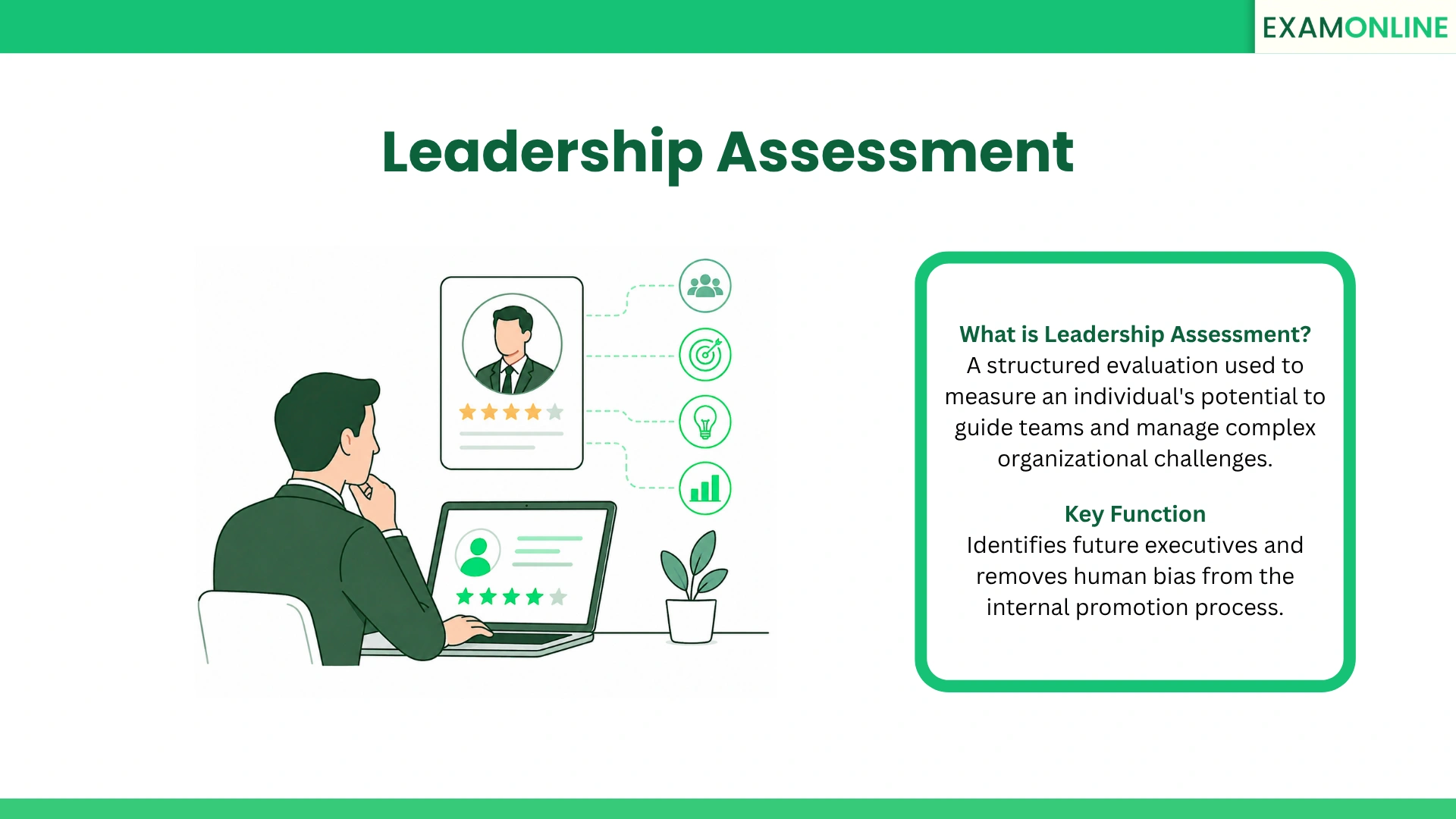
What is Leadership Assessment
A Leadership Assessment is a structured evaluation used to measure an individual’s potential to guide teams and manage complex organizational challenges. It focuses on evaluating soft skills, strategic thinking, and emotional intelligence. Organizations use these tools to ensure they promote individuals who can handle the pressure of executive responsibilities.
Unlike a technical evaluation, a Leadership Assessment looks closely at human behavior and decision-making logic. It measures specific Leadership Competencies required for a particular managerial role. This ensures that a candidate’s natural work style aligns with the strategic goals of the company.
By utilizing formal evaluation methods, businesses remove guesswork from their hiring processes. This approach guarantees that future managers possess the actual capability to lead, rather than just technical seniority.
Core Components of a Leadership Assessment
Understanding a candidate’s potential requires breaking down their abilities into measurable traits. A proper Leadership Assessment evaluates several distinct categories to create a complete profile.
First, it measures strategic thinking and the capacity to plan for long-term growth. Evaluators look at how well a candidate can navigate ambiguity and make difficult decisions without complete information.
Second, it tests interpersonal skills and conflict resolution. This helps determine if the candidate can inspire a team and handle difficult conversations effectively.
Third, these evaluations heavily weigh emotional intelligence and self-awareness. Leaders must remain calm under pressure and understand how their mood impacts their subordinates.
How the Evaluation Process Works
The evaluation process follows a specific sequence to gather comprehensive data on a candidate. HR administrators begin by assigning specific test modules based on the target management level.
Candidates often complete a psychometric profile to map their natural inclinations and stress responses. Following this, they face situational judgment exercises where they must solve realistic workplace conflicts.
Finally, organizations pair these test results with a structured Behavioral Interview. Interviewers use the data to probe specific weaknesses identified during the earlier testing phases.
Comparison Table: Leadership Assessment vs. Employment Assessment
| Feature | Leadership Assessment | Employment Assessment |
| Primary Focus | Strategy, emotional intelligence, and team management. | Technical skills and basic job knowledge. |
| Question Style | Subjective situational judgment scenarios. | Objective right or wrong answers. |
| Target Audience | Mid-level managers and executive candidates. | Entry-level and individual contributor roles. |
| Outcome Goal | Identifying long-term potential for guiding an organization. | Verifying immediate ability to perform specific tasks. |
Benefits of Leadership Assessment
Conducting a formal Leadership Assessment provides significant operational advantages for any growing enterprise. It removes personal bias from the promotion process. Managers rely on objective data rather than favoritism to select the next leader.
Promoting the wrong person often causes entire teams to resign. Objective evaluations ensure only capable individuals take charge of a department. This directly improves employee retention and morale.
This data also provides the exact metrics needed for accurate Leadership Succession Planning. Companies can identify future executives years before they are actually needed in those roles.
Furthermore, the results highlight specific areas for improvement immediately. This makes executive coaching and targeted training programs highly efficient and cost-effective.
Evaluating leadership potential also helps in restructuring departments during mergers or acquisitions. It allows upper management to place the most adaptable leaders in charge of transitioning teams.
Applications in Talent Management
Organizations deploy these evaluations across multiple critical phases of workforce management. They use them for internal promotions to decide which employee is ready for a team lead role.
Companies also use them to vet external candidates for high-stakes director positions. Sometimes, organizations use preliminary tests to filter candidates before inviting them to a live Management Assessment Center.
Finally, HR teams integrate leadership metrics into standard Performance Evaluation cycles. This allows them to track executive growth and development over time to ensure continuous improvement.
Best Practices
To get the most value from a Leadership Assessment, administrators must define their ideal candidate profile first. Every company requires a different type of leader.
You must establish which traits are non-negotiable for your specific corporate culture before testing begins. Always combine objective test results with human interaction to verify the candidate’s communication style.
Never use a single test to make a final hiring decision. Multiple data points ensure a much higher accuracy rate when predicting executive success.
Share the feedback with the candidate directly. This helps them understand their own professional development path and work actively on their weaknesses.
Conclusion
A Leadership Assessment is an essential tool for building a strong and capable management team. By replacing guesswork with structured data, organizations can accurately predict how an individual will handle executive pressures. Using objective evaluations ensures that succession planning is strategic and highly effective for long-term growth.
The ExamOnline platform features a built-in Leadership Assessment system that creates a foundation of trust, ensuring every professional assessment is completed by the rightful candidate under total security.
Related Terms: Learning Agility, Leadership Succession Planning, Manual Test Generation, On-Demand Assessment, Online Exam Conducting Software.