
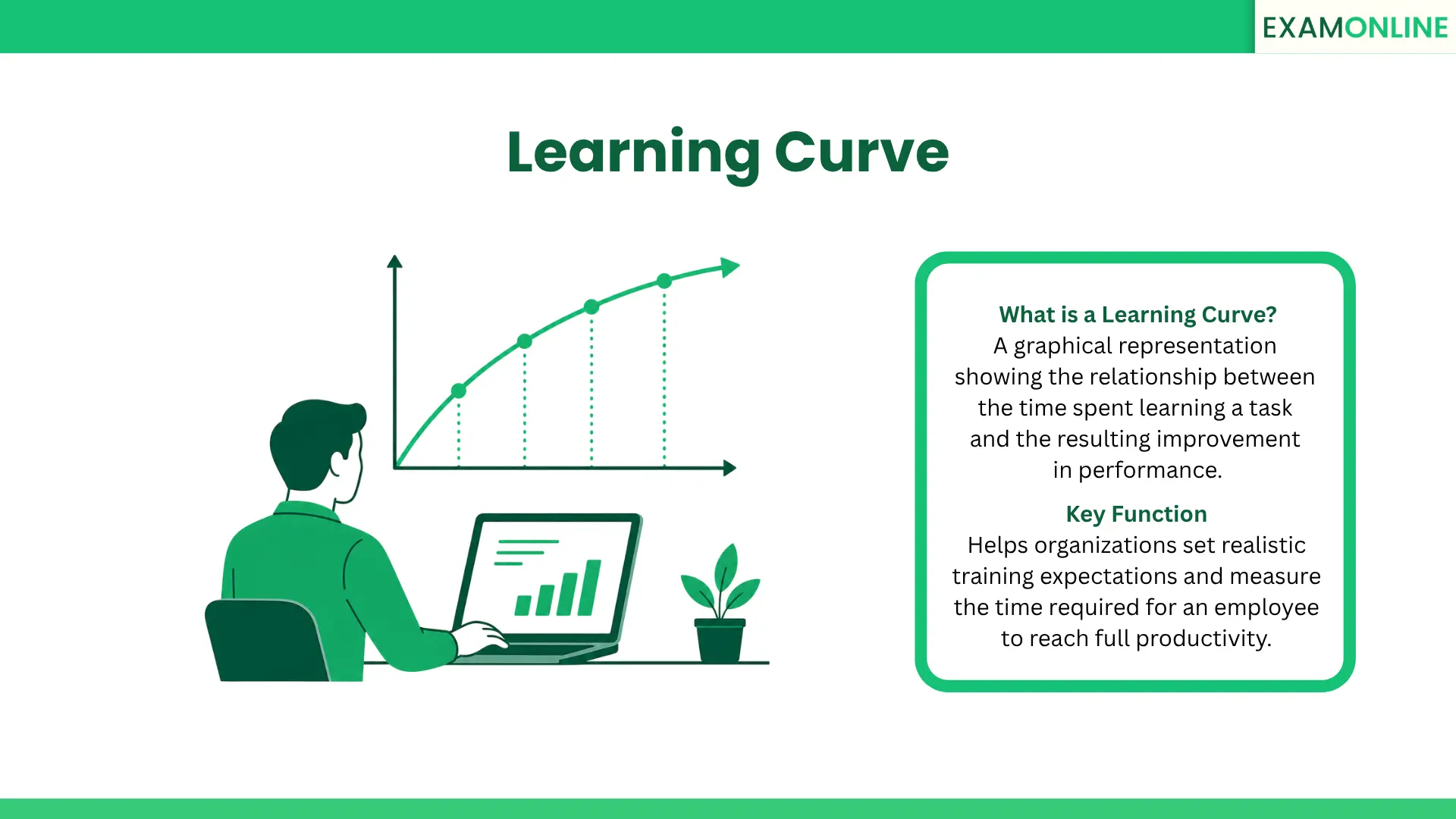
What is Learning Curve
A Learning Curve is a graphical representation that illustrates the relationship between the time or effort invested in a task and the resulting improvement in performance. It tracks how an individual’s proficiency increases as they gain more experience with a specific subject or skill. In corporate training and professional development, analyzing this progress helps organizations understand exactly how long it takes for a new employee to reach full productivity and mastery.
Rather than assuming all knowledge is acquired instantly, this concept acknowledges that skill acquisition happens in stages. By understanding the typical progression of a new concept, managers can set realistic expectations, design better training schedules, and provide the right support at the correct moments in an employee’s journey.
Key Aspects of a Learning Curve
To effectively measure progress, professionals look at several distinct variables that shape the learning process. The first aspect is the initial resistance or adjustment period. When a person encounters completely new information, their performance is usually low while they process the basic rules. The second aspect is the acceleration phase, where the individual grasps the core concepts and their efficiency improves rapidly.
The final major aspect is the plateau. A learning plateau occurs when progress stalls and the individual stops showing visible improvement, even with continued practice. Recognizing these phases is crucial for HR teams so they do not mistake a natural plateau for a lack of motivation.
Common Types of Learning Curves
The relationship between time and proficiency is rarely a straight line. Depending on the complexity of the subject, the progress will typically follow one of these common models:
- The S-Curve: This is the most common model for professional skills. It begins with a slow start as the learner struggles with new concepts. This is followed by a steep upward slope of rapid improvement, and it ends with a flat plateau as the learner reaches mastery.
- Diminishing Returns: This curve occurs when a task is incredibly easy to start but very difficult to master. The learner makes massive progress in the first few days, but subsequent improvements require significantly more time and effort.
- Complex Learning Curve: This model features multiple acceleration phases and multiple plateaus. It usually represents a highly technical job where an employee must master one subsystem before they can begin learning the next.
Why the Learning Curve Matters
Understanding the rate of skill acquisition is essential for effective workforce planning. If leadership expects immediate results from a highly complex task, they will quickly become frustrated with new hires. Tracking the actual rate of progress allows businesses to forecast when a new employee will become a profitable contributor.
Furthermore, analyzing this data helps organizations evaluate the quality of their own training materials. If employees are spending too much time in the slow initial phase, it indicates that the introductory materials are confusing. Companies can address this by conducting Diagnostic Testing to identify exactly where learners are getting stuck. Once the specific hurdles are identified, leaders can perform a Competency Gap Analysis to rewrite their training protocols and shorten the time to mastery.
How to Optimize the Learning Curve
Organizations can actively shorten the time it takes for employees to reach peak performance by using structured educational strategies. One effective method is to utilize Computer Based Training, which allows employees to learn at their own pace and revisit complex topics without feeling rushed by a live instructor.
Managers should also break complex subjects down into smaller, manageable modules. Instead of overwhelming an employee with an entire workflow on their first day, teaching one discrete skill at a time prevents cognitive overload. Finally, leadership must measure this progress objectively. By attaching clear Key Performance Indicators (KPI) to different stages of the training process, both the manager and the employee have a transparent view of what success looks like at week one, month one, and year one.
Applications in Business and Training
The concept of tracking learning rates applies to multiple strategic initiatives within a company. During the onboarding process, managers use historical progress data to build 30, 60, and 90-day performance goals. It is also highly relevant during Cross Skilling initiatives, where an organization trains existing employees to perform entirely new job functions. Because these employees already understand the company culture, their initial progress is often much faster than an external hire.
By maintaining a close watch on how teams absorb new information, organizations can confidently roll out new software tools, update operational procedures, and keep their workforce highly competitive.
Conclusion
The concept of the learning curve is a fundamental principle in education and professional development. By visualizing the connection between practice time and skill improvement, organizations can build realistic, supportive, and highly effective training environments. Understanding that learning is a gradual process allows leadership to provide the right resources at the right time, ensuring that every professional has the opportunity to reach complete mastery.
Related Terms: Incident Reporting, Job Behavioral Assessment, Employment Assessment, Digital Upskilling, Behaviour Analysis.