
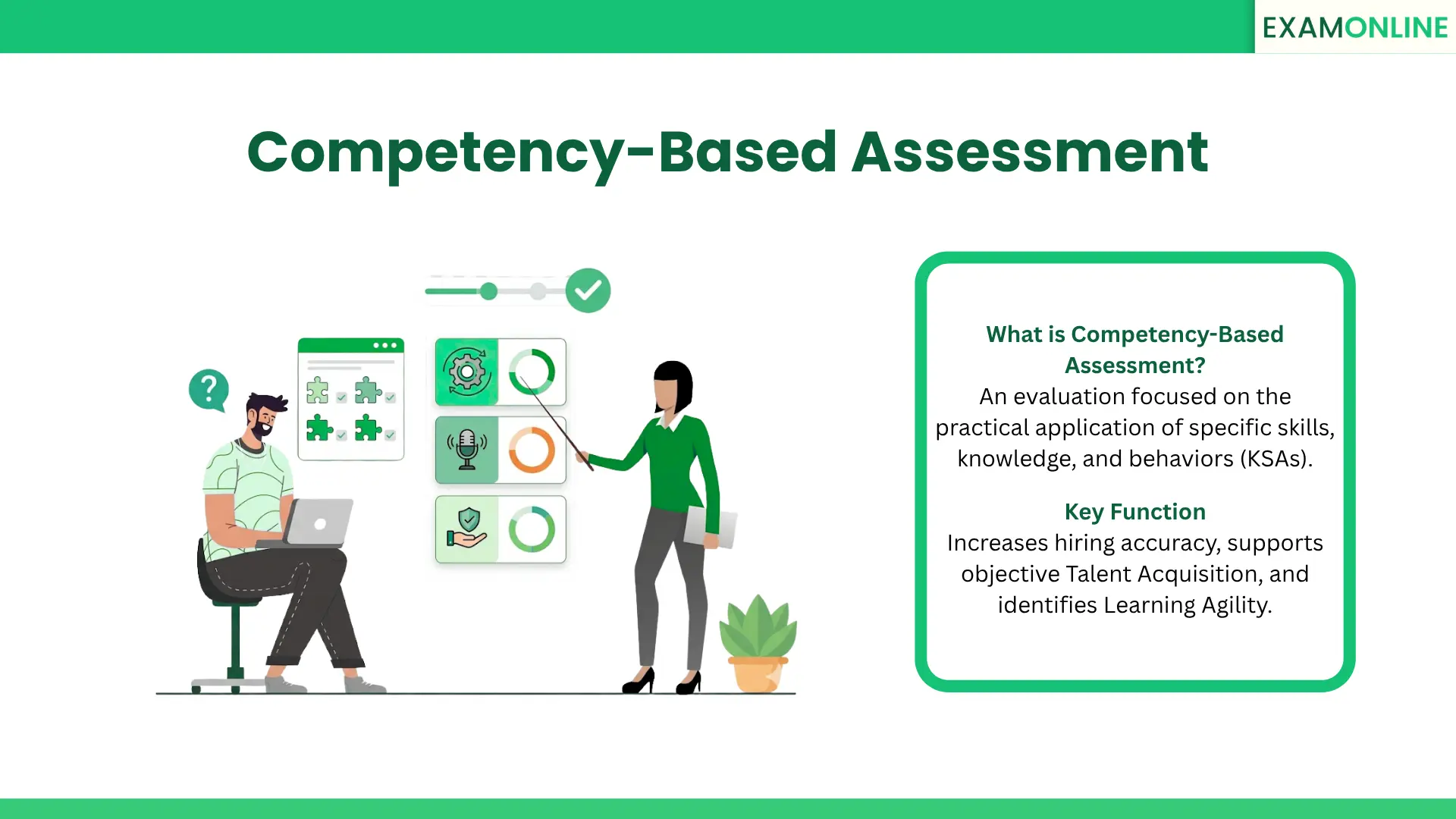
What is Competency-Based Assessment?
A Competency-Based Assessment is a structured process used to evaluate an individual’s ability to perform specific tasks based on predefined professional standards. Unlike traditional examinations that measure general intelligence, this approach focuses on the practical application of knowledge in real-world scenarios. The core purpose is to bridge the gap between “knowing” and “doing,” ensuring that candidates possess the exact “competencies” required for their specific job description.
In a modern Online Examination System, this framework allows organizations to move beyond resume-based hiring. By creating a direct link between an individual’s measurable actions and organizational goals, Competency-Based Assessment serves as the most reliable predictor of on-the-job success and long-term Learning Agility.
Core Components (The KSA Model)
The architecture of a professional competency model is built upon three primary pillars that define human performance. An effective Assessment Engine must be able to measure each of these independently:
- Knowledge (The “What”): The theoretical understanding, technical information, and academic background an individual possesses.
- Skills (The “How”): The practical ability to perform a task. This is the application of knowledge, such as Coding Skills for a developer or financial modeling for an analyst.
- Abilities/Attributes (The “Why”): The innate traits and behaviors, such as critical thinking, leadership, or resilience. These are often measured through a Psychometric evaluation to see how a person applies their skills under pressure.
Key Aspects of the Process
To maintain Test Integrity and high standards, a competency-based evaluation must adhere to these foundational principles:
- Standard-Referenced: Candidates are measured against a fixed competency map (benchmarks) rather than being ranked against each other.
- Evidence-Based: Decisions are backed by observable data, such as a completed project, a recorded video response, or a technical simulation.
- Holistic Evaluation: It looks at the “Whole Person,” ensuring that technical proficiency is balanced with the “soft skills” necessary for cultural fit.
- Transparency: The criteria for success are clearly defined, which fosters a culture of objective feedback and continuous Technical Training.
Types of Competency-Based Assessments
To gain a 360-degree view of a candidate’s potential, organizations utilize various assessment methodologies:
- Situational Judgment Tests (SJT): Digital scenarios where candidates choose the best response to a workplace dilemma.
- Skill-Based Simulations: Practical tasks, such as a Coding Assessment or a data analysis project, performed in a controlled environment.
- Behavioral Interviews: Using Video Based Assessment to evaluate how candidates have handled specific challenges in the past.
- Cognitive Assessment: Measuring the mental “muscle” and Learning Agility required to master new competencies quickly.
- Portfolio Reviews: Evaluating a candidate’s historical work against the required competency standards for a senior role.
Benefits to the Organization
Shifting to a competency-focused model via Digital Evaluation Software provides significant strategic advantages:
- Predictable Hiring Success: By verifying actual skills before hiring, organizations significantly reduce the risk of “mishires.”
- Support for Diversity Hiring: By focusing on objective, measurable competencies rather than educational pedigree, organizations eliminate unconscious bias.
- Targeted Reskilling: It identifies specific gaps in the current Talent Pool, allowing for more efficient and cost-effective Digital Upskilling programs.
- Improved Employee Retention: Matching an employee’s natural competencies to their role leads to higher job satisfaction and lower turnover.
Features of a Digital Assessment Engine
A robust platform like ExamOnline provides the technical infrastructure to manage competency data at scale:
- Competency Mapping: Tools to link every test question or task to a specific job-related competency.
- AI Based Proctoring: Ensuring the authenticity of the assessment through advanced identity verification and environment monitoring.
- Talent Analytics Dashboards: Visualizing a candidate’s competency profile against the ideal “job fit” benchmark.
- Remote Scalability: The ability to conduct a Remote Exam for thousands of candidates globally without compromising security or standards.
Conclusion
Competency-Based Assessment is the foundation of a modern, data-driven workforce. In an era where job roles are constantly evolving, focusing on raw competencies provides the only stable measure of potential. By utilizing a secure, AI-powered platform, ExamOnline enables organizations to build teams that are not just knowledgeable, but truly capable of execution.
Related Keywords: Cognitive Assessment, Aptitude Test, Psychometric, AI Based Proctoring, Talent Analytics.