
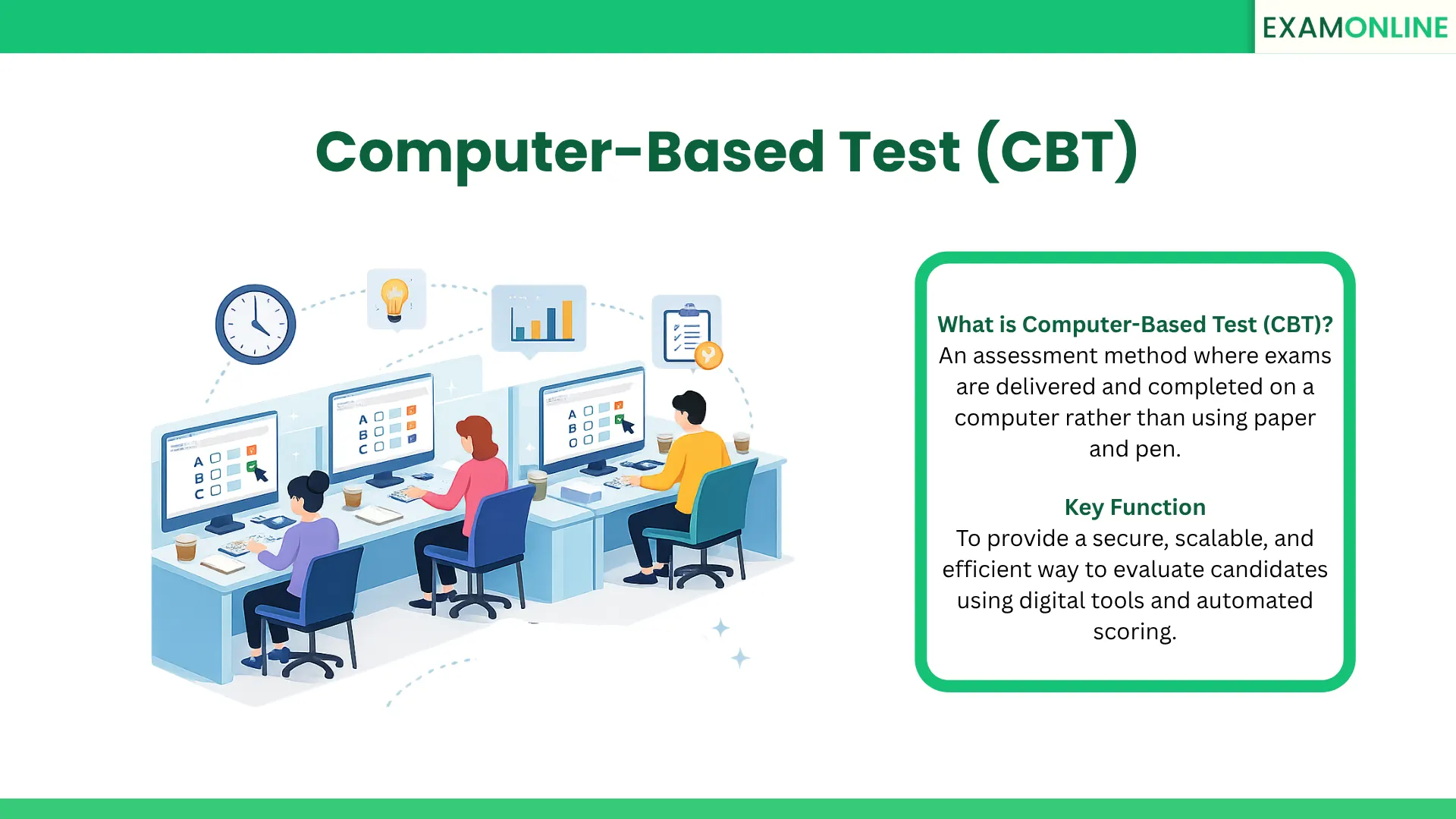
What is Computer Based Test (CBT)?
A Computer Based Test (CBT) is a modern assessment method where candidates take an exam using a computer or a digital device instead of the traditional paper-and-pencil format. In a Computer Based Test, the examination is delivered through a computer based system rather than a paper driven assessment process. Candidates receive questions through a digital test interface while the examination platform manages timing, navigation, responses, and submission. Depending on the examination design, questions may include multiple choice questions, descriptive responses, numerical answers, coding questions, multimedia items, or other structured formats. Administrators can organize these questions into sections and apply specific rules to each part of the examination. The platform records candidate activity throughout the session and stores responses for evaluation. This creates a structured digital environment for delivering assessments consistently across candidate groups.
While it marks the practical “retirement” of the No. 2 pencil, its real value lies in the precision, security, and speed it brings to the evaluation process. In a CBT, the entire lifecycle of an exam, from the delivery of questions via a Question Bank to the final submission, is managed within a specialized Online Examination System. For organizations managing a large Talent Pool, CBT is the engine that makes high-volume Recruitment possible. It eliminates the logistical nightmares of printing, shipping, and manually grading thousands of papers. Instead, it offers a standardized, data-rich environment that can be deployed across various geographies, ensuring that every candidate has a consistent and professional Candidate Experience.
For an organization, a computer based test provides much more than a digital question paper. It creates a centralized system where examination teams can manage candidates, question banks, schedules, exam rules, evaluation settings, and results. Different departments can use the same testing infrastructure while maintaining separate assessments and candidate groups. Large examination programs can also divide candidates across sessions while maintaining consistent examination settings. Digital workflows help administrators coordinate activities that previously required several manual processes. This makes CBT especially relevant for examination bodies, certification providers, recruitment teams, universities, training organizations, enterprises, and government institutions.
How does a Computer Based Test (CBT) work?
Computer based testing usually begins with examination planning and question preparation. Subject matter experts or authorized administrators create questions and organize them inside a digital question bank. Each question can carry information such as marks, difficulty, category, subject, topic, response type, or evaluation rules. Examination teams can then select questions manually or configure the platform to generate papers according to defined criteria. Different sections can have individual instructions, timers, scoring rules, or navigation settings. This creates a digital examination structure that reflects the organization’s assessment requirements.
Candidate management forms the next important part of the CBT process. Organizations can upload candidate information, create candidate groups, assign examinations, define schedules, and send examination communication through centralized workflows. Identity verification can also form part of the examination entry process when stronger authentication is required. Each authorized candidate receives access according to the rules configured for that examination. Once the session begins, the CBT interface presents questions, records answers, tracks time, and manages navigation. The platform maintains a digital record of activity throughout the assessment.
The transition from paper to digital is supported by a sophisticated technical workflow:
- Question Preparation: Subject matter experts populate a centralized Question Bank with various question types, ranging from multiple-choice to complex coding simulations.
- Candidate Authentication: Before the test begins, the system uses Biometric Verification or ID checks to ensure the right person is taking the exam.
- Digital Delivery: The exam is delivered through a secure interface. Questions can be randomized for each candidate to prevent collusion, thereby maintaining high Test Integrity.
- Proctored Monitoring: During the session, AI Based Proctoring monitors the candidate via webcam and microphone, flagging any suspicious behavior such as looking away from the screen or using unauthorized materials.
- Instant Evaluation: Once the candidate clicks “submit,” the system can provide instant scoring for objective questions, significantly reducing the waiting period for results.
Key features of Computer Based Test (CBT)
A strong computer based test system starts with flexible exam creation capabilities. Examination teams should be able to build question banks, organize subjects and topics, create sections, define marks, set durations, and configure examination instructions. Support for multiple question formats helps organizations create assessments that match different evaluation objectives. Bulk upload tools can simplify question management when examination programs contain large question libraries. Randomization can generate varied question sequences or question sets across candidates. Together, these capabilities give administrators greater control over examination design.
Features of Computer Based Test:
- Multimedia Integration: Unlike paper tests, CBT can include audio, high-definition video, and interactive simulations to test real-world skills.
- Adaptive Testing: Some advanced systems use “Computerized Adaptive Testing” (CAT), where the difficulty of the next question is adjusted based on whether the candidate answered the previous one correctly.
- Automated Timers: Ensures that each section of the exam is strictly timed, removing the possibility of human error or favoritism from a physical proctor.
- Secure Browsing: Often paired with a Browser Lockdown, which prevents candidates from opening other tabs or searching the web during the exam.
- Accessibility Tools: Allows for easy adjustments such as font resizing, high-contrast modes, or screen readers to accommodate candidates with different needs.
Benefits of Computer Based Test (CBT)
CBT helps organizations streamline examination creation, delivery, scoring, reporting, and administration. Digital workflows reduce repetitive manual work associated with paper based examination operations. Automated scoring can accelerate results for objective question formats. Central administration creates consistency across candidate groups, sessions, and locations. Security and proctoring controls can support higher integrity examination environments. Detailed assessment data also helps organizations analyse candidate performance and improve future tests.
Benefits of Computer Based Test:
- Unmatched Efficiency: Drastically reduces the time between “test taken” and “results delivered,” allowing recruiters to move faster in competitive markets.
- Enhanced Security: Features like Remote Proctoring and randomized question delivery make it much harder to cheat compared to traditional exam hall settings.
- Cost Savings: Eliminates the costs associated with physical venues, printing, invigilators, and the manual transportation of sensitive exam papers.
- Data-Driven Insights: Provides detailed analytics on candidate performance, such as how much time was spent on specific questions, helping to refine future assessments.
- Scalability: Allows a company to test a global Talent Pool simultaneously without the need for a massive physical infrastructure.
Applications of Computer Based Test (CBT)
Computer based testing is used across industries where organizations need a faster, more scalable, and structured way to assess candidates, employees, learners, or professionals. A CBT exam can support recruitment, certification, entrance assessments, workforce training, compliance testing, and large scale examination programs through a centralized digital system. Businesses and institutions can manage question delivery, candidate access, scoring, monitoring, and reporting through the same assessment workflow. An online computer based test also makes it easier to conduct assessments across different locations while maintaining consistent exam settings and evaluation standards. As assessment volumes grow, CBT helps organizations improve operational efficiency, strengthen exam security, and generate useful performance data. This makes computer based testing a practical solution for organizations managing recurring, high volume, or geographically distributed assessment programs.
Few applications include:
- Standardized Entrance Exams: Used by universities for admissions to ensure a fair and scalable evaluation of students worldwide.
- Corporate Pre-Employment Screening: Helping HR teams filter through thousands of applicants in the early stages of Recruitment.
- Professional Certifications: Providing a secure way for industry bodies to verify the skills of professionals in fields like IT, finance, and healthcare.
- Internal Training Assessments: Measuring the effectiveness of Digital Upskilling programs within an organization.
- Language Proficiency Tests: Using audio capture and playback to evaluate speaking and listening skills with high accuracy.
Conclusion
The Computer Based Test (CBT) has fundamentally changed the way we measure human potential. By replacing manual processes with digital precision, it ensures that assessments are not only more efficient but also fairer and more secure. As the demand for remote work and global hiring continues to rise, the reliance on a robust Online Examination System will only increase. ExamOnline provides the cutting-edge infrastructure needed to deliver these tests with absolute Test Integrity, helping organizations identify the best talent with total confidence.
For managing recruitment, certification, workforce assessments, or recurring examination programs, a computer based test provides a practical way to bring multiple assessment activities into one digital workflow. Examination teams can manage candidate groups, question delivery, timing, evaluation, reporting, and administrative controls more efficiently through a centralized platform. This improves consistency across locations and makes large assessment programs easier to coordinate. Digital records also give administrators clearer visibility into candidate activity and assessment outcomes. As examination needs become more complex, a structured digital environment helps organizations maintain better control over their testing operations.
Choosing technology with scalable infrastructure, secure examination controls, flexible configuration, and detailed reporting helps organizations prepare for changing assessment requirements. A well planned computer based test strategy can also support long term assessment growth across departments, programs, and candidate groups. ExamOnline enables businesses and institutions to manage these workflows through a centralized examination platform designed for modern digital assessments. With the right system in place, each computer based test can be delivered with greater efficiency, consistency, and operational visibility. This gives organizations a stronger foundation for managing assessment programs at scale.
Related Terms: Online Examination System, AI Based Proctoring, Remote Proctored Exam, Test Integrity, Secure Browser.