
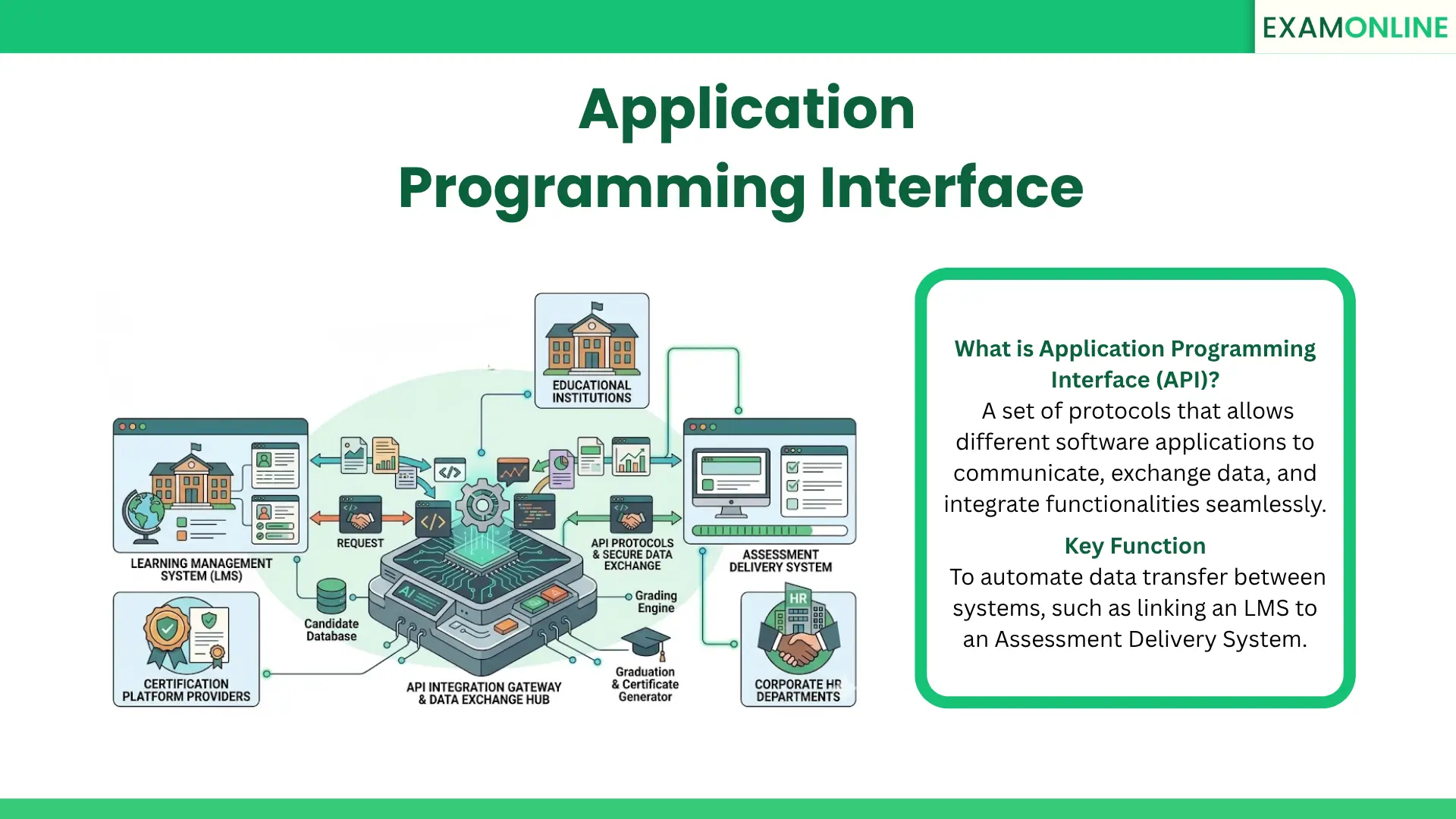
What is Application Programming Interface (API)
In the world of digital testing, an Application Programming Interface (API) acts as a universal translator and messenger. It is a set of protocols and tools that allows one software application to talk to another, ensuring that data moves smoothly between systems without human intervention. For organizations conducting an Online Exam, an Application Programming Interface is the invisible thread that connects an Assessment Delivery System to a Learning Management System (LMS) or an HRIS.
Instead of manually exporting candidate lists from one platform and importing them into a Proctoring System, an Application Programming Interface automates this workflow. It ensures that when a student registers for a Certification Exam on your website, their profile is instantly created in the Online Examination System, and their final score is automatically sent back to your main database once the test concludes.
How it Works
The operation of an Application Programming Interface follows a “Request-Response” cycle that happens in milliseconds:
- The Request: The “client” (e.g., your Learning Management System) sends a specific request to the “server” (e.g., the Online Examination System). This request might be “Send the test results for Candidate A”.
- Authentication: To maintain Data Privacy, the Application Programming Interface checks for a digital “key” or token. This ensures only authorized systems can access sensitive Online Assessment data.
- The Processing: The receiving system processes the request, gathering the necessary information from its database, such as Session Logs or Incident Reporting from a Proctored Exam.
- The Response: The system sends the data back in a structured format (like JSON), which the first application can easily read and display.
Features of an Application Programming Interface
- Endpoint Management: These are specific digital “addresses” where the software receives requests to perform certain tasks, like starting a Remote Proctored Exam.
- Security Protocols: High-level APIs use encryption (HTTPS/TLS) to protect candidate data and Biometric Verification records during transfer.
- Real-time Synchronization: Ensures that as soon as a Live Proctoring session ends, the status is updated across all integrated platforms.
- Webhooks: These allow a system to “push” information automatically. For example, a webhook can alert your Recruitment team the moment a candidate finishes a Coding/Programming Assessment.
Benefits of an Application Programming Interface
The primary advantage of using an Application Programming Interface is Scalability. Organizations can handle thousands of concurrent Online Proctored Exams because the administrative tasks—like user creation and result processing—are automated.
Furthermore, it significantly improves the Candidate Experience. A student can log in to their familiar Learning Management System (LMS) and start a Proctored Examination without needing to remember multiple sets of credentials or navigate away to a different website. For the organization, this reduces the Integrity Check burden by centralizing all Digital Evaluation data into one dashboard.
Applications of an Application Programming Interface
- Corporate Training: Integrating an Assessment Engine with Corporate Training Programs to track employee Digital Upskilling progress.
- University Admissions: Connecting Admission Testing platforms with university databases to automatically filter applicants based on their Cognitive Ability scores.
- High-Stakes Certifications: Linking a Certification Platform with a Remote Proctoring tool to ensure every Proctored Test meets strict Exam Security standards.
- Recruitment: Using an Application Programming Interface to pull results from a Psychometric Test or Behavioral Assessment directly into a Talent Management system.
Conclusion
The Application Programming Interface is the backbone of modern, interconnected testing environments. By allowing different specialized tools to function as one cohesive unit, APIs enable organizations to deliver secure, efficient, and user-friendly Digital Exams. As the industry shifts toward AI Based Exams and more complex Talent Analytics, the role of the Application Programming Interface will only become more vital. ExamOnline leverages robust API capabilities to ensure that whether you are using an Authoring Tool or conducting Video Proctoring, your data remains secure, accessible, and integrated.
Related Terms: Learning Management System (LMS), Assessment Delivery System, Online Examination System, Data Privacy, Digital Evaluation Software.