
What is Verbal Reasoning
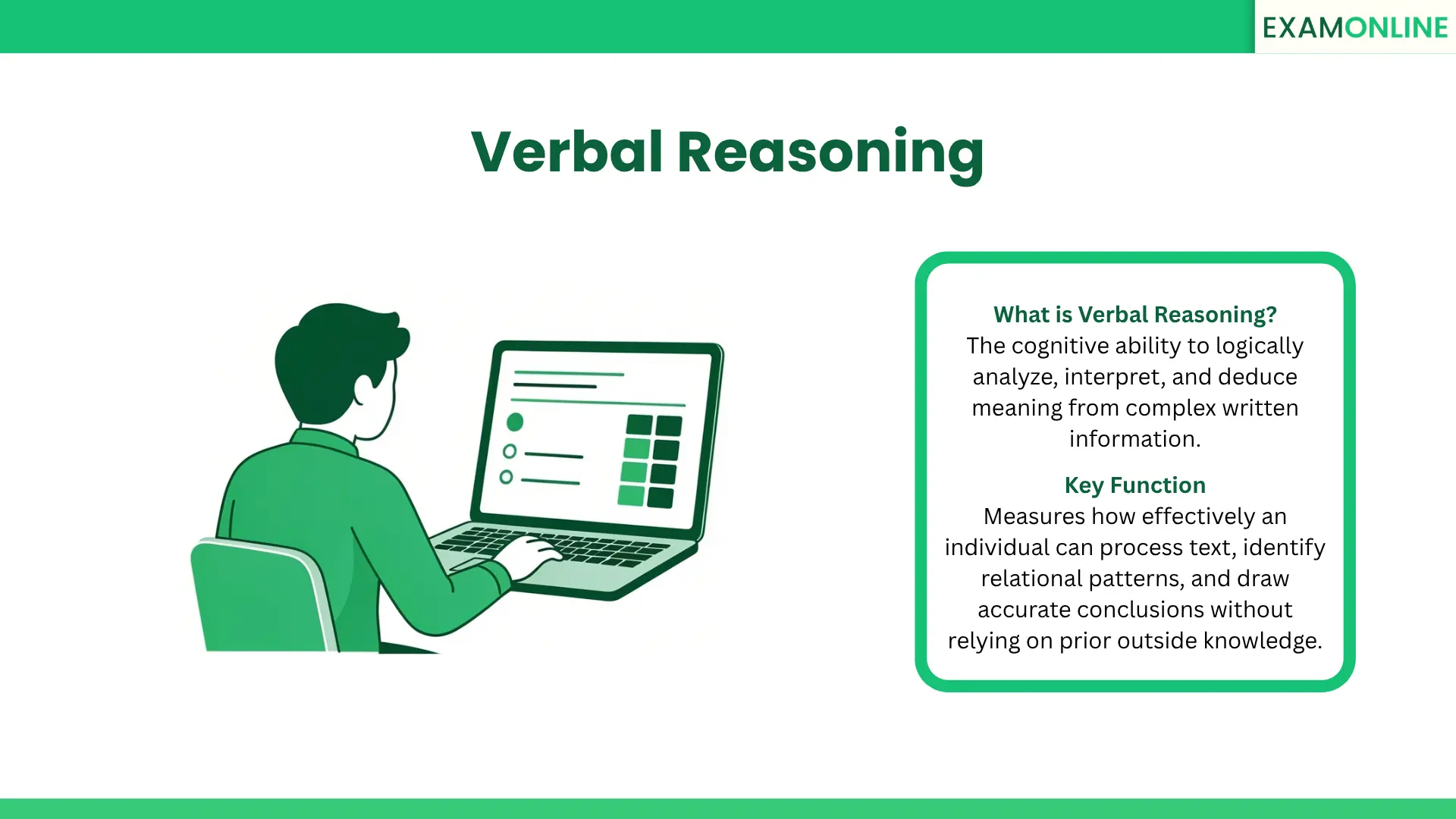
Verbal Reasoning is the cognitive ability to understand, analyze, and interpret information presented in written language. While a standard language test might only measure basic vocabulary or grammar mechanics, this concept focuses entirely on logical thinking. It evaluates how effectively an individual can extract meaning from complex paragraphs, identify underlying assumptions, evaluate arguments, and draw highly accurate conclusions from the provided text alone.
Because modern academic and corporate environments require individuals to constantly process large volumes of written data, this skill is considered a fundamental pillar of human intelligence. It is routinely utilized as the core of any rigorous Cognitive Assessment to measure a candidate’s capacity to digest new information and solve abstract problems using language as the primary analytical tool. By testing logic rather than rote memorization, evaluators gain a clear picture of a candidate’s genuine intellectual agility.
Key Components and Question Types
Assessments designed to measure this specific ability utilize a variety of highly targeted question formats. Each format is meticulously crafted to target a different facet of linguistic logic and analytical processing:
- Reading Comprehension and Analysis: Candidates must read a dense, unfamiliar, and often highly technical passage. They must then answer questions that require them to synthesize the main idea, infer the author’s underlying tone, or extract highly specific data points to form a conclusion.
- True, False, or Cannot Say: This is a staple of reasoning exams. The candidate reads a short text and must evaluate a subsequent statement. They must use strict logic to determine if the statement is definitively true based on the text, definitively false, or if there is simply not enough information provided in the passage to say either way.
- Analogies and Relationships: This format requires finding the hidden logical connection between pairs of words and then applying that exact same logic to a new set of words. It tests pattern recognition within language.
- Vocabulary and Classification: Often presented as odd one out questions. Candidates must identify the subtle logical rule that groups several words together and select the single word that breaks that rule, testing their understanding of synonyms, antonyms, and linguistic categories.
- Complex Logic Problems: These questions involve strict deductive reasoning. They often feature complex syllogisms, coding and decoding patterns, or relational word puzzles such as mapping out complex family blood relations based on a series of written clues.
Common Applications in the Modern World
Because clear communication and rapid comprehension are universally valuable skills, standardized testing of this capability is heavily utilized across multiple high-stakes sectors:
- Professional Job Recruitment: Talent acquisition teams rely on this methodology as a baseline Competency-Based Assessment. Whether hiring a corporate lawyer to read intricate contracts or a marketing manager to analyze dense campaign briefs, employers need absolute proof that a candidate can process work-related information quickly and accurately without misinterpreting the details.
- Educational and Academic Assessments: It is a foundational metric for school admissions globally. From the 11+ exams for secondary school entrance to high-level graduate tests like the GRE, evaluating a student’s General Aptitude for language processing is critical for predicting their future academic success.
The Role of Digital Testing
Today, these assessments are almost exclusively administered through modern digital platforms. Utilizing a Digital Evaluation framework allows organizations to test thousands of candidates globally with instantaneous, objective grading. Furthermore, modern platforms ensure a highly streamlined Candidate Experience, offering intuitive interfaces where test-takers can highlight text, flag questions for review, and easily navigate complex reading passages without the friction of traditional paper testing.
Actionable Tips for Improvement
Unlike basic memorization, enhancing your logical processing speed requires consistent, targeted mental exercise. Candidates looking to elevate their performance should focus heavily on the following strategies:
- Read Broadly and Actively: Do not just read for entertainment. Engage daily with dense, challenging materials like financial journals, scientific articles, and opinion editorials. Practice summarizing the author’s core argument after every paragraph to actively build your analytical reading skills.
- Strictly Isolate the Text: The most common mistake candidates make is bringing outside, real-world knowledge into the exam room. In a reasoning test, your answers must be based only on the information explicitly provided in the passage, even if you know the passage is factually incorrect in the real world.
- Practice Specific Question Formats: Familiarize yourself deeply with the exact structure of True, False, or Cannot Say questions. Understanding the strict parameters of these formats prevents confusion and hesitation on the actual day of the exam.
- Master Time Management: These evaluations are notorious for extreme time constraints. Practice solving complex word puzzles and reading comprehension tests under a strict timer to build mental stamina, improve your rapid processing speed, and learn when to move on from a difficult question.
Conclusion
Verbal reasoning is an indispensable skill that dictates how well an individual navigates the information-heavy modern world. By moving beyond basic literacy and testing pure logical interpretation, these assessments provide a highly accurate measurement of intellectual capability. Mastering this skill not only ensures success in high-stakes testing environments but also guarantees a high level of analytical competence in any future professional or academic endeavor.
Related Terms: Virtual Exam Monitoring, Online Assessment, Manual Test Generation, Job Simulation, Face Detection.