
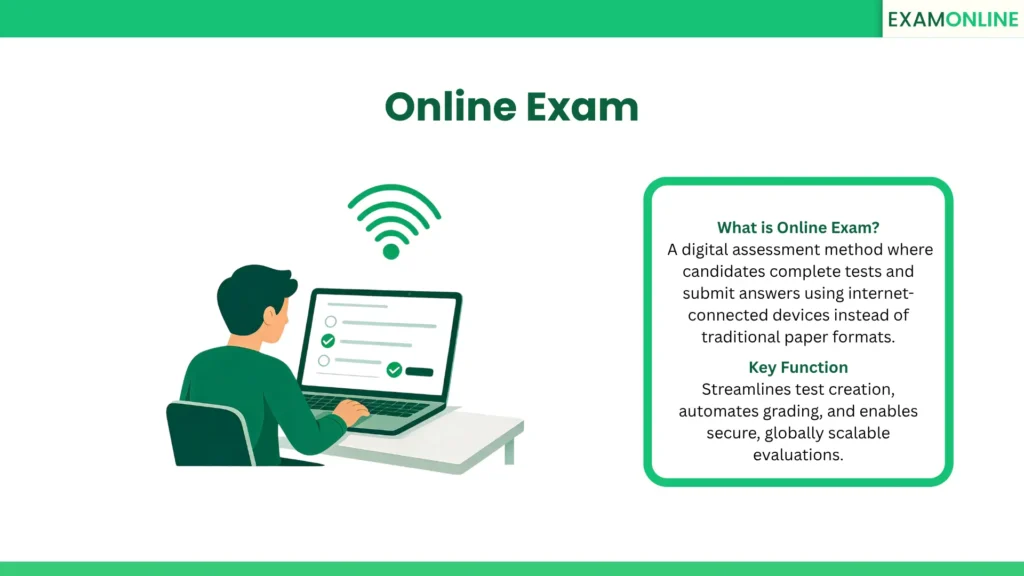
What is Online Exam
An Online Exam is a standardized digital assessment method where candidates read, interact with, and submit answers to test questions using an internet-connected device such as a computer, tablet, or smartphone. This modern evaluation approach replaces traditional physical test centers, printed question booklets, and manual answer sheets with a highly secure, centralized digital environment.
The transition to digital testing has fundamentally revolutionized how global organizations evaluate learners, professionals, and job applicants. By moving the entire evaluation lifecycle to the internet, test administrators can break down geographical barriers, allowing candidates from completely different continents to sit for the exact same standardized test simultaneously. The primary goal of this digital methodology is to evaluate knowledge accurately while drastically reducing the logistical friction associated with traditional paper-based testing.
Features of Online Exam
A reliable digital testing methodology relies on several foundational features to function smoothly and deliver accurate results. The core structural components of this evaluation format include:
- Comprehensive Question Banks: Administrators can build and store massive repositories of diverse question formats. Moving beyond simple multiple-choice, digital tests can seamlessly incorporate interactive media, complex matching scenarios, and specific Fill in the Blanks formats to measure precise factual recall.
- Instantaneous Processing: Digital tests eliminate the agonizing wait times associated with human grading. Platforms utilize sophisticated Auto-Grading algorithms to process objective responses the moment a candidate clicks the submit button, generating instant scorecards and detailed analytical reports.
- Dynamic Content Delivery: To ensure fairness, digital exams can randomize the sequence of questions and shuffle the multiple-choice options for every single test-taker. This ensures that no two candidates experience the exact same visual layout, significantly reducing the viability of coordinated cheating.
- Accessibility Controls: Digital formats allow candidates to adjust font sizes, change screen contrast, and utilize screen-reading software, making the evaluation process far more inclusive for individuals with visual or cognitive impairments.
Applications of Online Exam
Because digital testing is incredibly versatile, a wide variety of industries rely on this format to execute their most critical evaluation pipelines. Common global applications include:
- Corporate Talent Acquisition: Human resources departments deploy digital screening tests to evaluate thousands of job applicants simultaneously. This allows recruiters to identify top-tier engineering or management talent globally without forcing candidates to travel for an initial interview.
- Academic Evaluations: Universities and global educational institutes utilize digital testing to conduct high-stakes midterm and final exams. This method provides a standardized benchmark for international students applying for admission from overseas.
- Corporate Compliance Training: Training managers mandate digital tests to instantly verify if internal employees have absorbed new corporate policies, safety regulations, or software training modules.
- Professional Certification: Medical, legal, and IT boards rely on highly structured digital exams to issue licenses and credentials, ensuring professionals possess the exact specialized knowledge required for their respective fields.
Security in Online Exam
A historical concern with internet-based testing is maintaining the integrity of the credential when the candidate is testing from their own home. To prevent candidates from looking up answers or collaborating, modern digital evaluations deploy rigorous technological safeguards.
The evolution of the AI-Based Exam has solved the remote supervision problem entirely. By utilizing advanced Remote Proctoring technologies, administrators can monitor candidates directly through their own webcams and microphones. These systems automatically flag suspicious behaviors, such as a candidate looking away from the screen, unauthorized background voices, or the presence of a secondary mobile device. Furthermore, strict browser lockdown mechanisms completely block the candidate from opening new internet tabs, accessing local files, or using screen-capture tools until the test is officially submitted.
Benefits of Online Exam
The massive global shift from paper to digital evaluations is driven by a profound increase in operational efficiency. Organizations that adopt this testing methodology experience significant strategic advantages:
- Infinite Scalability: A digital test can accommodate ten users or ten thousand users simultaneously without requiring the organization to rent additional physical exam halls or hire more human invigilators.
- Massive Cost Reduction: Eliminating the need to print secure booklets, ship physical materials globally, and pay human graders drastically lowers the financial cost per candidate.
- Rapid Decision Making: The immediate generation of detailed analytics allows universities to send acceptance letters faster and enables corporate HR teams to hire top candidates before their competitors do.
- Environmental Sustainability: Transitioning to a completely paperless testing model significantly reduces an organization’s carbon footprint and eliminates massive amounts of physical waste.
Conclusion
The online exam is no longer just an alternative testing method; it is the definitive global standard for reliable, scalable evaluation. By fully embracing the digital format, organizations can deliver fair, highly secure, and incredibly efficient assessments to anyone, anywhere in the world. This approach protects the integrity of the testing program while providing a vastly superior, highly flexible experience for the candidate.
The ExamOnline platform is purpose-built to facilitate flawless digital testing. Our robust software provides the secure delivery architecture, advanced proctoring tools, and automated grading capabilities required to successfully execute your most critical online exams at scale.
Related Terms: Online Exam Conducting Software, Online Examination Management System, Proctored Examination, Virtual Assessment Center, Self-Assessment.